 Moss
The ruling
Yes, by blocking them, and the fix is to stop the supply. Monier names blocked gutters, downpipes and valleys as common sources of leaks, and BMI says valleys collect the moss and sediment washed down from the tiles. Clear the gutters and valleys, and treat the moss on the faces above, so the moss stops refilling them.
What valleys and gutters are for
A roof valley is the internal junction where two roof faces meet. It is the lowest line on that part of the roof, which makes it the busiest drain on it.1 Everything that runs off both faces funnels into one channel and down to the gutter.
The gutter has a design limit. Under the national construction rules, eaves gutters are sized to carry rain from a storm with a 5 per cent chance of happening in any year, provided they are not blocked, and they need overflow measures so that in a bigger storm the water is directed away without ponding against, entering or damaging the building.2 The overflow is meant to cope even when the gutter is blocked. But Lysaght, which makes gutters, says how well a system handles overflow over the years also depends on regular removal of leaves, "fungal growth", droppings, nests and other debris from the gutters, the leaf guards and the overflow devices themselves.2
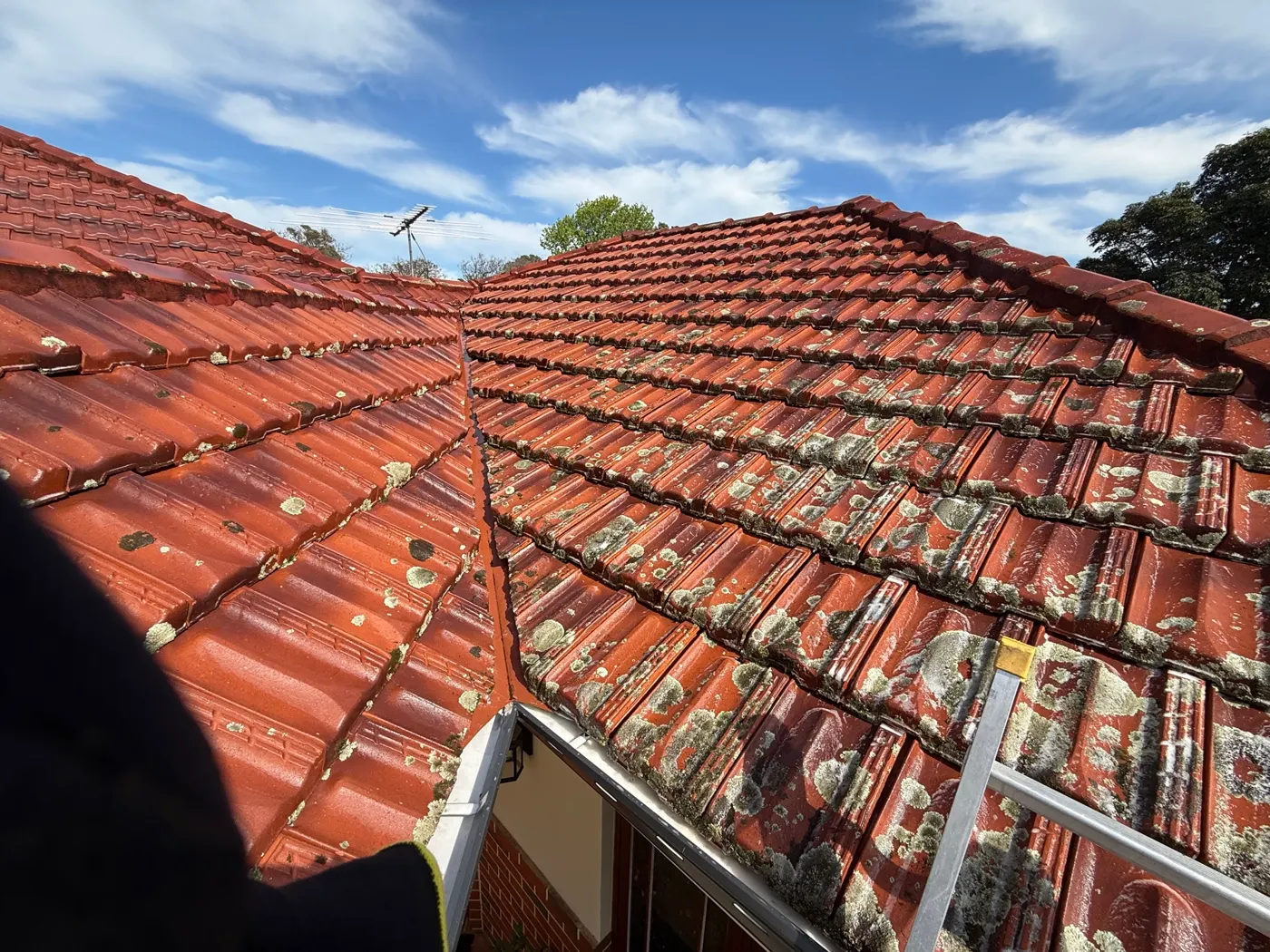
In plain terms A valley is the roof's stormwater drain. It takes two faces' worth of water through one channel, so it is the first place a blockage shows.
How moss ends up there
Valleys collect leaves, moss and sediment washed down from the tiles above.1 Trees add leaves and twigs.3 Moss spreads by fragments: a piece that lands somewhere suitable can grow into a new plant,4 and the wet, sheltered bed of a choked valley or gutter is that kind of place. Moss absorbs water quickly and releases it over a much longer period, and holds from a few times to many times its own weight in water,5 so a valley lined with moss and silt stays wet long after the rain, which suits the next lot of moss.
Moss also brings its own dirt. A moss cushion traps windblown organic debris, and as its stems grow, the lower leaves lose their light and die, building up a layer of organic matter underneath.5 What washes off a mossy face into the valley is the moss and the soil it has made.
The supply comes from the faces above. As long as the roof is growing moss, rain keeps washing pieces of it down. That is why a gutter under a mossy roof fills again so soon after it is cleared.
In plain terms A gutter full of moss and silt is a garden bed with a downpipe.
What a blockage does
The tile makers are blunt about this. Monier calls cleaning gutters, downpipes and valleys "the number one maintenance issue" on a roof, and says that when they become blocked, "you get a build up of water that overflows back into your roof, which can create an enormous amount of water damage".3 On its maintenance page it lists blocked gutters, downpipes and valleys as common sources of leaks.6 BMI, which sells Monier tiles in Malaysia, says a blocked valley backs water up and "can overflow into the roof space".1
There is a second, quieter cost if the roof feeds a rainwater tank. Australia's health guidance on tanks names soil and decaying vegetation left to build up in gutters as one of the principal sources of taste, colour and odour in tank water, particularly when the gutters do not fully drain between rains.7 Roof runoff and tanks have their own file: water off your roof.
In plain terms A blocked sink does not leak through the bowl. It overflows over the edge. A blocked valley does the same, sideways, and its edge is under the tiles.
Blocked valleys are on the leak list
BMI lists the seven most common causes of leaks in a tiled roof, and blocked or damaged valleys are one of them. The others are failed underlay, failed ridge and hip mortar, poorly detailed pipes, vents, chimneys and walls, cracked or slipped tiles, eave and verge details, and a pitch too low for the tile.1 Valley flashings that are damaged or incorrectly lapped are a common source of leaks in their own right,1 and finding and fixing a leak is a roofer's job.
What sets a blockage apart is that it refills. The other causes are a part that was built wrong, has worn out or has been broken. A blocked valley is fed from above, by the leaves, moss and sediment washing down the tiles,1 for as long as the roof keeps growing it.
In plain terms Most leaks are a broken part. A blocked valley is a drain the roof keeps filling itself.
Clearing them, and who should
Monier's advice is to check and clean the roof's gutters, downpipes and valleys at least once a year, and twice if you live in a particularly tree lined area.3 It also suggests trimming overhanging branches and fitting leaf guards to cut down debris,6 and the national tank guidance says roof catchments should be kept clear of overhanging branches.7
The bushfire season adds a second reason. WA's Department of Fire and Emergency Services says most homes lost in bushfires are set alight by burning embers.8 It says embers can land under or in the gutters, and that leaves should be kept clear of gutters, roofing and downpipes before and during the bushfire season to prevent fire entering through the roof.9 Its property checklist lists cleaning the gutters among the jobs for every month of the fire season.10 A mossy roof keeps adding to what is in them.
Clearing a gutter means a ladder. Hospital admissions for falls from ladders in Australia rose to almost 5,000 a year by 2011 to 2012, and over that decade four in five happened outside paid work.11 Monier recommends against cleaning your own roof because of the risk of falls and tile damage.6
And clearing the gutter treats the symptom. While the faces above keep growing moss, the gutter keeps filling.
In plain terms Clearing a gutter under a mossy roof is sweeping under a tree that is still dropping leaves.
Why valleys are where we sometimes need one line up
We treat roofs with UNGROW Bailiff, our treatment, at low pressure from ladders at the roofline. Nobody walks on the roof. That matters for leaks too: BMI lists cracked tiles among its seven causes, and names maintenance foot traffic among what cracks them.1 On most houses every face can be reached from the roofline. In rare cases, an obstruction or a second storey means some access is needed, and then it is one line, up a valley, never across the faces. A valley is where two faces meet, so one line up it reaches both. It is also where moss collects, so it is the line that most needs covering. The rest of the method is in why nobody walks on your roof.
Moss treated with Bailiff dies back and weathers off over the following months, a little with each rain, and it goes where the water goes. So some of it passes through the valleys and gutters on its way off the roof. Gutters on a normal cleaning schedule cope with that.
In plain terms You clear the drain and stop what keeps filling it. Doing only the first means doing it again.
What this means for your roof
The moss on the faces is what keeps refilling the valleys and gutters, so clearing them without treating the roof means clearing them again. Treating the moss where it grows, from the roofline, goes after the supply instead of the symptom. We apply Bailiff with a low pressure soft wash pump through non-directional nozzles, so nothing is forced under the tiles or the laps along a valley, and the dead moss weathers off with the rain. Growth recurs, so UNGROW Sentry, our preventative, keeps the faces treated after that, which keeps the supply from building back up.
Also asked
Can moss in gutters cause damp?
Yes, when it makes the gutter overflow. A gutter packed with moss, leaves and silt holds water instead of draining it, and in heavy rain the overflow has to go somewhere. Gutters are built so overflow is directed away from the house, and that depends on them being kept clear. Damp inside a wall or ceiling needs a builder or roofer to trace it.
How often should gutters and valleys be cleared?
Monier, who make roof tiles, say to check and clean them at least once a year, and twice in a particularly tree lined area. If the roof itself is growing moss, the moss keeps feeding the gutters between cleans, so dealing with the growth on the faces cuts down what ends up in them.
Does roof cleaning include the gutters?
Ours treats the roof, and gutter cleaning is a separate job. We treat with UNGROW Bailiff, our treatment, from the roofline. As the treated growth weathers off over the following months, some of it washes into them, so they are worth clearing after the first winter, by you or a gutter cleaner. What a treatment includes, and what it costs, is in how much does roof cleaning cost in Perth.
Will the treated growth block my gutters as it comes off?
It comes off slowly, a little with each rain over months, not in one load. It does go where the water goes, so some of it ends up in the valleys and gutters. A gutter that is cleared on a normal schedule copes with it. If yours are already packed, have them cleared before the wet season.
Do gutter guards stop moss?
They keep out leaves and twigs, and Monier recommends leaf guards to cut down debris. Moss is a different problem. It grows on the roof faces above and washes down in small pieces, and guards themselves need regular clearing. Guards help a gutter. They do not treat a roof.
Is moss on the roof a fire hazard?
The fire service's concern is the gutters, and moss is part of what fills them. WA's Department of Fire and Emergency Services says most homes lost in bushfires are set alight by embers, that embers can land in and under gutters, and to keep leaves clear of gutters, roofing and downpipes before and during the bushfire season. It lists cleaning gutters for every month of the fire season. Treated moss washes into them too as it weathers off, so clear them after the first winter.
My valley is leaking. Is that a job for you?
We deal with what keeps filling it. The moss on the faces that feeds the valley and the gutters is treated from the roofline with UNGROW Bailiff, our treatment. The leak itself is a roofer's job to trace and fix, because valleys also leak through valley flashings that are damaged or incorrectly lapped, not only through blockages.
On the record
- BMI Malaysia (Monier), Roof Leak Causes and How Tile Roofs Prevent Them
- Lysaght, Gutter overflow provisions (2025)
- Monier, FAQs
- Australian National Botanic Gardens, What is a bryophyte?
- Australian National Botanic Gardens, Bryophyte ecology
- Monier, Roof cleaning and maintenance
- enHealth (Australian Government), Guidance on the use of rainwater tanks
- Department of Fire and Emergency Services, Government of Western Australia, During a bushfire
- Department of Fire and Emergency Services, Government of Western Australia, The Homeowner's Bushfire Survival Manual, Sixth Edition (2014)
- Department of Fire and Emergency Services, Government of Western Australia, Preparing your property (2023)
- Australian and New Zealand Journal of Public Health, Falls from ladders in Australia: comparing occupational and non-occupational injuries across age groups (2016)