The ruling
Because the treatment goes on from the roofline. UNGROW Bailiff is applied at low pressure from ladders at the edge of the roof, so nobody walks the faces of your roof. That keeps boots off your tiles: tile makers advise against walking on them, warning of hairline cracks that go unnoticed, and a lichen covered roof is slippery underfoot.
Tiles are not made to be walked on
The people who make roof tiles are clear about walking on them. Marley "does not recommend foot traffic directly on the roof tiles or covering", says "Cracks or micro-cracks can occur on the roof covering if roofs are trafficked without appropriate access equipment", and points to British Standard BS 8000, which says any roof work in slating or tiling should be "treated as fragile".1 Wienerberger says to avoid walking on roof tiles whenever possible, because "even if they don't break under your weight, they may develop hairline cracks that go unnoticed".2
Monier, which makes concrete and terracotta tiles in Australia, says "Walking on roofs can be dangerous and may result in injury, damage, or void warranties", and "Even walking on a tiled roof can risk damaging tiles or personal injury".3 Its concrete and terracotta tile warranties do not cover damage caused or contributed to by "people walking on the Products".4, 5 Bristile's warranty excludes "damage caused by persons other than Company personnel while accessing the roof for any reason".6 Monier also recommends against cleaning your own roof tiles because of "the risk of falls and potential tile damage".3
Where the makers do say how to cross a roof, the advice starts with not crossing it. Bristile's technical manual says "Roof traffic should be minimised to ensure the roof remains watertight", to access the roof only when absolutely necessary, to wear non-slip, soft sole footwear, to watch the weather "Due to the slippery nature of tiles", to step only on the lower centre of the tiles, and to lay a walkway of plywood, ladders or planks if heavy traffic is necessary.7 Monier's 2014 terracotta tile warranty advises that only skilled roofing trades people repair or walk on your roof, and that if it is absolutely necessary to traverse it, you walk on the lower third of individual tiles.8 A cracked or broken tile is one of the usual causes of a leak, and the fix is to replace it.9
In plain terms A roof tile is like a dinner plate laid over a gap. It holds, until the day it does not, and the crack you cannot see is the one that leaks next winter.
Metal and fragile roofs have rules too
Steel is tougher, but the makers still set rules. Lysaght's installation manual says "It is important that you walk on roofing carefully, to avoid damage to either the roofing or yourself", tells you exactly where to put your feet on each profile, and warns to take particular care on wet or newly laid sheets, particularly on steeply pitched roofs. Walking along the sheets, that means across at least two ribs or corrugations, or in the pans of pan profiles; crossing the ribs, over or close to the supports; and always in smooth soft-soled shoes, not ribbed soles that pick up stones and swarf.10 BlueScope, which makes Colorbond steel, says foot traffic can dent, scuff or scratch roof sheeting, and that major dents may need fixing so water does not pond in them, which is more likely on low pitched roofs.11 Some roofing should not be walked on at all. WorkSafe WA lists acrylic, polycarbonate and other plastic sheets, glass, asbestos and other fibre cement sheets, corroded metal and skylights as fragile roof materials.12 WA Health says an ageing asbestos cement roof grows weaker and more brittle, and that the primary concern with that weakening is people falling through the roof if they walk on it.13
In plain terms Every kind of roof has a right way to stand on it, and some have none. Not standing on it at all is the one rule that works for all of them.
How much weight can a tiled roof hold?
The makers' advice is about where the weight goes. Under the Australian standard for roof tiles, a tile's strength is tested by laying it across two battens, set where they would sit on the roof, and loading it midway between them until it breaks.14 On a real roof, the load is wherever the foot lands. The Australian Roofing Tile Association's walking sheet says to walk on the lower edge of the tile, never its top edge, with most of your weight on the ball of the foot, and recommends that all work be done by qualified personnel.15 Marley says that while clay and concrete tiles are generally considered robust, most "are not designed to be walked on once installed, and any applied weight can cause cracks or breaks".16
Steel follows the same rule. BlueScope says weight on a roof should be spread across as many structural supports as possible, and excessive point loads avoided.17 Lysaght says to treat the overhang as an area not to be walked on, because it can deflect enough to cost you your balance.10 What a cracked tile does next, and how it is fixed, is in cracked roof tiles.
In plain terms The frame holds you, and the tile is a lid laid across it. A heel in the wrong place can crack a tile that looks perfect from the lawn.
Where people fall
Roofs and the ladders that reach them are where falls happen. In Safe Work Australia's study of 2003 to 2011, falls from ladders caused more worker deaths than any other kind of fall from height, 37 of them, and falls from roofs caused 25. Half of the fatal falls from roofs were from three metres or less, and most of those were on houses.18 In 2024, falls from a height caused the deaths of 24 Australian workers, 13 percent of all work deaths.19 In WA that year, three workers died falling through fragile roofing or roof openings, one of them while cleaning gutters and roof tiles at a house, when he fell through the roof of a patio.12
Across the whole population it is the same story. Falls on and from ladders led to 6,230 hospital admissions in Australia in 2024 to 25.20 At home, in a Monash University study of 576 domestic ladder falls serious enough to reach Victoria's trauma registry between 2005 and 2013, 91.5 percent were men and 70.5 percent were aged 60 or over, and the activities included cleaning gutters, windows and roofs, and climbing onto or off the roof.21
The roof that needs treating is the worst one to stand on. WA Health's guidance note on asbestos cement roofs carries the warning that lichen on roof sheeting "can be slippery, especially when it is wet".13 Spraying it adds to that: Wet & Forget warns its own customers never to walk on a section they have just sprayed, because it will be slippery until it is dry.22
In plain terms A single storey roof is not a small height. It is exactly the height the statistics are made of, and a lichen covered tile is a wet bathroom floor at the top of a ladder.
What is the safest way to walk on a roof?
WorkSafe WA's code of practice on falls sets the order, and it starts with not being up there. Where work involves a risk of a fall, the WHS regulations require it to be done on the ground or on a solid construction, so far as is reasonably practicable. Only where that is not reasonably practicable does the code move down the list: first a fall prevention device, such as edge protection, a work platform or a cover; then a work positioning system, such as a harness on a lanyard to an anchorage, set so the wearer cannot reach the edge; then a fall arrest system, which stops a fall once it has started. Administrative controls such as no go areas must not be relied on alone unless nothing higher is reasonably practicable. Footwear appears in the code as something to weigh when assessing the risk.23
For roofing work on houses, WorkSafe WA's housing code says physical edge protection should be considered for all roofing works, as guardrails or scaffold platforms at the roof edge. It sets a critical angle, the pitch below which roof workers may reasonably be able to work and walk across a roof, and says it should never be taken as more than 26 degrees, or 10 degrees where moisture, oil or other conditions make the roof slippery. Above 35 degrees, a roof "is an inappropriate surface to stand on, even with guardrailing or a catch platform".24
In plain terms The regulator ranks the ways to be on a roof, and the top of the list is not being on it. A harness and an anchor come well down the list, and a good pair of shoes is not on it at all.
How a roof is treated from the roofline
A treatment needs no scrubbing, no scraping and no jet, so it needs nobody on the tiles. We work from ladders at the roofline. Our treatment, UNGROW Bailiff, is mixed on the day to the label rate, measured to the roof's area, and applied with a low pressure soft wash pump through non-directional nozzles: professional spray equipment that carries it up each face from the edge, with nothing forced under the tiles or laps. On almost every roof, every face is covered without a foot on the tiles. Then it is left on the roof to work, and the weather does the removal over the following months.
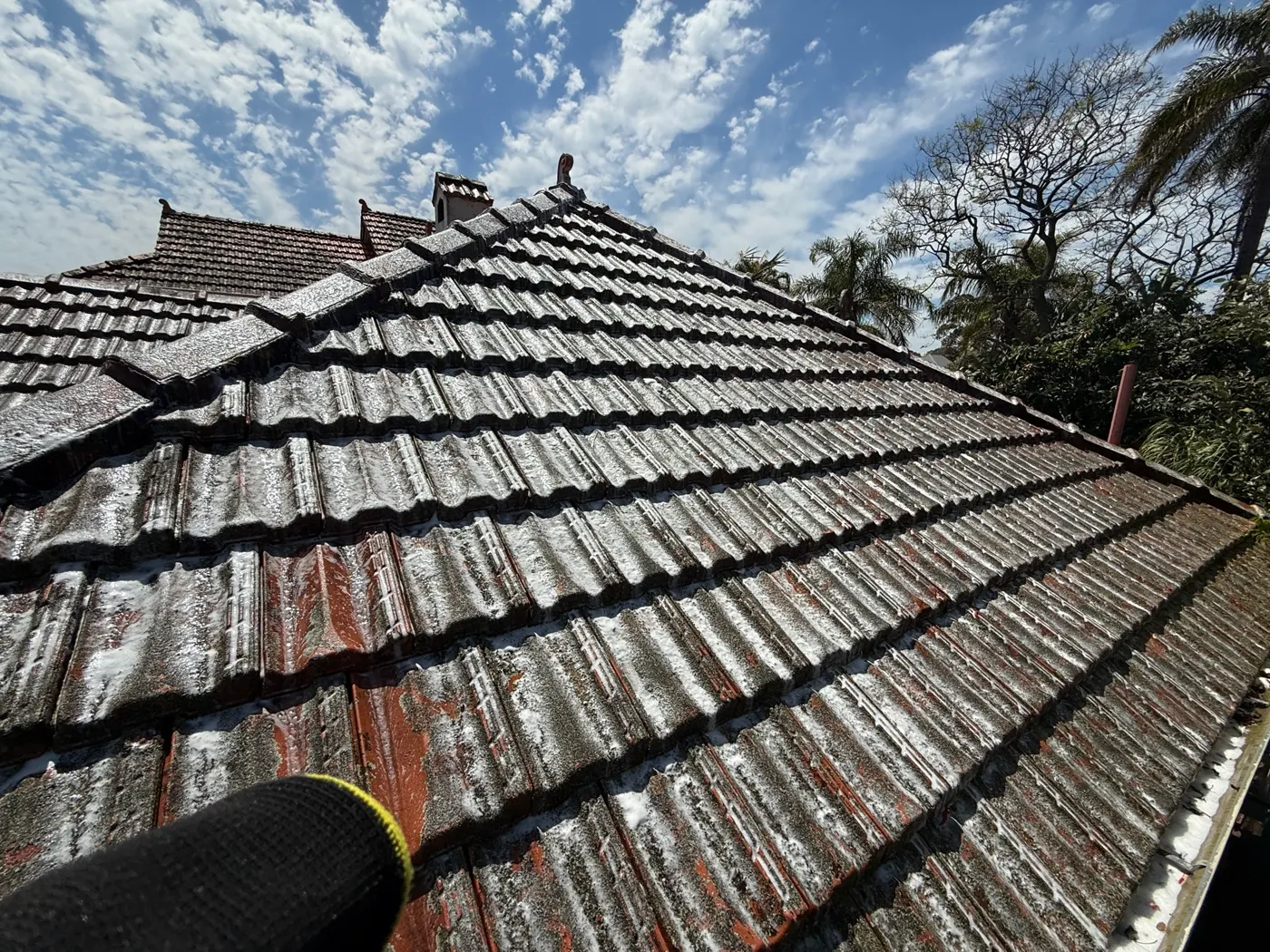
The hardware store hose end products are sold on the same idea: Wet & Forget says its hose end lets you coat up to 100 square metres "with your feet planted safely on the ground".25 It is the right instinct. The difference with a professional job is the dose, the coverage and the equipment to get it to the faces you cannot see from the lawn, which is covered in roof moss products at Bunnings.
In plain terms You can paint a ceiling from the floor with a long enough roller. A roof is the same, with the right equipment and someone who does it every day.
The one exception
Nobody walks on your roof is the rule. The exception is rare and narrow. Where an obstruction, or a second storey, means part of a roof cannot be reached from a ladder at the roofline, we walk one line, up a valley, treat what needs treating and come back down the same way. We do not cross the roof and we do not walk the faces.
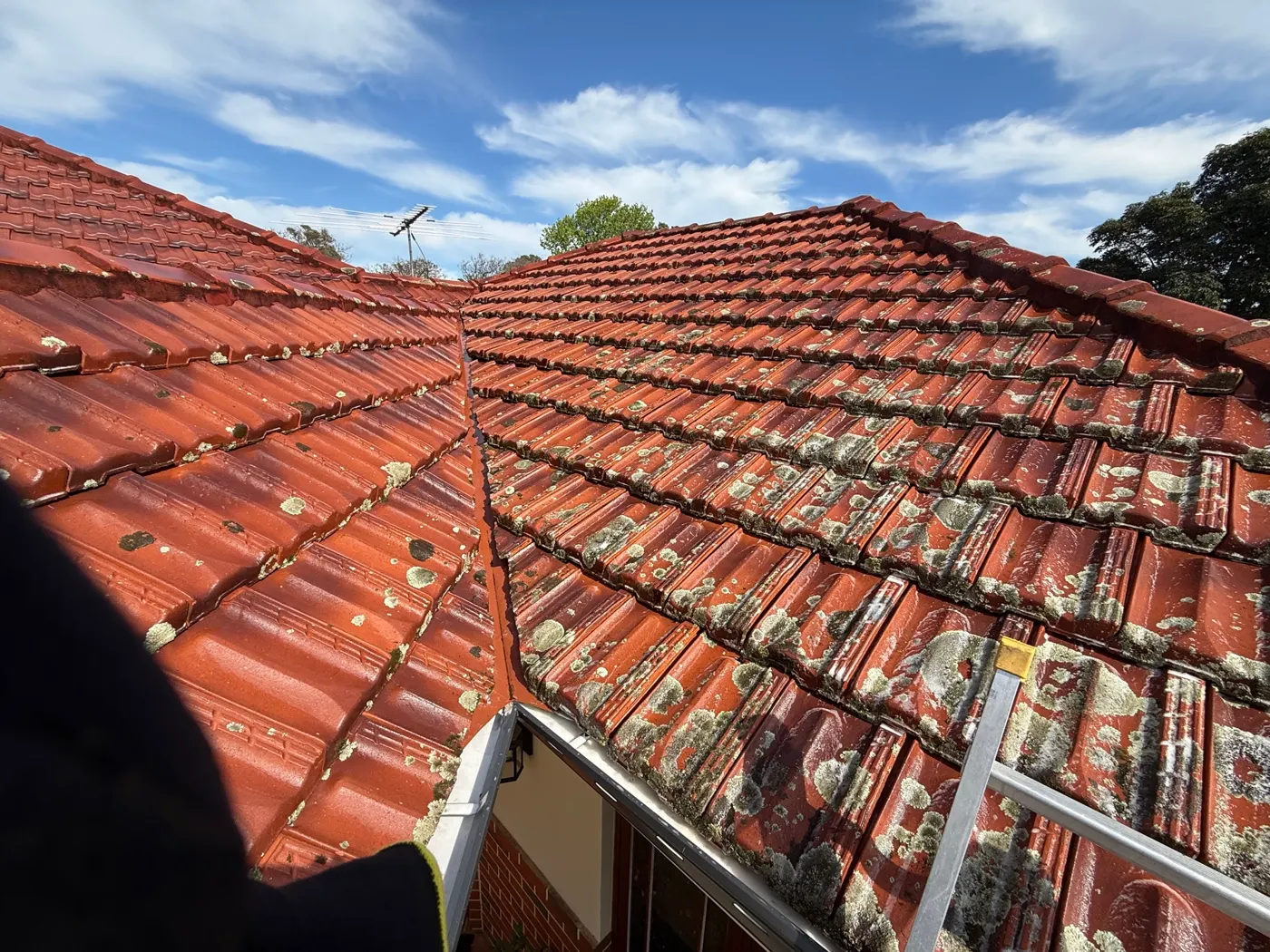
We are fully insured, and if we break something, we fix it at our cost. What the day itself looks like is in what happens on the day of a roof treatment.
In plain terms One careful line, up the valley where two faces meet, and back. Not a stroll across the tiles.
What this means for your roof
Bailiff needs nobody on the faces: it goes on at low pressure from ladders at the roofline, so no step risks a crack you cannot see and nobody stands on a slippery, lichen covered tile. The weather carries the growth away over the months that follow. Growth recurs, so UNGROW Sentry, our preventative, keeps the roof treated after that, from the roofline the same way. Your tiles are treated, not trodden on.
Also asked
Is it OK to walk on a tiled roof?
Not if it can be avoided, and the tile makers say so. Marley does not recommend foot traffic directly on roof tiles, Wienerberger says to avoid it whenever possible because tiles can develop hairline cracks that go unnoticed, Bristile says roof traffic should be minimised to keep the roof watertight, and Monier says walking on roofs “may result in injury, damage, or void warranties”. A cracked tile is one of the usual causes of a leak. We treat from ladders at the roofline, so nobody needs to.
Can I walk on my clay or terracotta tile roof?
Best not. Marley, which makes clay and concrete tiles, says that while they are generally considered robust, most “are not designed to be walked on once installed, and any applied weight can cause cracks or breaks”. Wienerberger warns that a tile which does not break under your weight can still develop hairline cracks that go unnoticed, and Monier's terracotta tile warranty does not cover damage caused by people walking on the tiles. UNGROW Bailiff goes on from ladders at the roofline, so nobody walks your terracotta.
Can I walk on my concrete tile roof?
Only when it is absolutely necessary, says Bristile, which makes concrete roof tiles. Its technical manual says roof traffic should be minimised to keep the roof watertight, to wear non-slip, soft sole footwear, to watch the weather because tiles are slippery, to step only on the lower centre of each tile, and to lay a walkway of plywood, ladders or planks if heavy traffic is needed. Monier's concrete tile warranty does not cover damage caused by people walking on the tiles.
Where do you step if you have to walk on roof tiles?
Monier's 2014 terracotta tile warranty says that if it is absolutely necessary to traverse your roof, walk on the lower third of individual tiles, and Bristile says to step only on the lower centre of roof tiles. Both start from keeping people off the roof as far as possible: Monier advises that only skilled roofing trades people walk on your roof, and Bristile says to access it only when absolutely necessary. Better still is not needing to: UNGROW Bailiff, our treatment, goes on from ladders at the roofline.
Can you walk on a metal roof without denting it?
Not reliably. BlueScope, which makes Colorbond steel, says foot traffic can dent, scuff or scratch roof sheeting, and that major dents may need fixing so water does not pond in them, more likely on a low pitched roof. Lysaght sets out where the feet go: across at least two ribs or corrugations, in the pans of pan profiles, over the supports when crossing the ribs, and never on the overhang. The rule that works on every roof is to stay off it: we treat metal roofs, like tiled ones, from ladders at the roofline.
Can my roof support my weight?
It depends on what the roof is made of and where your foot lands. Marley says most clay and concrete tiles are not designed to be walked on once installed, and that any applied weight can cause cracks or breaks. On steel, Lysaght says to keep to the supports and never walk the overhang, which can deflect enough to cost you your balance. WorkSafe WA lists skylights, plastic and fibre cement sheets and corroded metal as fragile roofing, which a foot can go through.
What shoes are best for walking on a roof?
The makers name soft soles. Lysaght says to always wear smooth soft-soled shoes on steel roofing and to avoid ribbed soles, which pick up stones and swarf, and Bristile says non-slip, soft sole footwear on concrete tiles. A sole changes the shoe, not the roof under it: WA Health warns that lichen can be slippery, especially when it is wet. WorkSafe WA's falls code weighs footwear when it assesses the risk; the protection it ranks, after working from the ground, is edge protection, harnesses and anchors.
How steep a roof can you safely walk on?
WorkSafe WA's code for housing construction sets a critical angle, the pitch below which roof workers may reasonably be able to work and walk across a roof. It should never be taken as more than 26 degrees, or 10 degrees where moisture, oil or anything else makes the roof slippery. Above 35 degrees, the code says a roof is an inappropriate surface to stand on, even with guardrails or a catch platform. WA Health warns that lichen can be slippery, especially when it is wet.
Is roof cleaning safe?
Roof cleaning is work at height, so it is a job for the right equipment and daily practice, not a weekend on the tiles. Monier recommends homeowners do not clean their own roof tiles because of the risk of falls and tile damage, and the serious home ladder falls in a Monash University study included people cleaning gutters and roofs. A treatment needs nobody on the tiles: UNGROW Bailiff goes on from ladders at the roofline, and we are fully insured.
Do you need scaffolding to treat a roof?
No. Scaffolding is edge protection for people working on a roof: WorkSafe WA's code for housing construction says physical edge protection should be considered for all roofing works, as guardrails or scaffold platforms at the roof edge. A treatment needs nobody on the faces of the roof. UNGROW Bailiff goes on from ladders at the roofline, through a low pressure soft wash pump and non-directional nozzles, so there is nothing to put up around your house.
How do you treat a two storey roof without walking on it?
Most of it is still reached from ladders at the roofline. In the rare case where an obstruction or a second storey means a part of the roof cannot be reached that way, we walk one line, up a valley, and come back down the same way. We do not cross the roof, and we never walk the faces.
What if a tile is already cracked?
Monier's advice is that cracked or broken tiles should be replaced individually, and that is a roofer's job, ideally done before anything else goes on the roof. UNGROW Bailiff, our treatment, goes on from ladders at the roofline, so nobody is walking the faces of your roof and adding to the cracks. We are fully insured, and if we break something, we fix it at our cost.
On the record
- Marley, Can you walk on roof tiles?
- Wienerberger UK, How to Clean Roof Tiles
- Monier, Roof cleaning and maintenance
- Monier Roofing (CSR Building Products), Warranty: Concrete Roofing Products (July 2026) (2026)
- Monier Roofing (CSR Building Products), Warranty: Terracotta Roofing Products (July 2026) (2026)
- Bristile Roofing, 50 Year Product Warranty terms and conditions (2025)
- Bristile Roofing, Concrete Roof Tiles Technical Manual (2025)
- Monier Roofing, Monier Terracotta Roof Tiles Product Warranty (October 2014), archived copy (2014)
- Monier, FAQs
- Lysaght (BlueScope), Roofing & Walling Installation Manual
- BlueScope, TB-36 Guide to good practice: steel roofing and photovoltaic/solar panels (2025)
- WorkSafe WA, Health and Safety Bulletin No. 17: Falls through fragile roofs and roof openings (2024)
- WA Department of Health, Guidance Note on Asbestos Cement Roofs
- Australian Roofing Tile Association, The Properties of Roof Tiles (2018)
- Australian Roofing Tile Association, Walking on a flat tiled roof (2018)
- Marley (UK), Cracked roof tile repair: a homeowner's guide (2024)
- BlueScope, CTB-17 Following trades (2022)
- Safe Work Australia, Work-related injuries and fatalities involving a fall from height, Australia (2013)
- Safe Work Australia, Key Work Health and Safety Statistics Australia 2025 (2025)
- Australian Institute of Health and Welfare, Injury in Australia: Falls (2026)
- Monash University Injury Research Institute, for the Victorian Department of Health, Report on the reduction of major trauma and injury from ladder falls (2014)
- Wet & Forget Australia, Lichen or black mould on your roof?
- WorkSafe WA, Managing the risk of falls at workplaces: Code of practice (2022)
- WorkSafe WA, Managing the risk of falls in housing construction: Code of practice (2026)
- Wet & Forget Australia, Rapid Application Mould Removal inc Moss, Lichen & Algae