The ruling
You do not need to be home. We treat every face with UNGROW Bailiff at low pressure, from ladders at the roofline or up one valley line, so nobody walks across your tiles and nothing is blasted. We photograph the roof from a fixed spot. From you: an unlocked gate, sometimes a tap, and a word about tanks and pets.
Before the day
You do not need to be home, and nobody needs to come inside. The price is worked out from aerial imagery of your address and fixed, so there is no site visit to wait in for either.
Two favours make the day work.
- Leave the side gate unlocked. That is the one that really matters: we treat the roof from all the way around the house, so we need a clear way round. Sometimes we need an outside tap as well.
- Move a car parked in close to the house, if you can. If it is still there we work around it, and any drift washes straight off.
And tell us three things when you book: whether a downpipe feeds a rainwater tank, whether anything is planted right up under the eaves, and whether you have pets. Each is covered below.
The forecast matters too. Bailiff goes on a dry roof with a dry window after it, because rain that comes too soon can wash a treatment off before it has properly soaked into the growth. The retail labels set the same rule: Surrender's says not to apply if rain is expected within 12 hours1, and Wet & Forget asks for the same 12 hours.2 If rain is forecast inside that window, the treatment moves to a dry day.
In plain terms It is like booking a house painter. They need a way in, a clear run and a dry forecast, and you do not have to stand there watching.
Ladders at the roofline
We set ladders at the roofline and treat each face from there, at low pressure. We work from the ground and from ladders, and that is the normal job.
Where an obstruction or a second storey means a face cannot be reached from the edge, we go up one line, in a valley, and we do not traipse across the tiles. The reason is the tiles. Monier, which makes them, says walking on roofs "can be dangerous and may result in injury, damage, or void warranties".3 Marley, another tile maker, warns that "cracks or micro-cracks can occur on the roof covering if roofs are trafficked without appropriate access equipment".4 More in why nobody needs to walk on your roof.
In plain terms A tiled roof is like a shelf of dinner plates. It carries rain all day, every day, but a boot on the wrong spot cracks one.
The treatment itself
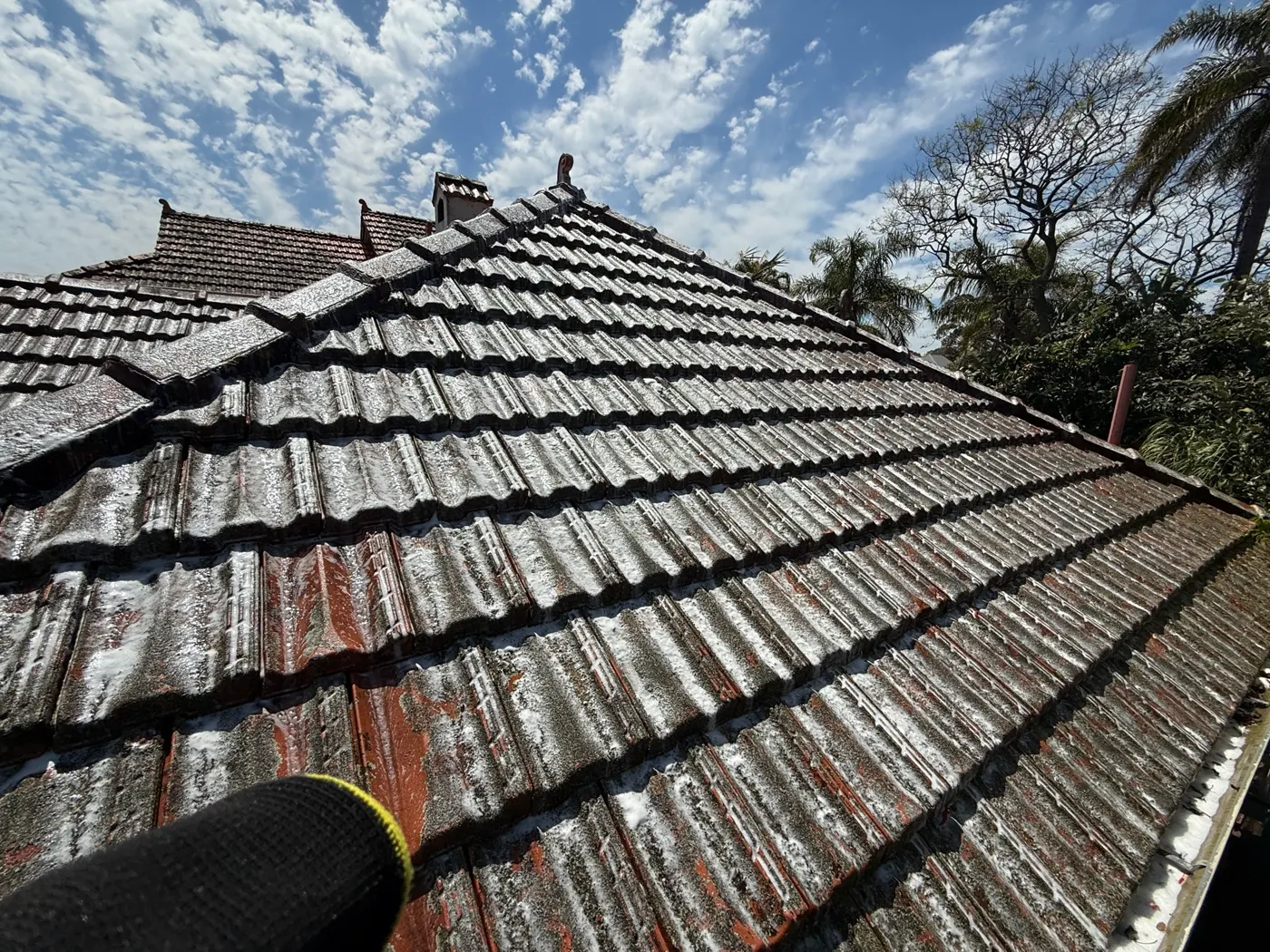
Our treatment is UNGROW Bailiff. It is mixed on the day to the label rate, measured to the roof's area, and applied to every face, in commercial quantities with professional spray equipment. It goes on with a low pressure soft wash pump through non-directional nozzles: sprayed on, not blasted on, so nothing is forced under the tiles or the laps, and nothing is stripped from the surface. The retail labels ask for the same light touch: Surrender's direction for tiled roofs is to "spray to just wet".1
That is the opposite of a pressure cleaner. Monier "strongly advises against the use of pressure washers for roof cleaning", because they "pose a significant risk of tile damage due to the high-pressure of water against tiles".3 What a jet does to a tile is in does pressure cleaning damage roof tiles?
Bailiff's active is benzalkonium chloride, a quaternary ammonium compound that disorganises the membranes of the cells it reaches and makes them leak.5 It is the main active ingredient in roof treatments.6 How it soaks in, and why the dose per square metre matters, is in how roof treatment works.
In plain terms It is watering a garden bed with a wand, not hosing a driveway. Wet, not blasted.
Tanks, panels, plants and pets
Rainwater tanks. Tell us if a downpipe feeds a tank, and we walk you through it. Before we start, every downpipe that feeds it comes off at the tank inlet, or is turned to run onto the garden or into the drain. It goes back on after three to four weeks and at least 6 mm of rain, as the label asks.1 The water already in the tank is not touched. Step by step, it is in rainwater tanks and roof treatment.
Solar panels. We spray around them, not on them. Why, in the panel makers' own words, is in lichen on solar panels.
Plants under the eaves. Bailiff goes on the roof, not the garden. Point out anything planted right up under the eaves and we keep the spray clear of it. The retail labels ask the same: Surrender's says not to let the spray contact the foliage of wanted plants, lawns aside.1
Pets. If you have pets, keep them inside while we are there, if you can.
Before we leave: the photo
Before we go, we photograph the roof from a fixed position, a spot the twelve month check can return to. That photo is the guarantee. If the roof looks the same as that photo at twelve months, we treat it again, free.
The photo is saved on your job, ready for the twelve month check. A notice goes in the letterbox too: leave by, over the next 3 to 18 months.
We are fully insured. If we break something, we fix it at our cost.
In plain terms The photo is the before shot, taken by us, on the day, from a spot we can find again. It is what the roof gets judged against.
What it looks like when we go
The growth looks exactly as it did when we arrived. That is correct. Bailiff has treated it where it sits, and it stays anchored until the weather breaks it down and carries it off. Yates says it plainly about its own roof product: it "kills lichens on roofs but does not remove them", and the removal "can be left to weathering".7 Growth starts coming away over 3 to 18 months. Rain is what carries it off, and Perth Metro gets about three quarters of its yearly rain from May to September8, so most of the visible change on a Perth roof comes through winter.
What to expect from there is in what a treated roof looks like, month by month, and why it takes that long is in how long does roof treatment take to work?
In plain terms The notice has been served. Nobody moves out on the day the notice goes up.
What this means for your roof
Treatment day is short and quiet because the work happens in the growth, not on the tiles. From ladders at the roofline, at low pressure, every face gets Bailiff at the label rate with nobody walking across the tiles and no jet against them, the two things the tile makers warn can damage a roof.3, 4 The weather then does the removal over the months that follow, and the photo from the day is what the roof is judged against at twelve months.
Also asked
Do I need to be home?
No. We work from the ground and from ladders at the roofline, so we do not need to come inside. If the side gate is unlocked and we can get around the house, we have what we need. We photograph the roof before we leave either way, and the photo is saved on your job.
How long does it take to clean a house roof?
One visit. How long it takes depends on the roof: its size, whether there is a second storey, and how many obstructions there are. Every face is covered with UNGROW Bailiff before we leave, and you do not need to be home for any of it. The clean itself is the weather's job: the treated growth starts coming away over 3 to 18 months. Why it takes that long is in how long does roof treatment take to work?
What if it rains?
The product label sets how long the roof has to stay dry after treatment, 12 hours on the common roof products. If rain is forecast inside that window, the treatment moves to a dry day. Rain after the window is welcome: it is what carries the treated growth off.
Will it get on my car or windows?
We work around anything parked close to the house, and any drift washes straight off. Moving the car before the day saves us both a job. Solar panels are different: we spray around them, not on them.
Will the roof look different when you leave?
Not the growth. It looks exactly as it did when we arrived, and that is correct. UNGROW Bailiff has treated it where it sits, and it stays anchored until the weather breaks it down and carries it off. Growth starts coming away over 3 to 18 months, and most of the change on a Perth roof comes through the winter rain.
On the record
- Yates / Hortag, Surrender Mosskiller label (10 L)
- Wet & Forget Australia, Roof cleaning information
- Monier, Roof cleaning and maintenance
- Marley, Can you walk on roof tiles?
- Clinical Microbiology Reviews (PMC), Antiseptics and disinfectants: activity, action, and resistance (1999)
- Water research, Benzalkonium runoff from roofs treated with biocide products - In situ pilot-scale study (2015)
- Yates, Yates Surrender Moss Killer
- Bureau of Meteorology, Climate statistics for Australian locations: Perth Metro (009225)