The ruling
Yes. Monier, which makes roof tiles in Australia, strongly advises against pressure washers on roofs, and its warranty excludes damage from cleaning with unsuitable pressure. A jet erodes a concrete tile's surface and colour and can force water under the laps. A treatment works instead: it ends the growth where it sits, and the rain carries it off.
What the people who make the tiles say
Monier, which makes concrete and terracotta roof tiles in Australia, is blunt about it: it "strongly advises against the use of pressure washers for roof cleaning", because "these devices pose a significant risk of tile damage due to the high-pressure of water against tiles".1 Marley, a UK tile maker, says high powered jet washes "can damage the surface of the slate or tile, thus reducing its expected life considerably".2 Wienerberger, another UK maker, says the spray "can damage the tile finish and strip away colour from concrete tiles".3 The UK's Roof Tile Association puts it most plainly of all: "On no account should a high pressure water jet be used to clean off moss and lichen growths from concrete tiles", because it "will result in erosion of the surface thereby reducing the potential lifespan of the roof tile".4
The tile warranties back the advice. Monier's does not cover damage caused by "incorrect cleaning including cleaning with unsuitable chemicals or pressure", and Bristile's does not cover "damage arising from inappropriate cleaning of the roof".5, 6 What that means for an owner is in what the tile warranties say about pressure washing. On pressure cleaning, the makers and we agree.
In plain terms The company that made your tiles is telling you not to point a pressure washer at them, and its warranty does not cover the damage if you do. That is about as clear as product advice gets.
What a jet does to a concrete tile
A concrete tile is a cement body with a colour coat on top, and Monier says that coat fades and weathers over time.7 Growth does not sit loose on that surface waiting to be rinsed off. On clay roof tiles, electron microscopy found lichen threads penetrating the tiles and filling their fissures and cracks.8 A jet strong enough to tear out growth anchored like that is strong enough to take the colour coat with it, which is exactly what the makers warn about, and then it works on the cement beneath.3, 4 How lichen anchors itself is in does lichen damage roof tiles.
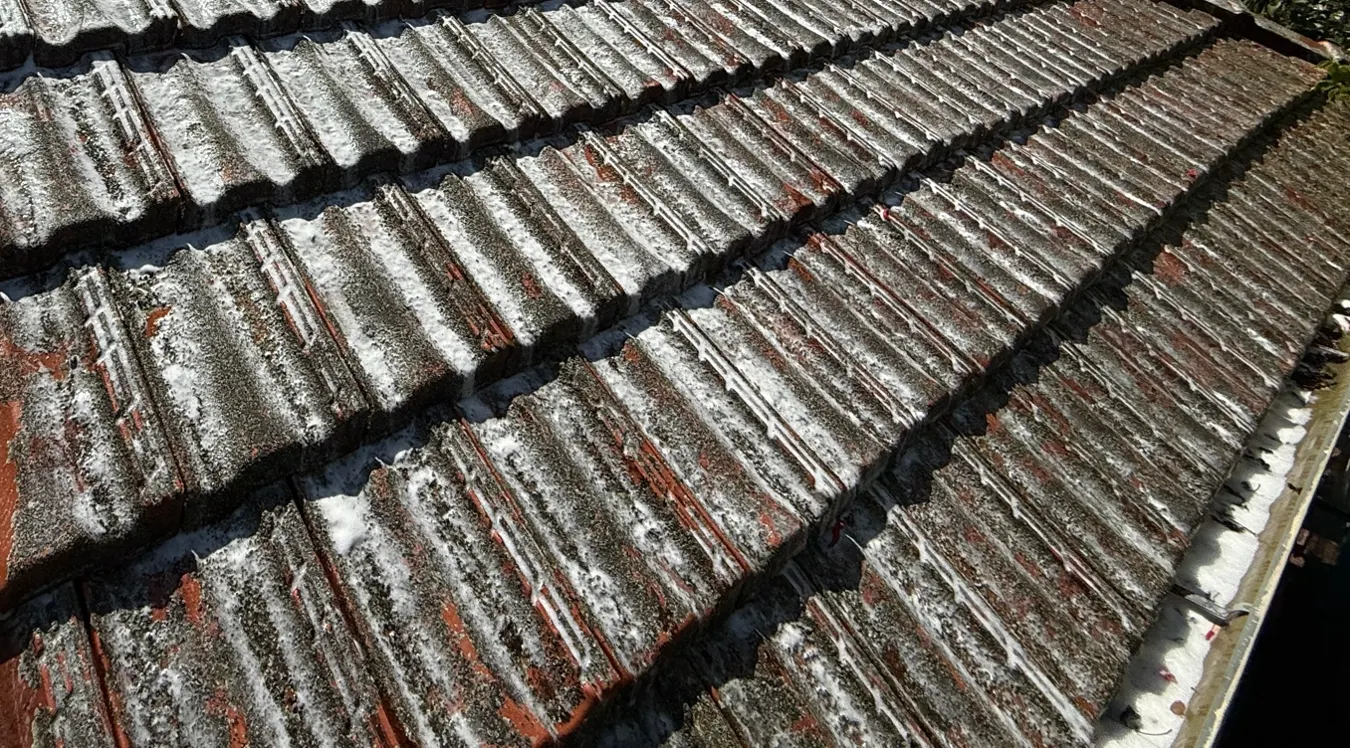
Terracotta is different. Its colour is baked into the clay during firing, so it does not fade the way a concrete tile's coat does.1 The risk on terracotta is to the tile itself and to the joints between tiles. The Australian Roofing Tile Association's consumer guide to fretting in clay roof tiles says to "avoid high-pressure washing as this can damage tiles".9 Monier's advice against pressure washers is for roof cleaning, not concrete alone.1
In plain terms It is like pressure washing an old painted fence. The dirt comes off, and so does the paint that was only just holding on.
Water under the laps, and the joints along the ridge
A tiled roof keeps water out by overlap. Each course of tiles laps over the one below, and the tiles lock together at the sides, so rain falling from above runs down and off. Wienerberger warns that high pressure water "can seep into the interlocks and headlaps, potentially causing water ingress", and says a washer's spray must be "directed from the apex of the roof downwards, never upwards, to prevent water from entering beneath the laps of the tiles".3 Marley's training and technical support manager goes further: high pressure jets "can crack or damage the roof tiles", and "force large and potentially damaging volumes of water and debris into the roof structure".10
The ridges and hips are the other weak point. The ridge capping sits on mortar bedding, finished with pointing. Monier lists cracked bedding to the ridge or hip capping among the usual causes of a leak, and says the capping should then be rebedded or repointed.7 A jet aimed along a ridge line is aimed straight at that joint.
In plain terms A raincoat keeps you dry because the flaps overlap downhill. Turn a hose up the sleeve and the overlap that kept the rain out lets the water in.
A rougher surface grows back faster
Roughness is a gift to the next growth. The Australian National Botanic Gardens puts it simply: rough surfaces are more likely to trap spores and water than smooth ones, and lichens are found well established in rough areas but absent, or nearly so, from nearby smooth areas with the same aspect and chemistry.11 In laboratory tests on cement based mortars, how fast algae fouled a surface was governed by the roughness and the porosity of the material.12 That is the tile's bioreceptivity: how good a home it makes.
A jet erodes a concrete tile's surface, and an eroded surface is a rougher one.4, 3 So a pressure cleaned tile gives the next spores a better foothold and holds water longer, and the growth comes back faster. How growth finds a roof in the first place is in why roofs grow moss and lichen.
In plain terms Water and spores sit on a sponge and run off a dinner plate. Every pass with a jet moves a tile a little further from plate towards sponge.
Asbestos cement roofs: in WA it is the law
On an asbestos cement roof this stops being advice. In Western Australia, high pressure water cleaning of asbestos cement is prohibited, because it "breaks down the surface of the material, and spreads asbestos-containing residue over a wide area".13 WA Health says the same prohibition sits in both the Health (Asbestos) Regulations 1992 and the Work Health and Safety (General) Regulations 2022, and that the residue has to be cleaned up by a Class A asbestos removalist.14 WorkSafe reports clean-up costs of between $7,000 and $50,000 for contaminated properties.13 The full case, including how to tell what your roof is made of, is in can you pressure clean an asbestos roof in WA.
In plain terms If your roof is grey corrugated cement sheeting from before 1990, WA Health says to treat it as asbestos.15 Nobody should put a pressure washer on it, and in WA nobody is allowed to.
What to do instead
Deal with the growth where it sits and let the weather do the removal. A roof treatment soaks into the growth and ends it in place. Yates says it plainly about its own roof product: it "kills lichens on roofs but does not remove them".16 The dead growth then loosens and washes off over the following months, and nothing is blasted off the tile surface. We treat it with UNGROW Bailiff, applied from the roofline with a low pressure soft wash pump through non-directional nozzles, so nothing is forced under the tiles or the laps, and nobody walks the roof. The chemistry is in how roof treatment works, and every method side by side is in every way to clean a roof.
Keeping people off the roof matters as much as keeping the jet off it. A pressure clean needs someone up there with the lance. Monier recommends you do not clean your own roof tiles at all, because of "the risk of falls and potential tile damage".1 Falls on and from ladders put 6,230 Australians in hospital in 2024 to 25.17 In Safe Work Australia's study of worker deaths from 2003 to 2011, half the fatal falls from roofs were from three metres or less, and most of those were at homes.18
Staying treated is what resolves growth, because growth recurs whichever way it was removed. That is the job of UNGROW Sentry, our preventative, which keeps the roof treated once Bailiff has done its work. A pressure clean resolves nothing: it takes surface off the roof and books the next one.
In plain terms Nobody takes an angle grinder to the weeds in a paved path. You spray them and let them die back. A roof is the same.
What this means for your roof
Your tiles keep their surface when the growth is treated where it sits. Bailiff goes on from the roofline at low pressure, the growth is ended where it is anchored and the weather carries it off, with nothing forced into the roof and nobody on it. That is what the people who make the tiles ask for: keep high pressure water off them, because a jet erodes the surface, drives water under the laps and leaves a rougher tile for the next growth to take hold on.
Also asked
Should you pressure wash your roof?
No. Monier, which makes concrete and terracotta roof tiles in Australia, strongly advises against pressure washers for roof cleaning, and its warranty does not cover damage from cleaning with unsuitable pressure. A jet erodes a concrete tile's surface, can force water under the laps, and leaves a rougher tile for the next growth to take hold on. Treated where it sits, the growth ends in place and the weather carries it off. Whether that pays is in is roof cleaning worth it.
Is pressure washing a roof safe?
Not for the tiles, and not for the person holding the lance. Monier says pressure washers "pose a significant risk of tile damage", and recommends you do not clean your own roof tiles, because of "the risk of falls and potential tile damage". Falls on and from ladders put 6,230 Australians in hospital in 2024 to 25, and in Safe Work Australia's study of worker deaths, half the fatal falls from roofs were from three metres or less. More in why nobody needs to walk on your roof.
Can I pressure wash my roof myself?
Monier, which makes concrete and terracotta tiles, recommends that you do not clean your own roof tiles at all, because of the risk of falls and of damaging the tiles, and it strongly advises against pressure washers for roof cleaning. If the roof is cement sheeting from before 1990, WA Health says to treat it as asbestos, and high pressure water on asbestos cement is against the law in WA. A pressure clean also needs someone up on the roof with the lance.
Can pressure cleaning make a roof leak?
It can. Wienerberger, which makes roof tiles, warns that high pressure water can get into the interlocks and headlaps of a tiled roof and let water in. Marley warns that a jet can force large volumes of water and debris into the roof structure. Cracked bedding under the ridge and hip capping is already one of the usual causes of a leak, and a jet finds those cracks. A roof is built to shed rain falling from above, not water forced up the slope.
Can you pressure wash moss off a roof?
You can blast it off, and the tile makers advise against it. The UK Roof Tile Association says "On no account" should a high pressure jet be used to clean moss and lichen off concrete tiles, because it erodes the surface and shortens the tile's life. Monier strongly advises against pressure washers for roof cleaning. Treated where it sits, moss ends in place and the rain carries it off over the following months. Every method is compared in how do you get rid of moss on a roof.
How do you pressure clean roof tiles?
Monier, the tile maker, strongly advises against pressure washers for roof cleaning. Wienerberger says to avoid high pressure jet washers, and that if a washer is used it "should be set to low pressure and directed from the apex of the roof downwards, never upwards", so water does not get beneath the laps. Working from the ridge down puts someone on the roof, and low pressure water only rinses the surface while the growth stays anchored in the tile. Treat the growth and let the weather carry it off.
Is it fine on a low pressure setting?
Not for the growth. Low pressure water rinses the surface, and growth is anchored into the tile, so it takes a treatment to end it, not water. Monier's advice is not to use a pressure washer on a roof at all. Wienerberger says it is crucial to avoid high pressure jet washers, and that a washer's spray must never be aimed up the roof, because that drives water beneath the laps. We apply UNGROW Bailiff at low pressure through non-directional nozzles for the same reason.
Does pressure cleaning affect my tile warranty?
It can take the damage out of it. Monier's warranty does not cover damage caused by incorrect cleaning, including cleaning with unsuitable pressure, or by people walking on the roof, and Bristile's does not cover damage from inappropriate cleaning. The warranty is not cancelled, but the damage the cleaning did is no longer the tile maker's problem.
How often should you pressure wash a roof?
We would not. Staying treated is what resolves growth; a clean only takes it off, and it recurs. Tile makers warn that a high pressure jet damages the tile surface, and a rougher surface traps spores and water and is colonised faster, so every round takes surface off and gives the next growth a better foothold. UNGROW Bailiff is applied at low pressure and left on the roof for the weather to do the removal, and UNGROW Sentry, our preventative, keeps the roof treated after that.
Do you pressure wash roofs?
No. We do not pressure wash roofs, and nobody walks on them. We treat the growth with UNGROW Bailiff, from ladders at the roofline, through a low pressure soft wash pump and non-directional nozzles, so nothing is forced under the tiles or the laps. We spray around solar panels, not on them. The growth ends where it is anchored and starts coming away with the weather over 3 to 18 months. A first treatment is from $539 including GST.
On the record
- Monier, Roof cleaning and maintenance
- Marley (UK), Can I clean or jet wash my roof tiles?
- Wienerberger UK, How to Clean Roof Tiles
- Roof Tile Association (UK), Care, Maintenance & Repair of Clay and Concrete Roof Tiles (2016)
- Monier Roofing (CSR Building Products), Warranty: Concrete Roofing Products (July 2026) (2026)
- Bristile Roofing, 50 Year Product Warranty terms and conditions (2025)
- Monier, FAQs
- Scanning, Evaluation of the effect of lichens on ceramic roofing tiles by scanning electron microscopy and energy-dispersive spectroscopy analyses (2005)
- Australian Roofing Tile Association, Fretting in Clay Roof Tiles: A Consumer's Guide (2024)
- Marley (UK), Roof tile maintenance: a homeowner's guide (2022)
- Australian National Botanic Gardens, Microhabitats
- The Science of the total environment, Bioreceptivity evaluation of cementitious materials designed to stimulate biological growth (2014)
- WorkSafe WA, Safety alert 12/2018: high pressure water cleaning of asbestos cement prohibited
- WA Department of Health, Managing contamination from pressure water cleaning of asbestos cement roofs: local government authority guide
- WA Department of Health, Guidance Note on Asbestos Cement Roofs
- Yates, Yates Surrender Moss Killer
- Australian Institute of Health and Welfare, Injury in Australia: Falls (2026)
- Safe Work Australia, Work-related injuries and fatalities involving a fall from height, Australia (2013)