The ruling
Because parts of it stay wet for long enough. Moss, lichen and algae only grow while wet, so what counts is wet time, not rainfall alone. In Perth that means winter, and the faces that dry slowest: south facing planes, shaded sections, low pitches and rough, worn tiles. Every face is treated from the roofline, the wettest included.
Wet time is everything
Everything on a roof is switched on by water and off by drying. Mosses are either fully wet and working or dry and dormant, and they need continuously wet spells of a few days or more to grow significantly.1 Lichens switch on and off as their water content rises and falls.2 Research on building materials puts it in one line: moisture and time of wetness are crucial for biological growth.3
Rain is only one source. A dormant moss can wake on fog or dew.4 On a clear night a surface radiates heat to the sky and cools below the air around it. Once it passes the air's dew point, it collects condensation. Building physicists at Germany's Fraunhofer Institute traced algae and fungus on house walls to exactly this, and pointed to a Swiss thermograph of an insulated wall where a surface temperature difference of less than one degree separated growth from none.5 A review of concrete's bioreceptivity goes further: for the water supply that matters to microbes, dew may count for more than rain, and high humidity can favour them without wetting the surface at all.3 A roof faces the night sky more squarely than any wall does.
In plain terms Think of a towel on the bathroom floor. One that dries within the hour stays fresh; one left damp for days goes mouldy. It is the hours spent wet that count, not the soaking, and a roof face runs on the same clock.
Perth grows in winter
Perth Metro averages 727 mm of rain a year, and more than three quarters of it, about 560 mm, falls from May to September. July averages 14.6 days of rain against 1.6 in January, and mean 9 am humidity runs at 78 to 80 percent in June and July.6 Winter also brings the least sun: Perth Airport averages 6.0 hours of sunshine a day in June against 11.6 in January.7 The rain comes with cold fronts, which reach south-west Western Australia first and are most common in winter.8
| Station | Rain a year | May to September | Days of rain a year | 9 am humidity in July |
|---|---|---|---|---|
| Perth Metro (city)6 | 727 mm | 559 mm | 80 | 80% |
| Swanbourne (coast)9 | 733 mm | 561 mm | 81 | 78% |
| Bickley (hills)10 | 1,082 mm | 841 mm | 86 | 86% |
| Pearce RAAF (north-east)11 | 650 mm | 516 mm | 59 | 79% |
Long-term means from each station's Bureau of Meteorology page, counting days with at least 1 mm. The records cover different years. The full Perth comparison is in where Perth roofs grow most.
Summer is the opposite: December to February together bring 38 mm at Perth Metro.6 In climates with wet winters and dry summers, mosses spend much of the summer dry and dormant and do their growing in the cooler, wetter months.12
The long-term trend is drier. April to October rainfall in south-west Australia has fallen by around 16 percent since 1970, and May to July rainfall by around 20 percent.13 Even so, every station in the table still gets more than 500 mm in the five winter months.
In plain terms Perth roofs have one growing season, and it is winter. Summer is the long sleep in between.
The south face, the shade and the pitch
In Australia the sun's path is to the north. North facing surfaces get sun for the longest part of the day in winter, the winter sun sits low, and a south facing slope is the one more likely to sit in shadow.14 The direction a surface faces, its aspect, is an important control on how wet and how warm it stays.15 Fraunhofer's measurements show what that means for drying: in Germany, where the sunny side is the south, the sun-facing walls stayed warmer and drier than the surrounding air all day, while a white wall on the shaded side ran cooler than the air.5 On a Perth roof, the south facing planes get the least winter sun, and so stay wet longest after every shower and every dewy night.
Shade does the same from above. Oregon State University Extension says moss depends on shade to thrive, and recommends trimming nearby trees so more sunlight reaches the roof.16 On engraved rock in Italy, watched for 54 months after cleaning, moss and a cyanobacterial film came back quickly across the more shaded zone, and the regrowth spread in from the uncleaned rock around each cleaned patch.17
Trees add more than shade. Monier notes that roofs under trees show dirt and debris sooner, that moss and lichen spores settle where moisture and dirt accumulate, and that gutters need clearing more often where trees surround the roof.18 Dust, organic debris, bird droppings and dead growth all count among the outside factors that decide how readily a surface is colonised.15
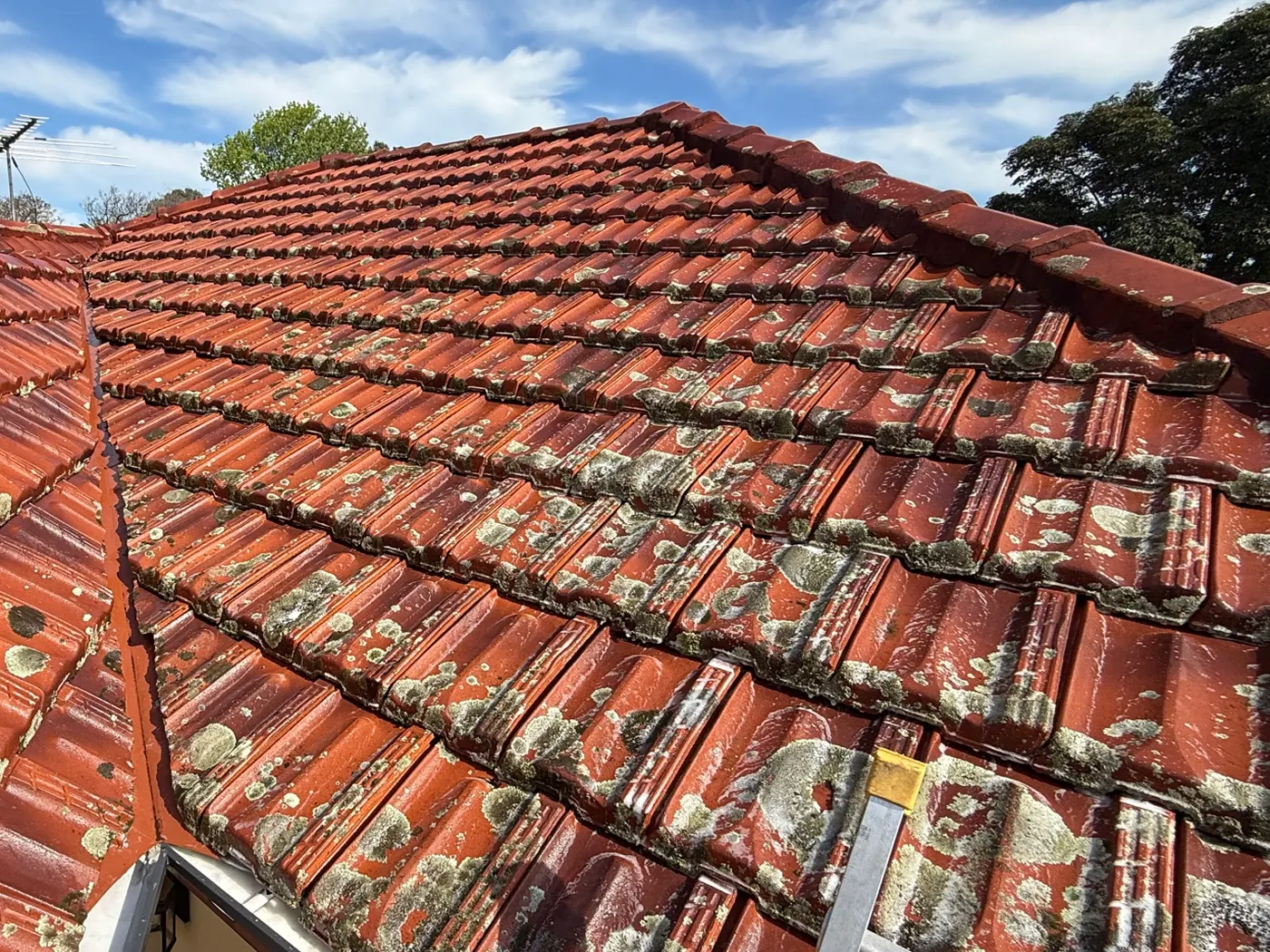
Pitch works the same way. The angle of a surface is another important control on its water and heat.15 Marley, a tile maker, notes that on low pitched roofs water drains away more slowly, leaving more of it on the roof at any one point.19 Every tile has a minimum pitch: Monier's go down to 12 degrees for one terracotta profile and 15 degrees for most of its concrete tiles.20 The flatter a plane, the longer the water sits on it.
In plain terms The south side of a fence is the one with moss at its foot, and the patch of lawn under the tree is the one still wet at lunchtime. A roof has a south side and a shady corner too.
The tile itself: rough, porous and getting older
Researchers call how readily a material is colonised its bioreceptivity, a term coined in 1995 for building materials. It is set mainly by surface roughness, porosity and mineral make-up, and it changes as the surface weathers.15 In cement based materials, the rate at which algae foul a surface is governed by its roughness and porosity, as well as the chemistry of the binder.21 Roof tiles are porous enough that their pores soak up the water microbes need and let the microbes into the material.22
Concrete and terracotta differ. In exposure trials reported by the Fraunhofer Institute, concrete roof tiles grew more than clay ones. The researchers put it down to concrete taking up moisture from the air more readily, which outweighed its lower absorption of liquid water.5 Concrete is also strongly alkaline when new, with a surface pH above 12, and carbonation lowers that over the years. Most organisms prefer a lower pH, which is why researchers who want concrete to grow things often speed up its carbonation to bring the surface pH down.3 The exception is the lime loving lichens, which only grow on alkaline surfaces and turn up on concrete roof tiles for exactly that reason.23 The two tile types are compared in terracotta or concrete.
Age changes the face of a tile more than its body. Monier says concrete tiles become stronger and less porous over time, while their colour coat fades and weathers to a more matt finish under sun and air pollution.20 What changes for the colonists is the surface. Weathering moves a material from its original bioreceptivity to a secondary one, and Guillitte, who coined the term, wrote that the secondary state is often the more important in practice.15 A sound surface treatment slows things: in a six year outdoor trial, clay tiles treated with water repellents carried visibly less lichen than untreated ones.22 Colour changes drying too. In Fraunhofer's measurements, a red surface absorbed more sun and peaked at a lower surface humidity than a white one on the same shaded wall.5
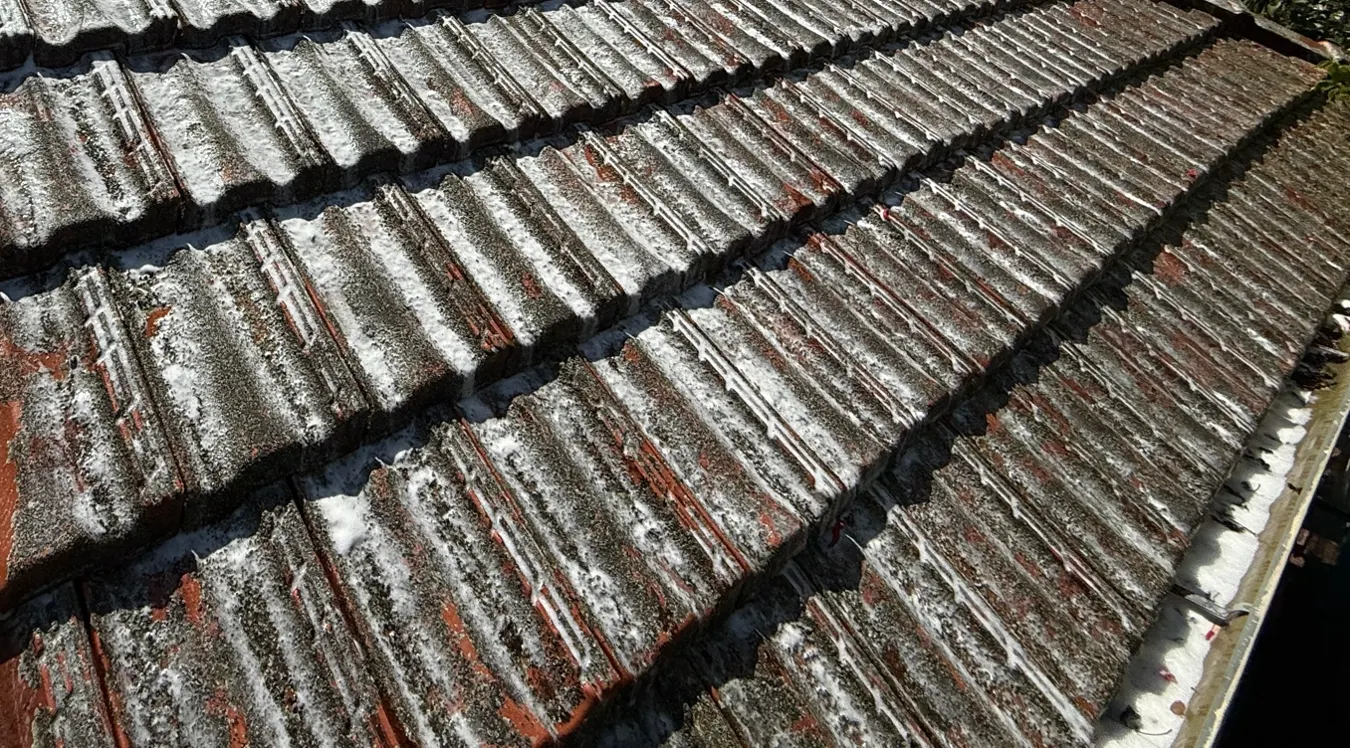
In plain terms A new tile is a freshly sealed benchtop and an old one is the chopping board. Same material, but one has a thousand tiny places for water and spores to settle and stay.
The setting beats the material
When the researchers who measured roughness and porosity in the laboratory put their concrete mixes outdoors in three different places, none showed visible colonisation in the study period. They concluded that, at that stage, the environment had a greater effect than the material.24 A review of algae and cyanobacteria on Mediterranean monuments reached the same order: colonisation follows the surface's physical character, its microclimate and its environment first, and the type of stone second.25 A highly bioreceptive material does not grow everywhere it is used; inclination, orientation and setting can have an immense impact.3
So on a Perth roof, look first at how long each face stays wet: its aspect, its shade, its trees and its pitch. Then at where the house is, in the hills or on the plain. The tile and its age come after that. What you can change is short: trim back what shades the roof16, keep the gutters and valleys clear18, and keep the roof treated, because growth recurs wherever the conditions for it stay. How it gets there in the first place is in what lives on a roof.
In plain terms Two identical tiles, one on the south face under a peppermint tree and one on the open north face, have different addresses. The tile decides how welcoming the house is. The address decides whether anyone moves in.
What this means for your roof
Wet time decides where growth settles, and on a Perth roof the wet time comes in winter, on the south faces, under the trees and down the valleys: the parts of a roof that stay occupied longest, and the parts a treatment has to reach. We price every roof from the air and treat each face with UNGROW Bailiff from the roofline, with a low pressure soft wash pump through non-directional nozzles, and the same winter rain that fed the growth is what carries it off once it is dead. The wet comes back every winter, so UNGROW Sentry, our preventative, keeps those faces treated after that. To see which faces of your own roof stay wettest, run the Roof Report.
Also asked
What does moss on the roof mean?
It means that part of the roof stays wet for long enough. Moss grows only while wet, and needs continuously wet spells of a few days or more to grow much, so it marks the faces that dry slowest: south facing planes, shaded sections, anything under a tree, low pitches and rough, worn tiles. It does not mean the roof needs replacing. It means those tiles are being held wet, and that face needs treating. More in is moss on the roof a problem.
Why is the moss only on one side of my roof?
Because that side stays wet longest. In Australia the sun tracks to the north, so south facing planes get the least winter sun and dry slowest after rain and dew. Add a tree's shade and the difference is stark. The tiles are usually the same on every face of a roof. The wet hours are not.
Does a wet winter mean more moss on the roof?
Yes. Moss, lichen and algae grow while the roof is wet, and in Perth more than three quarters of the year's rain falls from May to September. A wetter winter means more wet hours on every face, and the south and shaded faces get the most of them.
Will cutting back trees stop roof moss?
It helps, alongside treatment. Oregon State University Extension says moss depends on shade, and recommends trimming nearby trees so more sun reaches the roof. Trees also drop leaves into gutters and valleys. Trimming changes the conditions; the treatment clears what is already growing, and UNGROW Sentry, our preventative, keeps the roof treated after that.
Do old tiles grow more than new ones?
Usually, because the surface changes. On concrete tiles the colour coat fades and weathers to a matt finish, and over the years carbonation brings the surface pH down toward what most organisms prefer. Monier says the concrete itself gets stronger and less porous with age, so it is the face of the tile, not its body, that ages in a way the growth notices.
Do concrete tiles grow more than terracotta?
In exposure trials reported by the Fraunhofer Institute, concrete roof tiles grew more than clay ones, which the researchers put down to concrete taking up more moisture from damp air. Concrete is also alkaline, which lime loving lichens favour. On a real roof, aspect and shade still matter more than the tile.
On the record
- The Bryologist, Desiccation-tolerance in bryophytes: a review (2007)
- The Bryologist, Desiccation-Tolerance in Lichens: A Review (2008)
- Journal of Building Engineering, Bioreceptivity of concrete: A review (2023)
- Australian National Botanic Gardens, What is a bryophyte?
- Fraunhofer Institute for Building Physics (Buildings VIII conference, ASHRAE), Biological growth on stucco (2001)
- Bureau of Meteorology, Climate statistics for Australian locations: Perth Metro (009225)
- Bureau of Meteorology, Climate statistics for Australian locations: Perth Airport (009021)
- Bureau of Meteorology, Frontal systems
- Bureau of Meteorology, Climate statistics for Australian locations: Swanbourne (009215)
- Bureau of Meteorology, Climate statistics for Australian locations: Bickley (009240)
- Bureau of Meteorology, Climate statistics for Australian locations: Pearce RAAF (009053)
- Australian National Botanic Gardens, Bryophyte ecology
- Bureau of Meteorology, State of the Climate: report at a glance
- Your Home (Australian Government), Orientation
- Science of The Total Environment, Revisiting and reanalysing the concept of bioreceptivity 25 years on (2021)
- Oregon State University Extension Service, How to control roof moss and prevent long-term damage
- The Science of the total environment, Lithobiontic recolonization following cleaning and preservative treatments on the rock engravings of Valle Camonica, Italy: A 54-months monitoring (2023)
- Monier, Roof cleaning and maintenance
- Marley, Can Flat Interlocking Tiles Be Installed Straight Bonded? (2016)
- Monier, FAQs
- The Science of the total environment, Bioreceptivity evaluation of cementitious materials designed to stimulate biological growth (2014)
- Microorganisms, Methyl Potassium Siliconate and Siloxane Inhibit the Formation of Multispecies Biofilms on Ceramic Roof Tiles: Efficiency and Comparison of Two Common Water Repellents (2021)
- Australian National Botanic Gardens, Lichen habitats
- The Science of the total environment, Evaluation of natural colonisation of cementitious materials: effect of bioreceptivity and environmental conditions (2015)
- Microbiology, Biodiversity of cyanobacteria and green algae on monuments in the Mediterranean Basin: an overview (2009)