The ruling
A roof is colonised in layers, and every layer works on the tile. Bacteria come first, building a slime film that darkens as algae, cyanobacteria and fungi move in. Lichen and moss settle on top, and lichen threads grow into the tile. Spores keep arriving, so we treat every face, and staying treated keeps it in check.
A roof is a hard place to live
To anything alive, a roof is bare rock: no soil, full sun, and nothing to hold water once the rain stops. Microbiologists call the communities that manage to live on surfaces like this subaerial biofilms: films on solid mineral surfaces open to the air, found on buildings, desert rock and mountains at every latitude where a surface meets the atmosphere and full sunlight.1
The Australian National Herbarium describes bare rock exposed to sun and wind as hostile to the seeds of flowering plants but readily colonised by lichens, mosses and their relatives. It notes that roof tiles will never carry a garden, but may still carry complex communities of these organisms, small invertebrates and microbes.2
Perth adds a dry season. Perth Metro averages 38 mm of rain across December, January and February together, and 144 mm in July alone.3
In plain terms To a microbe, a Perth roof is a cliff face in a desert that gets a few months of rain each year. Only specialists live there, and everything you see on it is one.
First: an invisible film of bacteria
Colonisation starts before anything shows. When researchers sampled ceramic roof tiles, they found a pioneer biofilm with a large bacterial community already on new tiles that had never been outdoors, 279 distinct bacterial types, and more after a few months of outdoor exposure, 411.4
Tiles suit it. Their pores soak up the liquid water microbes need and let the microbes into the material. Bacteria, algae and fungi then build mixed biofilms on the tile, embedded in a thick protective matrix they make themselves.5
That matrix is the slime, properly called extracellular polymeric substances. It is mostly polysaccharides, proteins, nucleic acids and lipids. It sticks the film to the surface, holds the cells together, and works as an external digestive system by keeping their enzymes close.6 On open surfaces, a biofilm's whole economy centres on holding water and shading its cells from the sun. It feeds on what the air brings, aerosols, gases and particles, and the air is also how new members arrive.1
The film does not just sit there. Researchers working on clay roof tiles describe biodeterioration as a process that first modifies the tile surface and ultimately destroys it, and this pioneer film is the first stage of the colonisation that drives it.4 On the tile, the microbes' metabolism profoundly alters its composition, and the films play a crucial role in its deterioration.5 Out on bare rock, films like this work into the mineral surface and contribute to its decay.1
In plain terms The slippery coat on a creek rock is the same thing. On a roof it is the foundation slab: glue, water tank and pantry for everything built on it later, and it is working on the tile the whole time.
Then: the film darkens
The film turns visible as its pigmented members take hold. On wet, shaded surfaces algae dominate; where the sun gets at it, fungi take the lead.5
The photosynthetic side is cyanobacteria and green algae. A review of 45 case studies of the cyanobacteria and green algae that cause deterioration of stone monuments around the Mediterranean counted about 172 kinds. The most common were the cyanobacteria Gloeocapsa, Phormidium and Chroococcus and the green algae Chlorella, Stichococcus and Chlorococcum. Where they settle depends first on the surface and its microclimate, and only second on the type of stone.7
The fungal side is melanised fungi, with thick cell walls packed with the dark pigment melanin. On outdoor stone monuments they are among the most damaging microbes there are: they darken the surface, crack it and pit it. They are also among the most stress resistant organisms on Earth, built to take strong sun, drying out and wide swings in temperature.8 On clay roof tiles left out for six years under a Mediterranean climate in the south of France, every tile carried their typical dark spots.5
Part of that pigment is protection. Many cyanobacteria tint their outer sheaths with scytonemin, a yellow-brown pigment that screens out near ultraviolet light, and they make more of it in strong light.9 Among bacteria, cyanobacteria are notably good at surviving complete drying, and one well studied species, Nostoc commune, does it with a coat of its own slime and plenty of UV-absorbing pigment.10 On roof tiles, these biofilms mature and become pigmented, and show as black or green spots.5 This is the film that shows as black streaks on a roof and the green film of roof algae.
In plain terms The dark colour is not dirt. It is a crowd of microbes, and some of what you are looking at is the sunscreen they make for themselves.
Last: lichen and moss move in
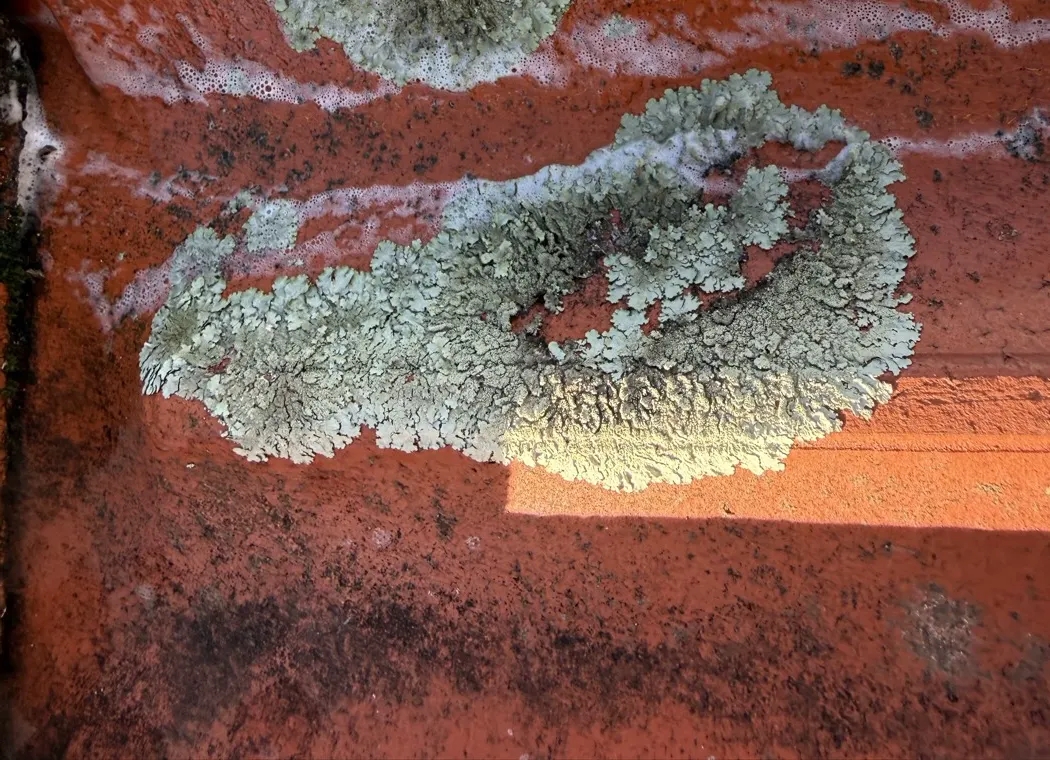
Lichen and moss are what people notice, and they settle into a surface the film has already changed. Biofilms on roof tiles promote the settlement of mosses.5 Ecologists call this ordered change succession: each arrival makes the surface a better home for the next.
A lichen has a harder start. Its fungus spreads by spores, and a spore makes a new lichen only if it germinates near the right alga or cyanobacterium.11 In crust lichens, the first patches may form around free-living algal cells already on the surface.12 Many lichens skip the search by shedding soredia, tiny granules of photobiont cells wrapped in fungal threads, which carry both partners and can start a new lichen wherever they land.13 Concrete is alkaline, so concrete tiles also suit the lime loving lichens that grow only on alkaline surfaces.14
Once established, both build on themselves. Lichens trap moisture and windblown debris, then add to it as they die and decay.13 Moss cushions do the same: the stems grow up, the lower leaves lose the light and die, and the cushion fills with organic matter.11 Researchers who study bioreceptivity expect fast growing, well dispersed species to dominate a fresh surface, and more competitive species to replace them as the surface weathers.15
A lichen does not just sit on the tile; it grows into it. On clay roof tiles six to ten years old, electron microscopy found lichen threads penetrating the tile and filling its fissures and cracks, and the same researchers traced the lichen's attack on tile material to oxalic acid.16 What that does to a roof over the years is in what growth does to a roof.
The Herbarium lists freshly tiled roofs among the bare surfaces where lichens and mosses are often among the first organisms to settle.2, 11 Among the first you can see, that is. On clay tiles left out for six years, the microbial film had colonised the tiles before any lichen could be seen.5
In plain terms A lichen spore is half a lichen. The film already on the tile is where it finds the other half, and once it has, it threads into the tile the way tree roots work into a footpath.
How they arrive: wind, water and birds
Nothing has to be carried onto a roof by hand. Every one of these organisms travels as a propagule: a spore, a fragment or a granule that can grow into a new one.
- Lichen. Its fungal spores are small enough to be carried off by the slightest breeze. Water and animals carry its fragments too, and migratory birds can pick them up and carry them long distances. Many lichens are brittle when dry, so a dry patch that is knocked breaks into pieces, and a broken piece can grow into a new lichen.13
- Moss. Most moss spores travel on the wind, and a broken fragment of moss can grow into a new plant where it lands.17 Moss leaf fragments have been found embedded in the feathers of migrating shorebirds.18
- Algae. Microscopic algae ride the air as well, and survive the trip.19

Most of it comes from close by. In a 54 month study of cleaned and treated rock surfaces in Italy, regrowth spread mainly from the untreated surfaces around each treated patch, and a biocide applied after cleaning gave the best results through two growing seasons.20
That is why breaking living growth up is not the same as ending it: every piece knocked loose can start again where it lands. A treatment soaks in and ends it in place, and the weather does the removal. Yates says of its own roof product that it "kills lichens on roofs but does not remove them".21 The chemistry is in how roof treatment works.
In plain terms The air over a suburb carries spores the way it carries dust. Every roof gets its share, every year, and the nearest supply is the growth already on the roofs, trees and walls around it.
How they survive a Perth summer: they dry out and wait
Lichens and mosses are poikilohydric: their water content follows their surroundings.22, 23 Their answer to drought is desiccation tolerance. The leafy shoots of a moss take on or lose water quickly and are either fully wet and working or dried out and switched off. On rewetting, breathing and photosynthesis restart within minutes to an hour or two.23 Dormant mosses can wake on very little water; fog or dew is often enough.17 Most lichens tolerate drying completely, and some have revived after months dry in the laboratory.24
Dry, they are hard to hurt. Lichens tolerate 65 to 70 °C when dry but are sensitive to heat when wet: six hours at 55 °C ends them if they are kept fully wet.22 Mosses and their chlorophyll survive intense light while dried out, a combination that would quickly bleach the leaf of a garden plant.17 Some lichens carry their own sunscreen; the orange pigment parietin protects the lichen Xanthoria.25
In temperate places with wet winters and dry summers, mosses spend much of the summer dry and dormant and are active through the cooler, wetter months.11 That is the Perth year exactly. Growth also needs wet time, not just water: a moss needs continuously wet spells of a few days or more to grow significantly.23 Why some roofs get far more of that than others is the subject of why your roof grows it.
In plain terms Think of instant yeast in the packet. Dry, it sits for months. Add water and it is working within minutes. A grey, crunchy lichen in February is not dead; it is waiting for May. How to tell the difference is in is lichen alive or dead.
What this means for your roof
The film is on every face before anything shows, so a face that looks clean is only earlier in the same sequence. We treat every face with UNGROW Bailiff, not just the patches you can see, and end the growth where it sits: from the roofline, with a low pressure soft wash pump through non-directional nozzles, so nothing is blasted loose to spread, and the weather carries it off. Spores keep arriving from the roofs and trees around yours, so growth recurs, and UNGROW Sentry, our preventative, keeps the roof treated after that.
Also asked
Where does moss on a roof come from?
From the air. Moss spores travel mostly on the wind, and a broken fragment of moss can grow into a new plant where it lands on a suitable surface. Birds carry fragments too. Every roof gets its share, and the nearest supply is the growth already on the roofs, trees and walls around it. Whether it takes hold depends on how long the roof stays wet, which is why the south face and the shaded side go first.
Why does a roof go dark before anything else grows on it?
The first visible stage is a film of microbes living in a slime they make themselves, cyanobacteria and algae where it stays damp, dark fungi where the sun gets at it. As the film matures it becomes pigmented and shows as black or green streaks and spots. On test tiles the film was there before any lichen showed, so the dark stage is the start of the sequence, not a separate problem.
Is the grey lichen on my roof dead in summer?
Usually not. Lichens dry out completely in hot weather and switch off, then start working again soon after the next rain. Most lichens tolerate being dried out, and some have revived after months dry in the laboratory. A dry, brittle lichen in February is dormant, waiting for the winter rain.
Can a new roof get lichen?
Yes. Bacteria are already on new tiles before they go up, and a film builds within months outdoors. Lichens and mosses are among the first visible colonists of freshly tiled roofs. How quickly they show depends on wet time, so a shaded, south facing plane goes first.
Once a roof is treated, will the growth come back?
Spores keep landing on every roof, so the answer is staying treated. UNGROW Bailiff, our treatment, ends what is there, and UNGROW Sentry, our preventative, keeps the roof treated after that. In a 54 month field study, a biocide applied after cleaning gave the best results through two growing seasons, and regrowth came mainly from the untreated surfaces around each patch, which is why we treat every face. More sun on the roof, where you can get it, helps too.
On the record
- Environmental Microbiology, Life on the rocks (2007)
- Australian National Botanic Gardens, Lichen ecology
- Bureau of Meteorology, Climate statistics for Australian locations: Perth Metro (009225)
- International Biodeterioration & Biodegradation, High bacterial diversity in pioneer biofilms colonizing ceramic roof tiles (2019)
- Microorganisms, Methyl Potassium Siliconate and Siloxane Inhibit the Formation of Multispecies Biofilms on Ceramic Roof Tiles: Efficiency and Comparison of Two Common Water Repellents (2021)
- Nature Reviews Microbiology, The biofilm matrix (2010)
- Microbiology, Biodiversity of cyanobacteria and green algae on monuments in the Mediterranean Basin: an overview (2009)
- IUBMB Life, Conventional and innovative approaches to black fungi control for stone heritage preservation (2025)
- Journal of Phycology, Characterization and biological implications of scytonemin, a cyanobacterial sheath pigment (1991)
- Microbiological Reviews, Desiccation tolerance of prokaryotes (1994)
- Australian National Botanic Gardens, Bryophyte ecology
- Geografiska Annaler: Series A, Physical Geography, Growth of crustose lichens: a review (2010)
- Australian National Botanic Gardens, What is a lichen?
- Australian National Botanic Gardens, Lichen habitats
- Science of The Total Environment, Revisiting and reanalysing the concept of bioreceptivity 25 years on (2021)
- Scanning, Evaluation of the effect of lichens on ceramic roofing tiles by scanning electron microscopy and energy-dispersive spectroscopy analyses (2005)
- Australian National Botanic Gardens, What is a bryophyte?
- PeerJ, First evidence of bryophyte diaspores in the plumage of transequatorial migrant birds (2014)
- Applied and Environmental Microbiology, Airborne Microalgae: Insights, Opportunities, and Challenges (2016)
- The Science of the total environment, Lithobiontic recolonization following cleaning and preservative treatments on the rock engravings of Valle Camonica, Italy: A 54-months monitoring (2023)
- Yates, Yates Surrender Moss Killer
- Environmental science & technology, Heat shock treatments: a new safe approach against lichen growth on outdoor stone surfaces (2012)
- The Bryologist, Desiccation-tolerance in bryophytes: a review (2007)
- The Bryologist, Desiccation-Tolerance in Lichens: A Review (2008)
- Oecologia, Parietin, a photoprotective secondary product of the lichen Xanthoria parietina