The ruling
Neither tile stays clean, and where the roof sits matters more than what it is made of: shade, trees and the way each face points decide how much grows. Concrete suits the lime loving crust lichens. On terracotta, other lichens anchor their threads into the fired clay. UNGROW Bailiff treats the growth the same way on both, from the roofline.
Two different materials
Concrete and terracotta tiles can look alike from the street. They are made of different things and they age differently, and lichen gets into both.
| Concrete tile | Terracotta tile | |
|---|---|---|
| Made from | Concrete, sand and pigments1 | Natural clay, fired in a kiln1 |
| Colour | A colour coating Monier calls purely decorative, which fades and weathers over time1 | Baked into the tile in firing, and Monier says it does not fade1 |
| Finish | The coating takes on a subdued, matt look from UV and air pollution1 | Glazed or unglazed, depending on the tile1 |
| Chemistry | Alkaline, like all concrete2 | Fired clay; in lab tests, the acid lichen makes formed calcium oxalate crystals in it3 |
| What lichen does | Lime loving orange and yellow crusts settle on it2, 4 | Threads penetrate the tile and fill its fissures and cracks3 |
In plain terms A concrete tile is a painted paver. A terracotta tile is a flowerpot.
Water: why porosity matters
Water is what growth runs on. Researchers studying clay roof tiles put it directly: roof tiles are particularly prone to microbial colonisation because of their high porosity, and the pores take up liquid water, which is essential for microbial development.5 The films of bacteria, algae and fungi that settle on the tiles then promote the settlement of mosses.5 For cement based materials, laboratory work found the rate of fouling is governed by the roughness and porosity of the surface.6
Once moss is in, it brings water of its own. The UK Roof Tile Association, writing about clay and concrete tiles alike, says moss on the surface of a roof tile retains water longer, and where it affects drainage down valleys, abutment gutters and the tiles' interlocking drainage channels, it should be carefully removed.7
In plain terms The more a tile behaves like a sponge, the longer it stays damp after rain, and damp is what moss, algae and lichen live on. Moss on top is a second sponge.
Alkalinity: which lichens favour which
Some lichens only grow on alkaline surfaces. Concrete is alkaline, so the lime loving species that would grow on limestone turn up on concrete walls and concrete roof tiles.2 The orange brown crusts on concrete are most likely Caloplaca, and the yellow ones Candelariella, and both grow on concrete roof tiles.4
On lime, these lichens are on home ground. On limestone and dolomite, the lichens studied dissolved the calcite with oxalic acid, and where lichen met rock the calcite was completely gone. On building mortar, the attack shows on the surface and inside it, as micropitting and etching.8
Fired clay is a different surface. The clearest clue comes from brick walls: on a wall of clay bricks, the botanists say, you may find lime loving lichens on the mortar between the bricks, but not on the bricks themselves.2 That does not leave terracotta bare. Other lichens move in, and they anchor. On clay roof tiles six to ten years old, electron microscopy found the threads of the lichen Verrucaria nigrescens penetrating the tile and filling its fissures and cracks.3
Concrete's alkalinity does not keep it clean. In the laboratory, a lower pH cement fouled with algae faster than ordinary Portland cement, the binder most used in construction.6 Out in the weather the order flipped: the ordinary Portland cement samples carried more microbial life, in both variety and quantity.9
In plain terms To a lichen, concrete is a limestone cliff and terracotta is closer to a brick. Different tenants move in, but both get tenants.
How each weathers, and what lichen leaves
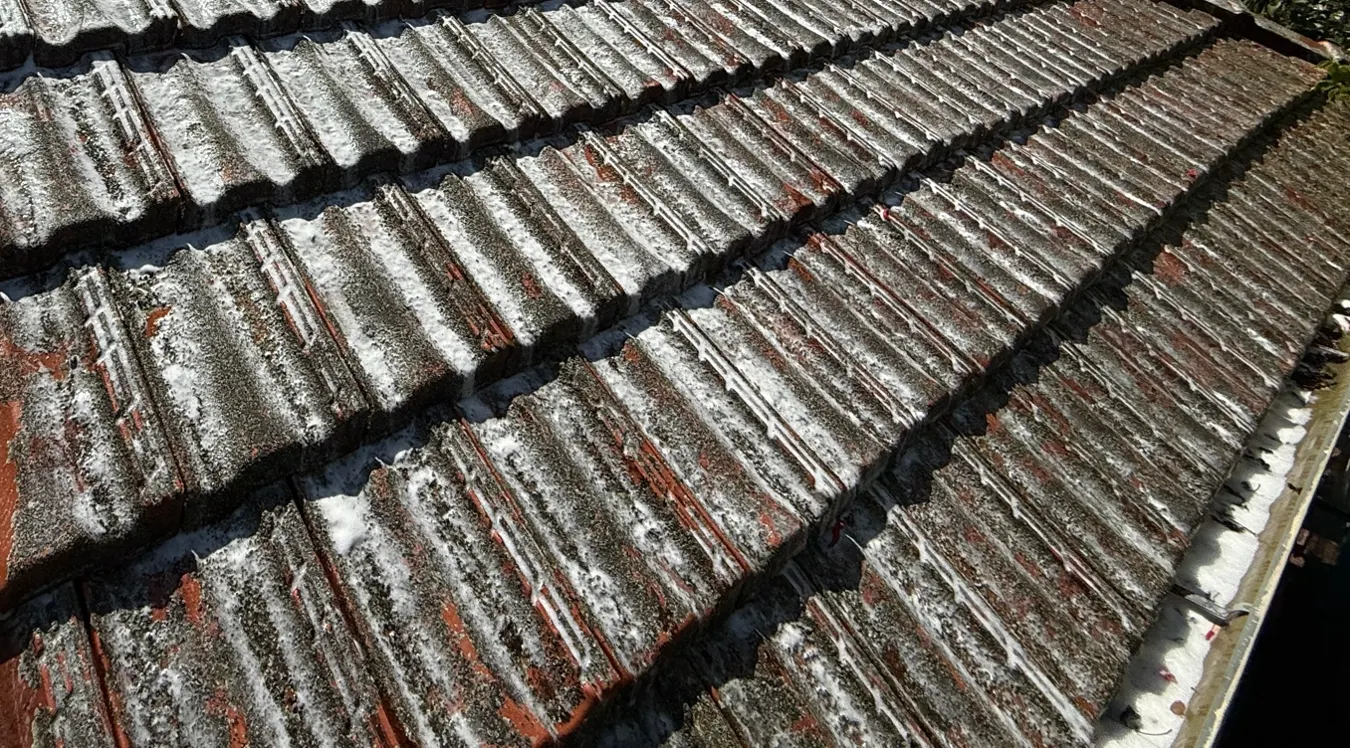
Concrete. The colour coat is purely decorative. Over several years it takes on a more subdued, matt look from air pollution and the sun's UV.1 Repainting refreshes the look but must be redone every five years or so.10 Natural salts in the concrete can also come to the surface as a whitish grey bloom, efflorescence, which Monier says should disappear naturally over time.1 More in white spots on roof tiles.
Terracotta. The colour is fired in, so it holds.10 What lichen does to it happens in the body of the tile. The Novi Sad researchers traced the way lichens act on ceramic roofing tiles to oxalic acid. In their lab tests it changed the texture of the ceramic and formed whewellite, a calcium oxalate crystal they call destructive, and they concluded that this acid action can deteriorate the ceramic and age roofing tiles.3
Both. Lichen acid works on the calcium in either tile8, 3, and where it has etched the surface, weather does not put it back. When the colony finally comes away, that outline can stay as a ghost mark. The full case is in does lichen damage roof tiles?
In plain terms A concrete tile fades like a painted fence, coat first. A terracotta tile holds its colour like a flowerpot, but lichen acid marks either one the way lemon juice marks a marble benchtop, and the mark can stay after the lemon is wiped off.
Low pressure looks after both
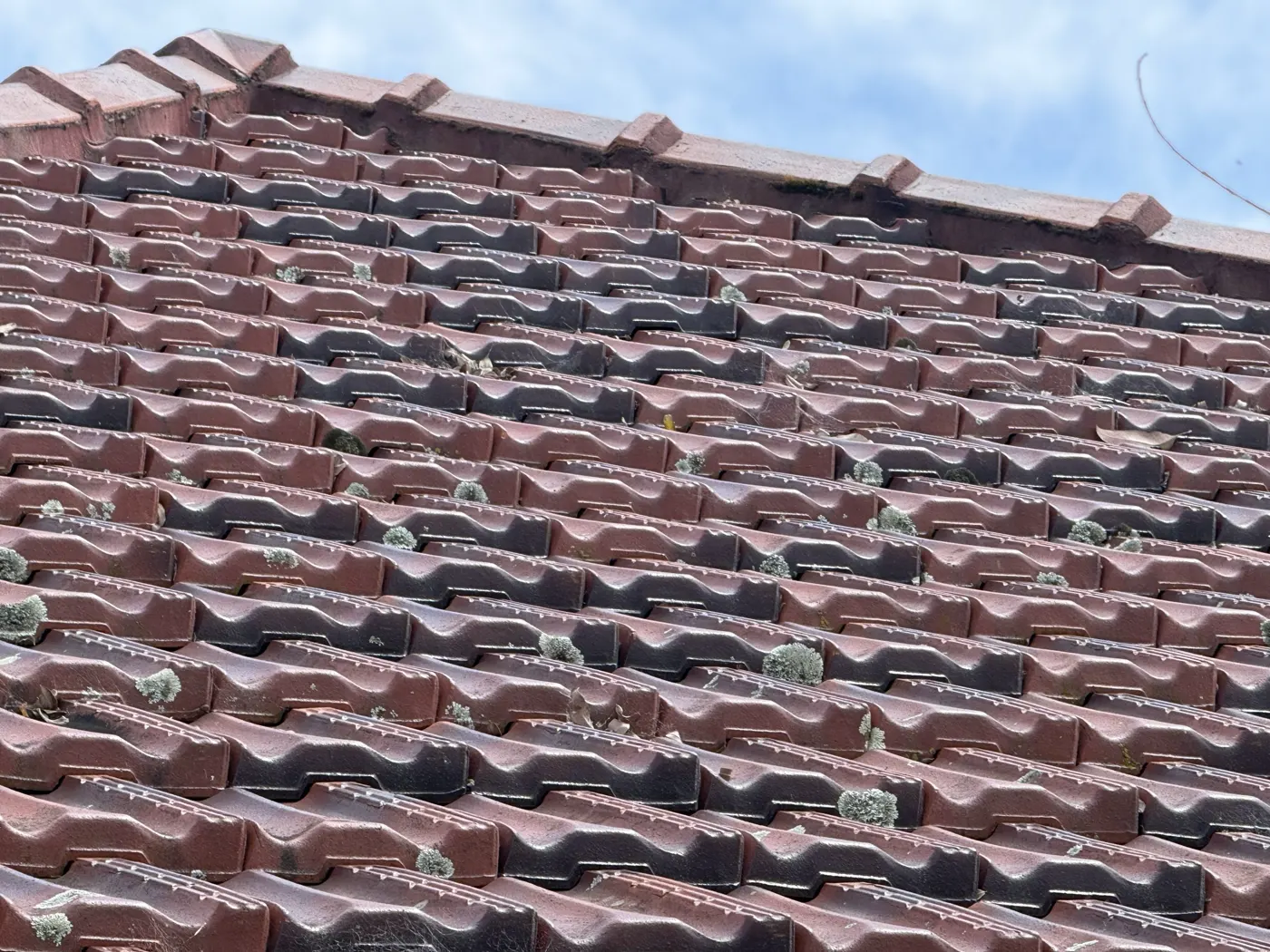
Monier, which makes both kinds, strongly advises against pressure washers for roof cleaning, because of the significant risk of tile damage from the high pressure of the water.10 On concrete, the colour is a decorative coat1, and Wienerberger, a UK tile maker, says the forceful spray of a high pressure jet washer can damage the tile finish and strip away colour from concrete tiles.11 The UK Roof Tile Association says a high pressure jet on concrete tiles "will result in erosion of the surface thereby reducing the potential lifespan of the roof tile".7 Marley says the same of tiles generally: a high powered jet wash "can damage the surface of the slate or tile".12
An eroded surface is a rougher one, and roughness is a gift to the next growth. Rough surfaces trap water and the spores and fragments lichens spread from, and lichens are found well established in rough areas but absent, or nearly so, from nearby smooth areas with the same aspect and chemistry.13 On cement mortars in the laboratory, roughness and porosity governed how fast algae fouled the surface.6
Walking the roof to do it is a risk of its own: Monier says walking on roofs can be dangerous and may result in injury or damage.10 The full case is in does pressure cleaning damage roof tiles?
In plain terms On either tile, a pressure cleaner takes the top off. On concrete, the top is the colour.
So which grows more?
Neither tile keeps a roof clean. What decides how much grows is where the roof sits. When cement samples made to be more or less welcoming to growth were left out in three different places, the researchers found the setting had a greater impact on early colonisation than the material's own properties.9 On a roof, that setting is shade, trees, the way each face points and the rain it gets: moss flourishes where trees are nearby and on shady slopes that stay damp longer.7 That is in why your roof grows it.
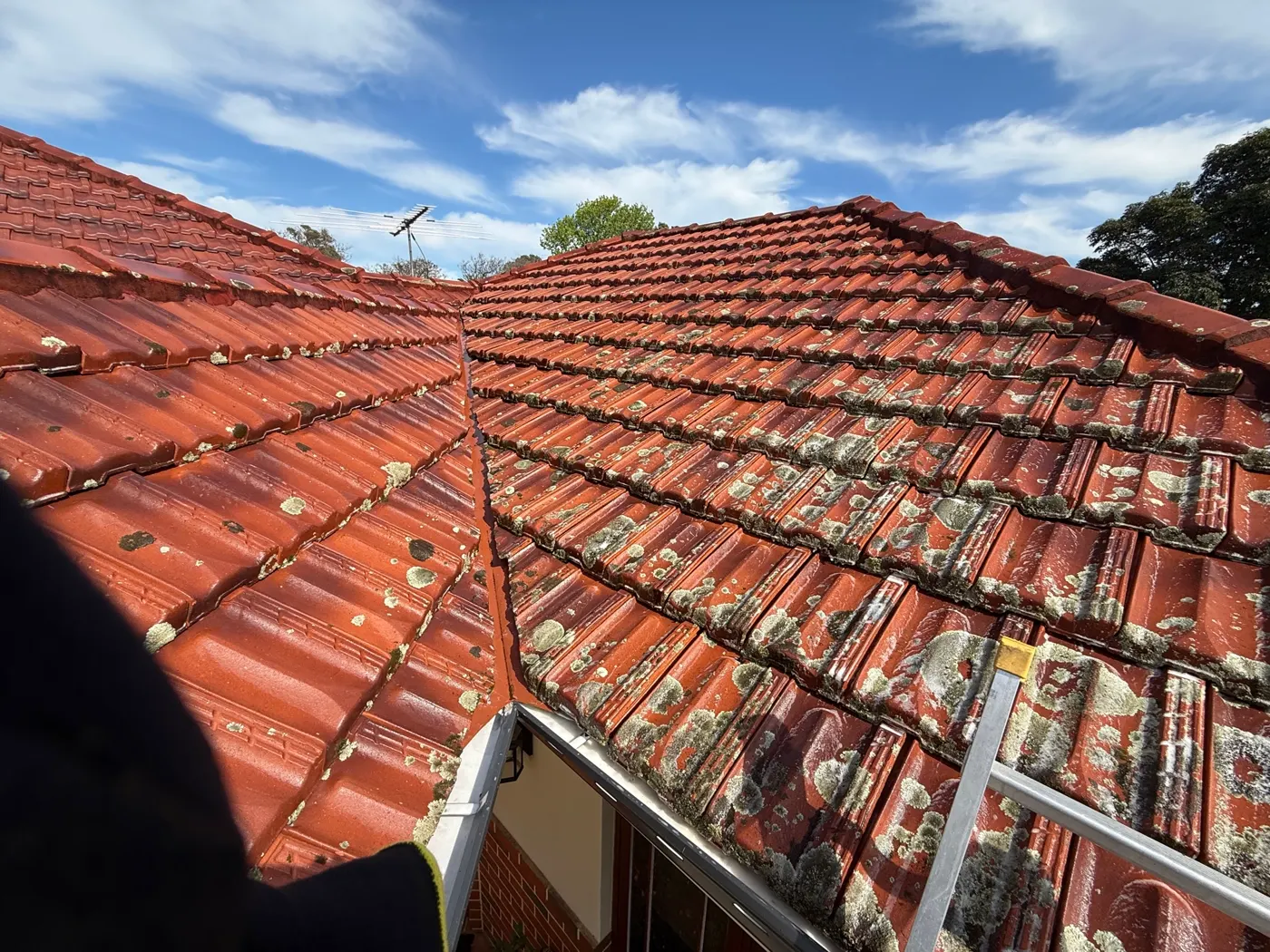
Material shapes which growth moves in. Concrete suits the lime loving orange and yellow crusts.2, 4 Porosity counts on both: on clay tiles the pores take up the water growth needs5, and on cement based surfaces roughness and porosity set how fast they foul.6 On the roofs we treat, terracotta carries heavy lichen too, as the Applecross roof above shows.
In plain terms A flowerpot in a damp corner grows moss faster than a paver in the sun. Where it sits matters more than what it is.
What this means for your roof
Concrete or terracotta, the growth on your roof is working on the tile: threads in the fissures, acid in the surface, moss holding water against the tiles and in the valleys. The tile decides which lichens move in, not whether they do. We treat it where it sits with UNGROW Bailiff, applied from the roofline through a low pressure soft wash pump and non-directional nozzles, so nothing is blasted off a colour coat or forced under the tiles, and the weather carries the dead growth away. Growth recurs on either tile, so UNGROW Sentry, our preventative, keeps the roof treated after that.
Also asked
How do I tell if my tiles are concrete or terracotta?
Look at a broken or chipped edge. Concrete is made from concrete, sand and pigments, so the edge is gritty and sandy, and some concrete tiles are coloured right through. Terracotta is fired clay: unglazed it is the natural red orange of the clay, and glazed it has a glassy coat over the clay. With age a concrete tile's colour coat turns subdued and matt, while terracotta's fired colour holds.
Are terracotta tiles better if I want less lichen?
No. Terracotta suits fewer of the lime loving lichens, but other lichens anchor into it: on clay roof tiles, electron microscopy found lichen threads filling the tile's fissures and cracks. Moss and algae grow on both. A terracotta roof under a tree on a south face will usually grow more than a concrete roof in full sun.
What are the downsides of a tile roof?
Not the lifespan: Monier says more than a century of service is not uncommon for terracotta. The downsides are on the surface. The UK Roof Tile Association puts moss and lichen on tiled roofs down to a rough surface that filters dirt out of rainwater, and clay tiles' pores take up the water growth needs. A concrete tile's colour is a decorative coat that fades. Tiles do not suit feet or jets: Monier says walking on roofs may result in injury or damage, and strongly advises against pressure washers.
Does roof treatment work the same on both?
Yes. Treatment works on the growth, not the tile. UNGROW Bailiff, our treatment, soaks into the lichen, moss or algae and ends it where it sits, on concrete or terracotta, and the weather carries it off over the months that follow. What differs is the surface the growth leaves behind: a faded colour coat on concrete, fired colour on terracotta, and on either, any etch the lichen made.
Why do my concrete tiles have white patches?
Often it is efflorescence: natural salts in the concrete coming to the surface as a whitish grey bloom. It is not alive, and Monier says it should disappear naturally over time. Lichen is the flat, crusty patch anchored to the surface, and it widens every year it stays. The two are easy to confuse from the ground.
Should I paint concrete tiles after treatment?
That is a choice about looks. Monier says repainting concrete tiles refreshes their appearance but must be redone every five years or so. Painting does nothing about the growth itself: moss and lichen spores settle wherever moisture and dirt gather on a roof, painted or not. Staying treated is what resolves it, and that is the job of UNGROW Sentry, our preventative.
On the record
- Monier, Monier Roofing FAQs
- Australian National Botanic Gardens, Lichen habitats
- Scanning, Evaluation of the effect of lichens on ceramic roofing tiles by scanning electron microscopy and energy-dispersive spectroscopy analyses (2005)
- Australian National Botanic Gardens, Urban lichens in Canberra
- Microorganisms, Methyl Potassium Siliconate and Siloxane Inhibit the Formation of Multispecies Biofilms on Ceramic Roof Tiles: Efficiency and Comparison of Two Common Water Repellents (2021)
- The Science of the total environment, Bioreceptivity evaluation of cementitious materials designed to stimulate biological growth (2014)
- Roof Tile Association (UK), Care, Maintenance & Repair of Clay and Concrete Roof Tiles (2016)
- Catena, Weathering of rocks induced by lichen colonization: a review (2000)
- The Science of the total environment, Evaluation of natural colonisation of cementitious materials: effect of bioreceptivity and environmental conditions (2015)
- Monier, Roof cleaning and maintenance
- Wienerberger UK, How to Clean Roof Tiles
- Marley (UK), Can I clean or jet wash my roof tiles?
- Australian National Botanic Gardens, Microhabitats