 Lichen
The ruling
Yes. Lichen is a fungus in partnership with an alga or a cyanobacterium. It pushes threads into a tile's hairline cracks, and its acids, oxalic acid chief among them, etch the surface and leave calcium oxalate crystals. Treating it where it sits ends that, and the sooner it is treated, the less of the tile it marks.
What lichen actually is
A lichen is not one organism. It is a fungus living in partnership with a photosynthetic partner, a green alga or a cyanobacterium, and more than 3,000 kinds are known from Australia alone.1 The fungus builds the body and holds on; the partner, the photobiont, turns sunlight into the sugars both of them live on.
In plain terms Lichen is a fungus that farms its own food. That is how it lives on a bare roof tile with nothing else to eat.
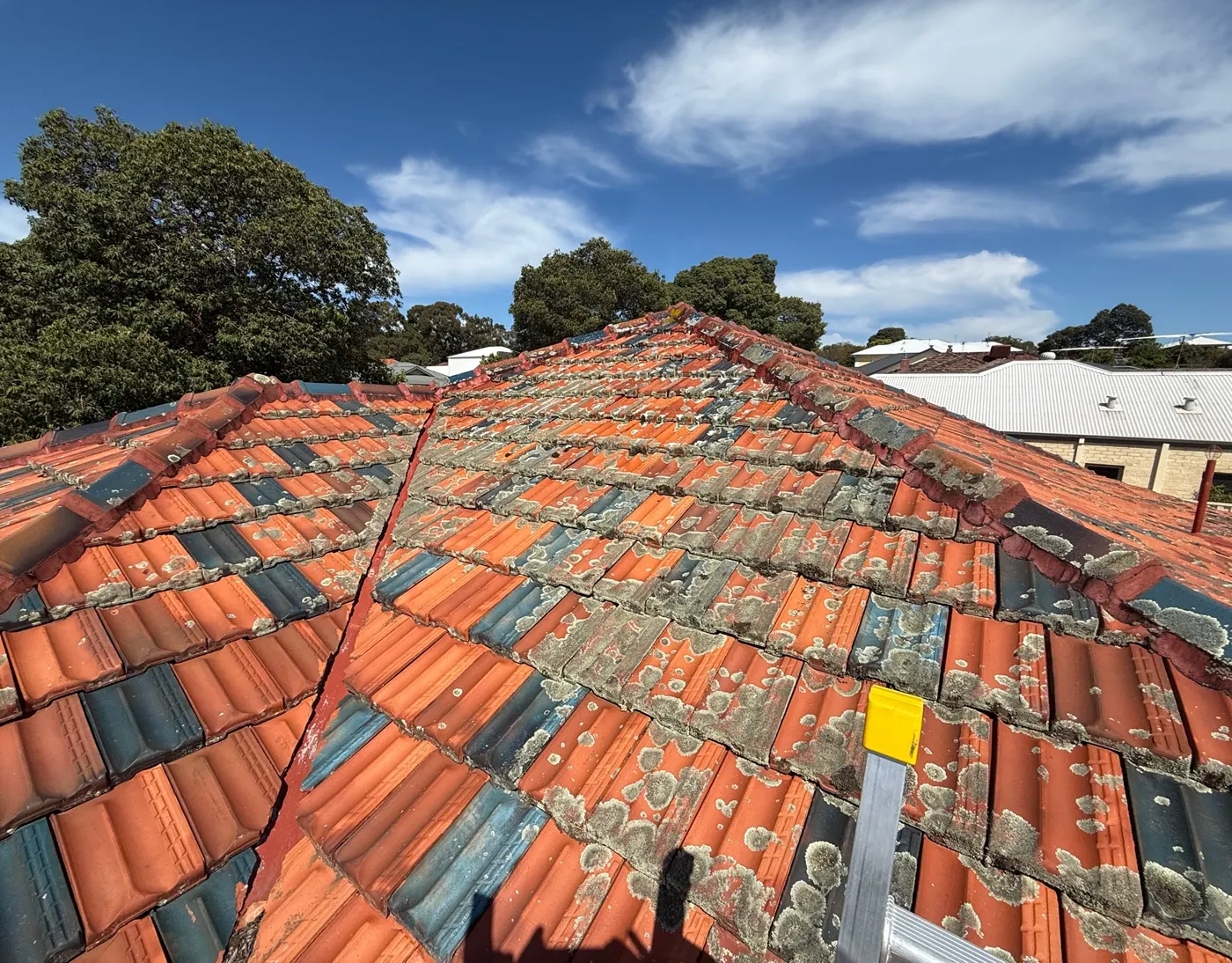
Many of the lichens on roof tiles are crustose: threads grow down from the lichen into the surface and anchor it so tightly that its underside cannot be seen.2 Some crust lichens go further and grow within the surface itself, in porous rock and finely fissured wood.3 The leafy foliose kinds anchor with rhizines, bundles of threads that penetrate the surface.2 Concrete is alkaline, so lime loving lichens settle on concrete walls and concrete roof tiles, the crusts of Caloplaca and Candelariella among them.4, 5
In plain terms The crusty patches on your tiles are not sitting on the surface. They are anchored into it.
How it anchors into a tile
A lichen's fungus is built from hyphae, threads far finer than a hair. Lichens are often among the first things to colonise a bare surface, and the Australian National Botanic Gardens lists freshly tiled roofs among them.6 Once there, the threads grow into pores and fissures. Rhizines growing into fissures press on the rock around them, and so does the wetting and drying of a lichen bound tightly to it: studies have shown lichens can cause "appreciable weathering in a relatively short time".6 The inner layer of a lichen holds up to three times its own dry weight in water, so with every rain and every dry spell it swells and shrinks inside whatever it has grown into.7
On roof tiles this has been seen directly. Researchers at the University of Novi Sad put clay roof tiles six to ten years old under the electron microscope and found lichen hyphae penetrating the tile and filling its fissures and cracks.8 That is the material of a terracotta roof: Monier describes its terracotta tiles as "a natural, kiln-fired clay product".9 A review of the research names that penetration as one of the most important ways lichens damage natural rock and building stone alike, and on building mortar the threads and the lichen's fruiting bodies pit the surface.7
In plain terms Think of tree roots lifting a footpath, at the scale of a hair, on every square metre the lichen covers.
The acid
Lichen fungi excrete organic acids, oxalic acid chief among them. Oxalic acid dissolves minerals and binds the metals they release.7 It reacts with calcium in the surface and leaves crystals of calcium oxalate, which build up in and immediately beneath the lichen.7
On roof tiles, this is what the research found. Studying clay roof tiles 20 to 30 years old, the Novi Sad team traced the damage to the lichen's oxalic acid: the reactions it drives broke down the body of the tile and aged the tiles. They named the calcium oxalate crystal it forms, whewellite, "the destructive crystal phase".10
Concrete roof tiles carry the lime loving lichens, the same kinds that grow on limestone and on the mortar between bricks.4 On limestone and dolomite, four lichens studied all dissolved the calcite with oxalic acid, and where lichen met rock the calcite was completely gone. On building mortar, the attack shows on the surface and inside it, as micropitting and etching.7
In plain terms It etches the tile, slowly, the way a spilt drink leaves a dull mark on a marble benchtop that no amount of wiping brings back.
Slow, but it adds up
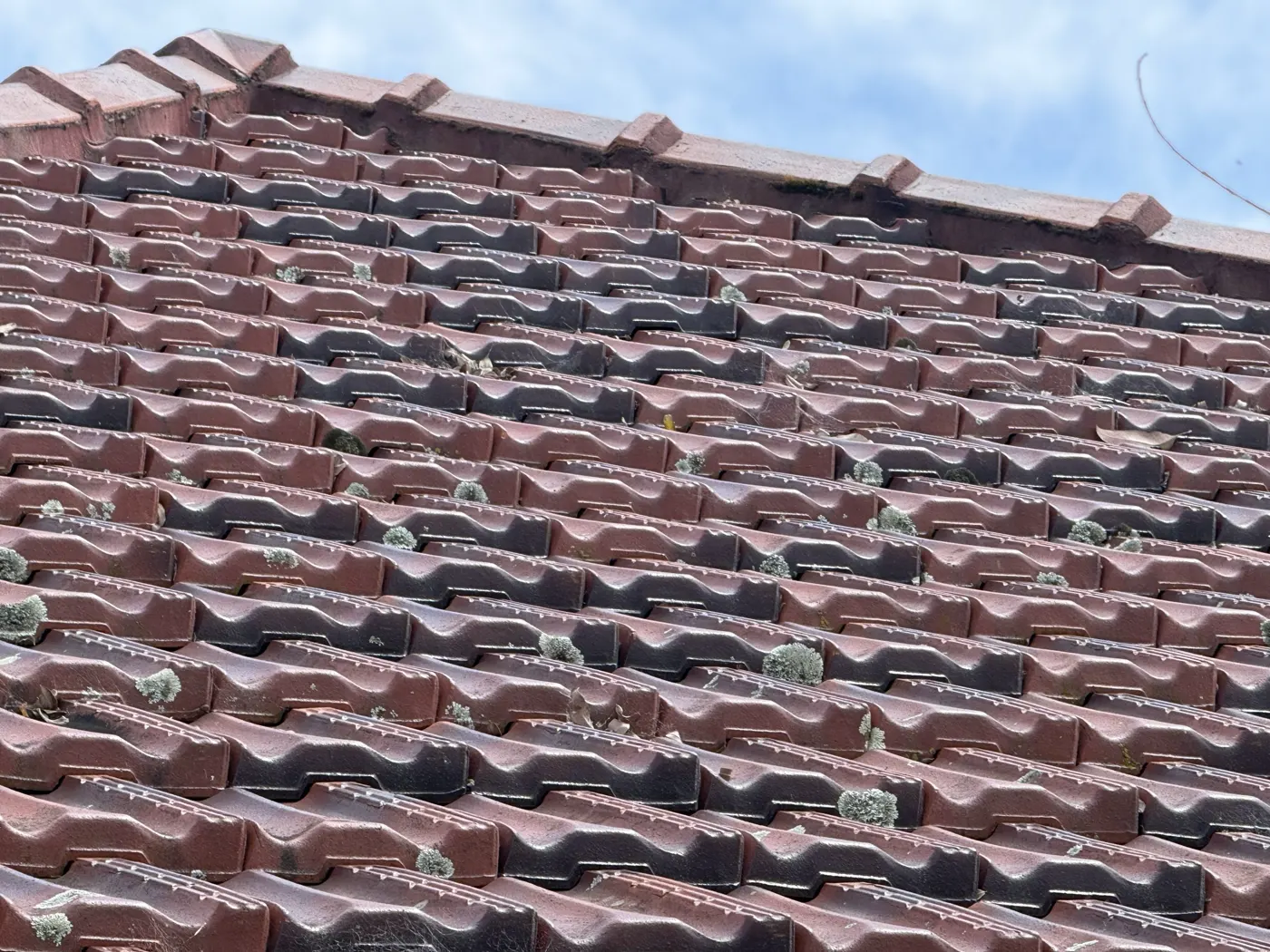
Lichen grows slowly. Crust lichens are the slowest growing of all, and the leafy kinds mostly spread 1 to 5 mm a year across their radius.11, 12 Slow growth is not slow damage. On rock in the mountains of southern Norway, the surface under one lichen species was estimated to be wearing down 25 to 50 times faster than by other weathering in the same area, and granite on a modern building finished only four years earlier was already showing signs of deterioration caused by lichen.7 The damage is never sudden. It is steady, every year, for as long as the lichen is there.
In plain terms A lichen patch the width of a 50 cent coin has been on that tile for years. Whatever it is doing to the surface, it has been doing it all that time.
Three things make it add up:
- The etch can stay. When lichen dies and weathers off, the patches it only shaded even out in the weather. The patches it etched may not. That outline is a ghost mark.
- A rougher tile grows more. In lab tests on cement mortars, how fast algae fouled the surface was governed by its roughness and porosity13, and weathered rock is more inhabitable for lichens than fresh rock.7 A surface the lichen has etched gives the next spores a better foothold.
- The usual fix makes it worse. Pressure cleaning takes surface off with the growth. Monier, who make roof tiles, "strongly advises against the use of pressure washers for roof cleaning"14, and Marley, the UK tile maker, says high powered jet washing "can damage the surface of the slate or tile, thus reducing its expected life considerably".15
So what do you do about it
Deal with it where it sits. We treat it with UNGROW Bailiff, applied from the roofline: it soaks into the lichen and ends it in place. Then the weather does the removal. Yates says it plainly about Surrender, its own moss and lichen product: it "kills lichens on roofs but does not remove them".16 That is why a treated roof looks the same on the day, and why the growth starts coming away over the following 3 to 18 months as the dead crust loosens and the rain carries it off. How that works is in the chemistry.
In plain terms You do not dig weeds out of a paved path with an angle grinder. You spray them and let them die back. A roof is the same.
What this means for your roof
Every year lichen stays on a tile, its threads stay anchored in the cracks and its acid etches more of the surface, and that etch does not grow back. The sooner it is treated, the less of the roof carries the mark. We apply Bailiff where the lichen sits, from the roofline, with a low pressure soft wash pump through non-directional nozzles, so nothing is blasted off the tile or forced under it, and the weather carries the dead lichen away. An etched tile gives the next spores a better foothold, so UNGROW Sentry, our preventative, keeps the roof treated after that.
Also asked
Does lichen damage terracotta roof tiles?
Yes. Terracotta is natural clay fired in a kiln, and the Novi Sad research on lichen and roof tiles was done on fired clay tiles. On tiles six to ten years old, electron microscopy found lichen threads penetrating the tile and filling its fissures and cracks. In lab tests, the oxalic acid lichen makes formed a calcium oxalate crystal in the fired clay that the researchers call destructive. How terracotta compares with concrete is in terracotta or concrete roof tiles.
Is lichen worse than moss for a roof?
They do different damage. Moss holds water against the tiles and packs into valleys and gutters, where it blocks the water's way off the roof. Lichen works on the tile itself, anchoring its threads into the surface and etching it with acid. Many roofs carry both, and both are treated the same way, where they sit.
Will the marks go once the lichen has died?
The colour evens out where the lichen only shaded the tile from the weather, as the patch catches up with the rest of the roof. Where its acid etched the surface, the etched outline can stay, as a ghost mark. That is the case for treating lichen sooner rather than later. Every year it stays, it marks more of the tile.
Can I just scrape it off?
A crust lichen anchors its threads into the tile, so there is no edge to get a blade under, and scraping takes the top of the tile with it. It also means someone walking the roof, and tiles crack underfoot. Treating it where it sits, and letting the weather carry it off, takes no surface off with it.
Does lichen mean my roof is damp?
It means that part of the roof stays wet long enough after rain for lichen to establish. On a Perth roof that is usually the south facing planes and anything under a tree, because they see the least winter sun.
On the record
- Australian National Botanic Gardens, What is a lichen?
- Australian National Botanic Gardens, Lichen form and structure
- Australian National Botanic Gardens, Crustose lichens
- Australian National Botanic Gardens, Lichen habitats
- Australian National Botanic Gardens, Urban lichens in Canberra
- Australian National Botanic Gardens, Lichen ecology
- Catena, Weathering of rocks induced by lichen colonization: a review (2000)
- Scanning, Evaluation of the effect of lichens on ceramic roofing tiles by scanning electron microscopy and energy-dispersive spectroscopy analyses (2005)
- Monier, Monier Roofing FAQs
- Journal of the European Ceramic Society, Influence of lichen biocorrosion on the quality of ceramic roofing tiles (2007)
- Geografiska Annaler: Series A, Physical Geography, Growth of crustose lichens: a review (2010)
- NERC Open Research Archive, Growth of foliose lichens: a review
- The Science of the total environment, Bioreceptivity evaluation of cementitious materials designed to stimulate biological growth (2014)
- Monier, Roof cleaning and maintenance
- Marley (UK), Can I clean or jet wash my roof tiles?
- Yates, Yates Surrender Moss Killer