The ruling
A ghost mark is the outline lichen leaves when it weathers off. Where the colony only shaded the tile, the patch evens out as it catches up with the weather. Where its threads and acid etched the surface, the mark can stay. A ghost proves the growth has gone. The etch is the case for treating it sooner.
What a ghost mark is
When a colony of lichen dies and finally weathers off, it can leave its shape behind on the roof: a patch lighter, darker or rougher than the tile around it. That outline is a ghost mark. Two different things happened under the colony while it was there, and they do not end the same way. The shaded part evens out. The etched part can stay.
In plain terms A ghost is the colony's footprint. Most of the footprint fills in. The part that was dug in does not.
Lichen leaves the clearest ghosts because of how it lives. A crust lichen is bound so tightly to the surface that its underside cannot be seen, and threads grow down from its body into the surface and anchor it very tightly.1 Lichens also spread outward from one spot slowly. Crust lichens are the slowest growing of all, and even the leafy kinds mostly spread 1 to 5 mm a year across their radius.2, 3 So a colony sits on the same patch of tile, working on it, for years.
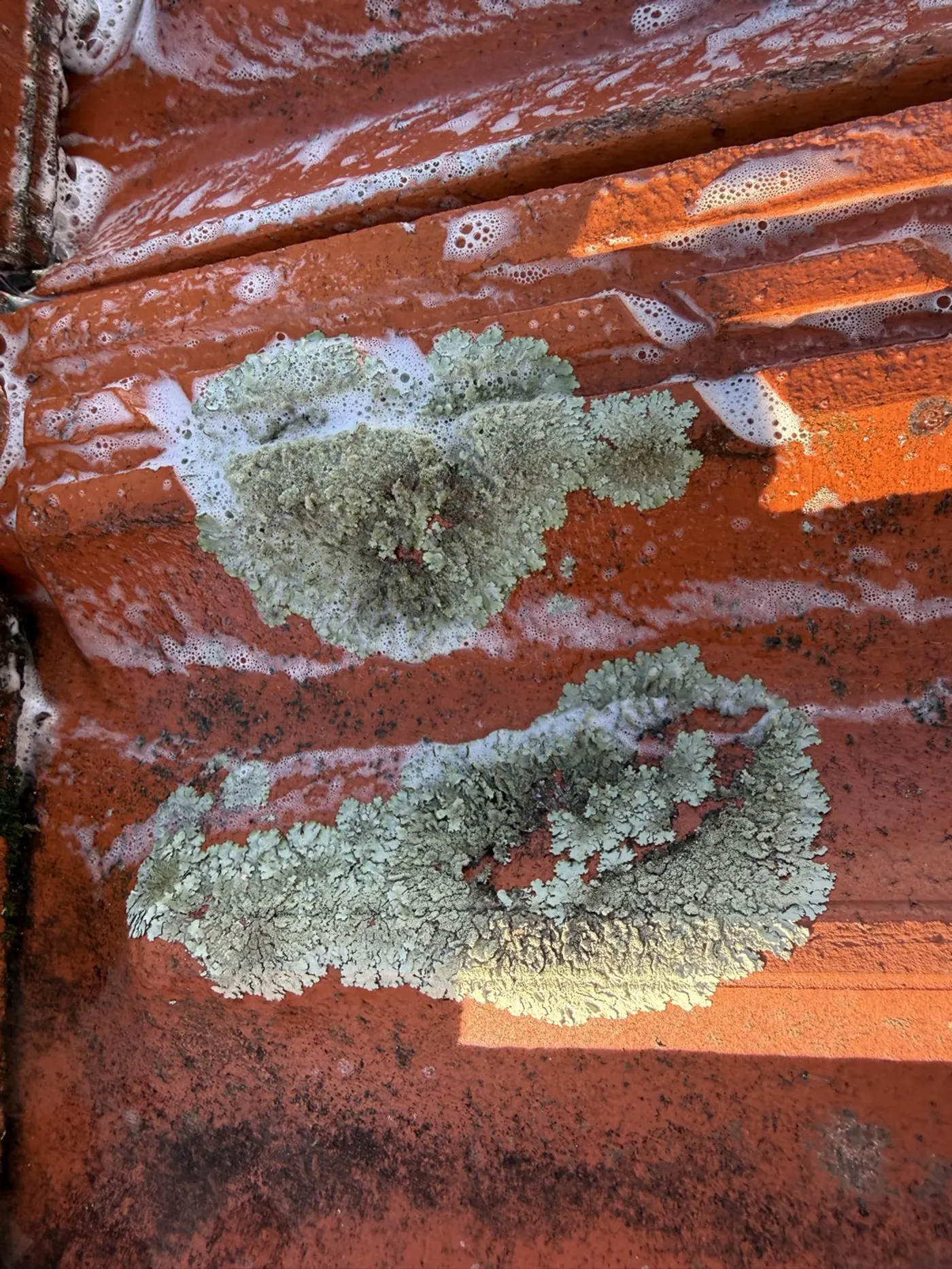
The shaded part evens out
A colony covers the patch it sits on. For as long as it is there, that patch is out of the direct sun, rain and grime that the rest of the roof is taking.
What the rest of the roof goes through depends on the tile. Monier, which makes roof tiles, says that over several years the colour coat on concrete tiles takes on a more subdued, matt look from UV light and air pollution, while terracotta colour is baked into the tile and does not fade.4 So on concrete, a patch that was covered has seen less of that ageing and can show brighter than the tile around it. On terracotta the colour holds, and the difference is in what the open surface has collected over the years: the dust, soot and other particles that settle on a roof out of the air.5
Once the lichen has gone, the patch is open to the same sun, rain and grime as everything around it, and the difference closes as it catches up.
In plain terms Take down a picture that has hung on a wall for ten years and the paint behind it looks newer than the rest. It missed ten years of light, and left uncovered it catches up.
The etched part stays
The second thing a lichen does is work its way into the surface. A crust lichen's threads, its hyphae, grow down into whatever it sits on, and many leafy lichens are held down by rhizines, bundles of those threads that penetrate the surface and anchor them.1 On clay roof tiles aged six to ten years, electron microscopy found lichen hyphae penetrating the tiles and filling their fissures and cracks.6
Then there is the acid. The same researchers traced the way lichens act on ceramic to oxalic acid, the acid lichens make. In their lab tests it changed the texture of the ceramic and formed whewellite, a crystal of calcium oxalate they describe as destructive, and they concluded that this acid action can deteriorate the ceramic and age roofing tiles.6
Where that has happened the surface itself has changed, and weather does not put it back. When a colony first comes away, the shaded part and the etched part can look alike. Time sorts them: what evens out was shade, and what stays was etched. The full case is in does lichen damage roof tiles, and the mechanism in what growth does to a roof.
In plain terms Think of a chopping board. Wash it and the stain lifts. The knife marks stay.
A ghost means the treatment worked
A treatment ends the lichen where it sits. It does not take it off. Yates says it plainly about its Surrender moss product, which it labels for roofs: it "kills lichens on roofs but does not remove them", and they can be left to weathering.7 The dead crust loosens, and the weather carries it off. Growth starts to come away over 3 to 18 months, and a ghost can only show once a colony has gone. How that works is in how roof treatment works and why dead lichen stays on the roof.
So a ghost is proof of two things: that the colony was there, and that it has gone. That is why our guarantee is written the way it is. When we treat a roof with UNGROW Bailiff, we photograph it on the day from a fixed position. If at twelve months it looks the same as that photo, we treat it again, free. A roof with ghosts on it does not look the same as that photo. What the months in between look like is in a treated roof, month by month.
Dark films behave differently from lichen. Roofing research traces the dark stains on light coloured roofs to the build up of dead colonies of cyanobacteria5: the dead film is itself the colour. So a roof that was black with a film lightens as the rain carries the dead film away. See what is the black stuff on my roof.
What not to do is take a pressure cleaner to the ghosts. Monier strongly advises against pressure washers for roof cleaning, and says they pose a significant risk of tile damage.8 Marley, which makes roof tiles in the UK, says a high powered jet wash "can damage the surface of the slate or tile, thus reducing its expected life considerably".9 And to even out a mark on part of a tile, a pressure cleaner works over all of it. More in does pressure cleaning damage roof tiles.
In plain terms A ghost is a receipt. It shows what was there, and that it has been dealt with.
A ghost dates the decision
Because lichen spreads so slowly, the size of a ghost is a record of time. Even at the 1 to 5 mm a year of the leafy kinds, a ghost the width of a 50 cent coin marks a colony that sat on that spot for years, and a crust lichen is slower still.3, 2 Every year a colony stays, its footprint is a little wider, and so is the patch its threads and acid have worked on. More in how fast lichen grows.
That is the case for dealing with lichen sooner: the longer it sits, the more of the roof carries an etch that can stay. It is worth knowing before a roof is treated, not after, because a ghost met for the first time at the twelve month check looks like a failure. It is the opposite.
In plain terms The ghost is the bill for the years the lichen was there. Dealing with it early keeps the bill small.
What this means for your roof
Every lichen colony on your roof is working its threads and acid into the patch under it, and that patch widens every year the colony stays. Treating it with Bailiff from the roofline ends the colony where it sits and leaves the weather to carry it off, with no blast across the tile. The shaded part of the ghost then evens out, and the sooner the colony is treated, the smaller the etch it leaves behind.
Also asked
What are lichen stains?
Usually one of two things. The first is the lichen itself. A crust lichen grows flat, anchored so tightly to the tile that it reads as a stain, not a living thing, while its threads work into the surface under it. The second is the ghost mark it leaves once it has gone. The part it only shaded evens out with the weather. The part its threads and acid etched can stay. Clearing the first is in how do you get rid of lichen on roof tiles.
How do I remove lichen stains from my roof?
Treat the lichen, and let the weather do the rest. Where the lichen only shaded the tile, the patch evens out as it weathers along with the rest of the roof. Where it etched the surface, that texture is part of the tile now, and treating lichen early is what keeps that footprint small. Leave the pressure cleaner out of it. Marley, which makes roof tiles, says a high powered jet wash "can damage the surface of the slate or tile", and it works over the whole tile to even out a mark on part of it.
Does a ghost mark mean the treatment did not work?
The opposite. A ghost can only show once the lichen has gone, and on a treated roof the lichen goes once it has died and the weather has carried it off. When we treat a roof with UNGROW Bailiff, we photograph it on the day, and our guarantee is that if at twelve months it looks the same as that photo, we treat it again, free. A roof with ghosts on it no longer looks like that photo.
How long do ghost marks take to even out?
The shaded part follows the weather. Once the lichen has gone, that patch takes the same sun, rain and settling grime as the tile around it, and it closes the gap as it catches up. A patch that was covered for years has years of weather to catch up on, so it evens out gradually, not overnight. The etched part may not even out at all, which is why it pays to treat lichen while its footprint is small.
Do moss, algae and mould leave ghost marks too?
Lichen leaves the clearest ones, because a crust lichen is fixed flat to one spot for years and works its threads and acid into that spot. A dark film behaves differently. The dark stain is the build up of the dead colonies themselves, so a treated film stays dark for a while and lightens as the rain carries the dead film off.
On the record
- Australian National Botanic Gardens, Lichen form and structure
- Geografiska Annaler: Series A, Physical Geography, Growth of crustose lichens: a review (2010)
- NERC Open Research Archive, Growth of foliose lichens: a review
- Monier, FAQs
- Lawrence Berkeley National Laboratory, Weathering of Roofing Materials: An Overview
- Scanning, Evaluation of the effect of lichens on ceramic roofing tiles by scanning electron microscopy and energy-dispersive spectroscopy analyses (2005)
- Yates, Yates Surrender Moss Killer
- Monier, Roof cleaning and maintenance
- Marley (UK), Can I clean or jet wash my roof tiles?