The ruling
Real damage, to the tile and to the drainage, which is why growth is treated where it sits. Lichen anchors its threads into the tile and its oxalic acid etches the surface. Moss holds water against the tiles and packs the valleys, laps and gutters. A treatment left to soak in ends the growth without taking any surface off.
Growth damages a roof three ways
Ask the people who make roof tiles. Wienerberger, a tile maker, asks in its own cleaning guide whether moss damages roof tiles, and answers "In short, yes."1 Marley says moss, algae and lichen growth "can trap moisture and cause roof tiles to degrade over time".2 The Australian Roofing Tile Association lists moss and lichen among the causes of fretting in older clay tiles, where the tile wears away into fine dust: "These organisms can retain moisture and may damage the tile over time."3
The microscope agrees. On clay roof tiles, electron microscopy found lichen threads inside the tile, filling its fissures and cracks.4 The full case for lichen is in does lichen damage roof tiles.
Growth works on a roof three ways. Lichen and biofilm work into the tile's surface. Moss holds water against the tile long after the rest of the roof has dried. And growth chokes the valleys, laps and gutters that carry water off the roof. Then the usual way of getting it off, a pressure washer, takes surface with it.
In plain terms A roof is a drainage system as much as a covering, and growth works on both at once.
Moss holds water against the tile
Moss has no true roots. Its rhizoids anchor it, and it takes in water over its surface instead.5 Mosses hold from a few times to many times their own weight in water, soak it up quickly and let it go slowly.6 A cushion on a tile is a reservoir, still wet long after the bare tile beside it has dried. Wienerberger spells out what that does: tiles covered in moss stay damp, and clay tiles kept damp are more prone to delamination, where the clay surface separates from the body of the tile.1
That water feeds everything else on the roof. Moisture and time of wetness, the length of time a surface stays wet, are crucial for biological growth on it.7 Moss also traps soil and debris and holds moisture.8 The film beneath it is built around water too: the metabolism of a subaerial biofilm centres on holding water9, and on roof tiles these films promote the settlement of mosses.10 The film brings the moss, and the moss keeps the film wet.

In plain terms A wet sponge left on a benchtop. The bench under it stays wet long after the rest has dried, and anything that likes damp moves in underneath.
Lichen and biofilm work into the surface
Lichen works on the tile itself, and it starts by anchoring. A crust lichen sends threads down into the surface and binds so tightly that its underside cannot be seen; the leafy kinds anchor with rhizines, bundles of threads that penetrate the surface.11 Those threads are hyphae. On clay roof tiles six to ten years old, scanning electron microscopy showed lichen hyphae penetrating the tile and filling its fissures and cracks.4 A review of the research names hyphal penetration as one of the most important ways lichens do mechanical damage, to natural rock and building stone alike, and on building mortar the threads and the lichen's fruiting bodies form pits in the surface.12
Once anchored, the lichen levers. Rhizines growing into fissures press on the material around them, and so does the wetting and drying of a lichen bound tightly to it.13 The inner layer of a lichen holds up to three times its own dry weight in water, so with every rain and every dry spell it swells and shrinks inside whatever it has grown into. In a wetting and drying experiment on limestone, the underside of the lichen came away carrying fragments of the rock in its threads, plucked from the surface as the lichen shrank. In central Italy, that swelling and shrinking, with other physical action, can cause visible mechanical damage to stonework in ten years or less.12

In plain terms A weed in a paving crack. It gets in through the crack, swells every time it rains, and widens the crack a little every year it is left there.
Then there is the acid. Lichens produce compounds that weather rock13, and the one that matters most is oxalic acid: lichen fungi excrete it, and it dissolves minerals and binds the metals it frees.12 On ceramic roof tile materials in the laboratory, oxalic acid changed the texture of the ceramic and formed whewellite, a calcium oxalate crystal the researchers call destructive. They identified the lichen's attack on the tile as chemistry driven by oxalic acid, which they link to deterioration of the ceramic body and the ageing of roof tiles.4
Concrete tiles get the lime loving lichens. Concrete is alkaline, so the lichens that grow on limestone also grow on concrete roof tiles.14 Rock rich in lime suffers much more severe lichen weathering than other rock: on limestone and dolomite, four lichen species studied all dissolved the calcite with oxalic acid, and under the strongest of them the calcite was completely gone where lichen met rock. On building mortar the attack shows on the surface and inside it, as micropitting and etching.12
In plain terms The acid is the same one that is in rhubarb leaves, made a little at a time, right against the tile, for every year the lichen lives there.
The film works too, more quietly. Biofilms on open mineral surfaces change the material chemically and physically and penetrate into it, contributing to rock and mineral decay9, and on roof tiles their metabolism profoundly alters the tile's composition.10
Crust lichens are the slowest growing lichens of all15, but slow growth is not slow damage. On rock in southern Norway, the surface under one lichen was estimated to be wearing down 25 to 50 times faster than by other weathering in the same area, and granite on a modern building finished only four years earlier was already showing deterioration caused by lichen.12
Valleys, gutters and laps: where the water goes
A tiled roof sheds water in stages. Single lap tiles, which include concrete interlocking tiles, rely on side interlocks with drainage channels built into them to carry water away.16 Monier lists blocked gutters, downpipes and valleys as common sources of leaks, and says to clear them at least once a year, more often where the roof is surrounded by trees.17
Each stage can be choked:
- The interlocks. Monier names blocked drainage channels under the sidelaps of tiles among the usual causes of leaks, and says any build up of dirt or debris should be removed.18 Marley, a tile maker, warns that when interlock channels flood, water gets in, and that the risk is highest on low pitched roofs, where water drains away more slowly.19 Wienerberger says moss grows within the joints and interlocks of tiles, where it can block the channels and let water through to the sub-roof.1
- The valleys. A valley is where two roof planes meet, so it carries the water of both. Monier names blocked valleys alongside gutters and downpipes as common sources of leaks.17
- The gutters. Water a gutter cannot carry flows back over into the eaves, and from there into the walls and ceilings, as Queensland's building resilience guidance puts it. Over time, the same guidance says, water flowing over the back of a gutter can cause structural damage, with rot in timber and corrosion in metal.20
- The ridge. Moss thrives on mortar, Wienerberger says, and grows heavily around ridge tiles, where it "can cause damage and cracking in the mortar as it penetrates the cement".1 Monier names cracked or broken mortar bedding under the ridge capping among the usual causes of leaks.18

Growth feeds every one of these. Moss traps soil and debris.8 Monier says moss and lichen spores settle where moisture and dirt accumulate.17 On a tiled roof that means the joints, the lower edges and the valleys, the water's own path, as in the photograph below. Whatever takes up room in a channel takes it from the water.
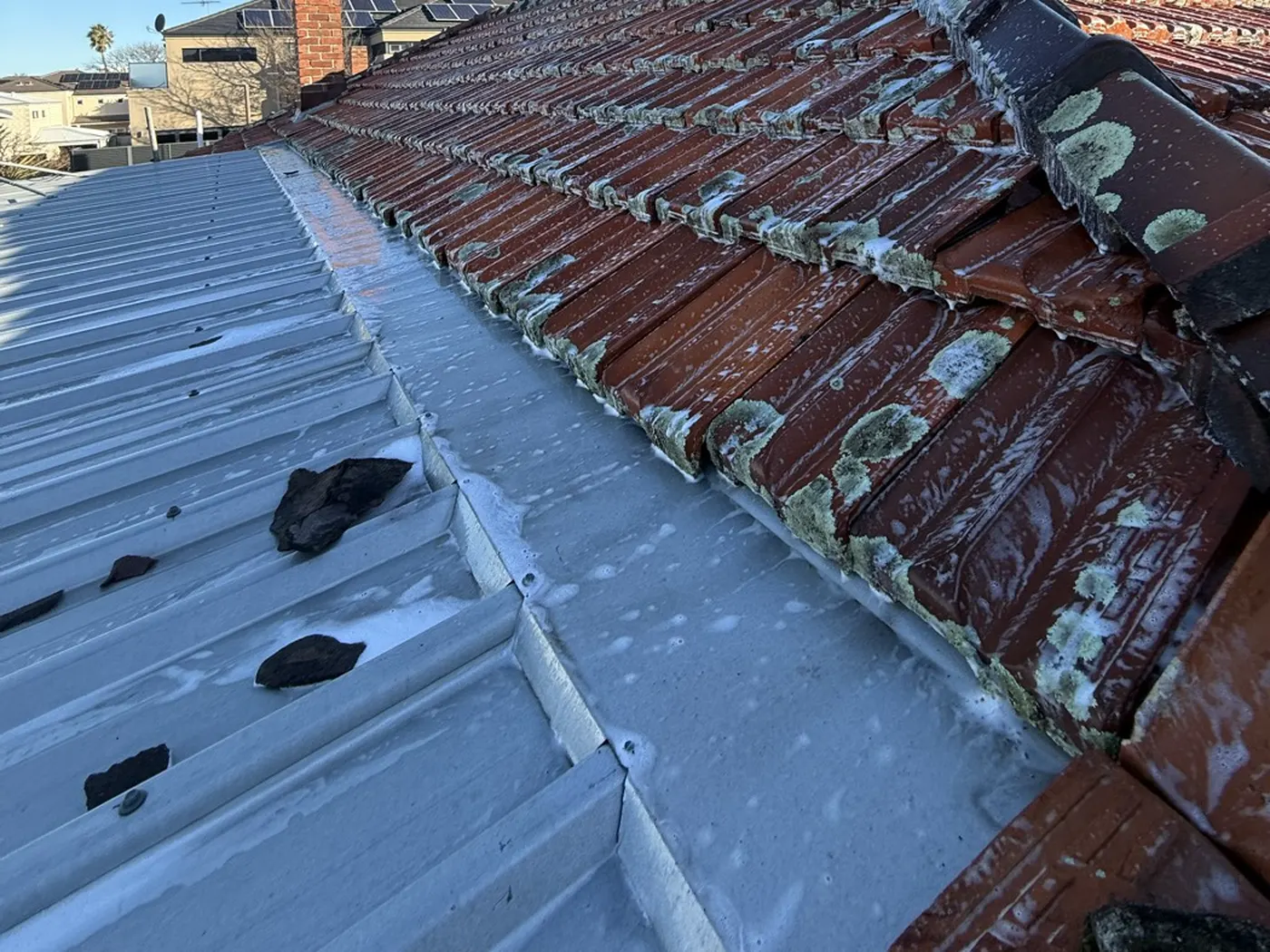
In plain terms A shower with a hair-clogged drain. The shower itself is fine; it is the bathroom floor that floods.
Stained, roughened and easier to colonise
Growth changes how a roof looks before it changes how it works. Mature biofilms become pigmented and show as black or green spots.10 Where lichen has etched the tile, its outline can stay after the growth has gone, as a ghost mark.
The colour on a concrete tile is a coating. Monier says it fades and weathers over time under sun and air pollution, while terracotta's colour is fired into the tile.18 A pressure washer can take that coating off: Wienerberger says the forceful spray of a high pressure jet washer can damage the tile finish and strip away colour from concrete tiles.1
The bigger effect is on the next generation. In cement based materials, how fast algae foul a surface is governed by its roughness and porosity.21 Roughness gives cells more area to anchor to, holds water and nutrients, and shelters a biofilm from wind and running water.7 Weathered rock is more inhabitable for lichens than freshly exposed rock.12 Researchers call how readily a surface is colonised its bioreceptivity, and it changes with time: weathering, by organisms or by the elements, turns a surface's original bioreceptivity into a secondary one. Cleaning that changes the surface physically changes it again, and several studies have found recolonisation after cleaning runs faster than the first colonisation did.22

That is the strongest scientific reason not to blast growth off a roof. Monier "strongly advises against the use of pressure washers for roof cleaning"17, and Marley says high powered jet washing "can damage the surface of the slate or tile, thus reducing its expected life considerably".23 A surface roughened by cleaning is a better home for whatever lands next. More in does pressure cleaning damage roof tiles.
In plain terms A scratched non-stick pan. Once the surface is roughed up, everything sticks to it faster, and scrubbing harder only scratches it more.
What matters most on a real roof
Put together, the priorities run in this order.
- Keep the water moving. Monier names blocked gutters, valleys and the drainage channels under tile sidelaps as common causes of leaks.17, 18 That is where growth turns into a repair bill. More in moss in gutters and valleys.
- Keep the surface on the tile. A rougher tile grows the next crop faster.21 Removal that takes surface with the growth trades one problem for a faster version of the same one.
- End the growth where it sits, and let the weather remove it. Yates says of its own roof product that it "kills lichens on roofs but does not remove them", and that the dead growth can be left to weathering.24 That takes no surface off with it. The options are compared in every way to clean a roof.
- Sooner is better than later. Lichens can cause "appreciable weathering in a relatively short time"13, and the damage to the surface builds for as long as the growth stays.
What this means for your roof
Every year growth stays, lichen works further into the tiles and moss packs more of the valleys, laps and gutters. Treating it where it sits ends both without taking any surface off. We treat it with UNGROW Bailiff, applied from the roofline with a low pressure soft wash pump through non-directional nozzles, so nothing is blasted off the tile or forced under the laps, and the weather carries the dead growth away. Growth recurs, and a tile the lichen has already etched gives the next spores a better foothold, so UNGROW Sentry, our preventative, keeps the roof treated after that.
Also asked
Does moss damage roof tiles?
Yes. Wienerberger, who make roof tiles, ask that question in their own cleaning guide and answer it with "In short, yes." Moss soaks up water and holds it long after the rain stops, so the tiles beneath stay damp, and clay tiles kept damp are more prone to their surface separating from the body of the tile. Moss also grows into the joints and interlocks, where it blocks the channels that carry water off the roof.
Does lichen just sit on the surface of a tile?
No. A crust lichen sends threads down into the tile and anchors so tightly that its underside cannot be seen. Under the electron microscope, clay roof tiles six to ten years old showed lichen threads penetrating the tile and filling its fissures and cracks. In the same study, oxalic acid, the acid lichen makes, changed the texture of roof tile ceramic and formed calcium oxalate crystals the researchers call destructive.
Can moss make a roof leak?
Yes. Monier names blocked gutters, valley gutters and downpipes, and blocked drainage channels under the sidelaps of tiles, among the usual causes of roof leaks. Moss, and the soil and debris it traps, sits in exactly those places. Wienerberger warns that moss growing in the interlocks of tiles can block their channels and let water through to the roof beneath.
Will the stains go once the growth has died?
Most of the colour goes with the growth. Dead lichen and moss loosen and weather off over the months that follow. Where lichen etched the surface, the mark can stay, in the outline of the old patch. The longer growth sits on a tile, the more of the tile carries that mark, which is the case for treating it sooner rather than later.
Does pressure cleaning make growth come back faster?
Yes. Cleaning that roughens a surface gives the next crop a better start. In cement based materials, how fast algae foul a surface is governed by its roughness and porosity, and studies of cleaned building surfaces found recolonisation ran faster after cleaning than the first colonisation did. Monier strongly advises against pressure washers on roofs, and Wienerberger says the spray can damage the tile finish and strip the colour from concrete tiles.
On the record
- Wienerberger UK, How to Clean Roof Tiles
- Marley (UK), Roof tile maintenance: a homeowner's guide (2022)
- Australian Roofing Tile Association, Fretting in Clay Roof Tiles: A Consumer's Guide (2024)
- Scanning, Evaluation of the effect of lichens on ceramic roofing tiles by scanning electron microscopy and energy-dispersive spectroscopy analyses (2005)
- Australian National Botanic Gardens, What is a bryophyte?
- Australian National Botanic Gardens, Bryophyte ecology
- Journal of Building Engineering, Bioreceptivity of concrete: A review (2023)
- Oregon State University Extension Service, How to control roof moss and prevent long-term damage
- Environmental Microbiology, Life on the rocks (2007)
- Microorganisms, Methyl Potassium Siliconate and Siloxane Inhibit the Formation of Multispecies Biofilms on Ceramic Roof Tiles: Efficiency and Comparison of Two Common Water Repellents (2021)
- Australian National Botanic Gardens, Lichen form and structure
- Catena, Weathering of rocks induced by lichen colonization: a review (2000)
- Australian National Botanic Gardens, Lichen ecology
- Australian National Botanic Gardens, Lichen habitats
- Geografiska Annaler: Series A, Physical Geography, Growth of crustose lichens: a review (2010)
- Wienerberger UK, Single Lap
- Monier, Roof cleaning and maintenance
- Monier, FAQs
- Marley, Can Flat Interlocking Tiles Be Installed Straight Bonded? (2016)
- Queensland Government (Strata Resilience Program), Install overflows in eaves or box gutters (2025)
- The Science of the total environment, Bioreceptivity evaluation of cementitious materials designed to stimulate biological growth (2014)
- Science of The Total Environment, Revisiting and reanalysing the concept of bioreceptivity 25 years on (2021)
- Marley (UK), Can I clean or jet wash my roof tiles?
- Yates, Yates Surrender Moss Killer