 Lichen
The ruling
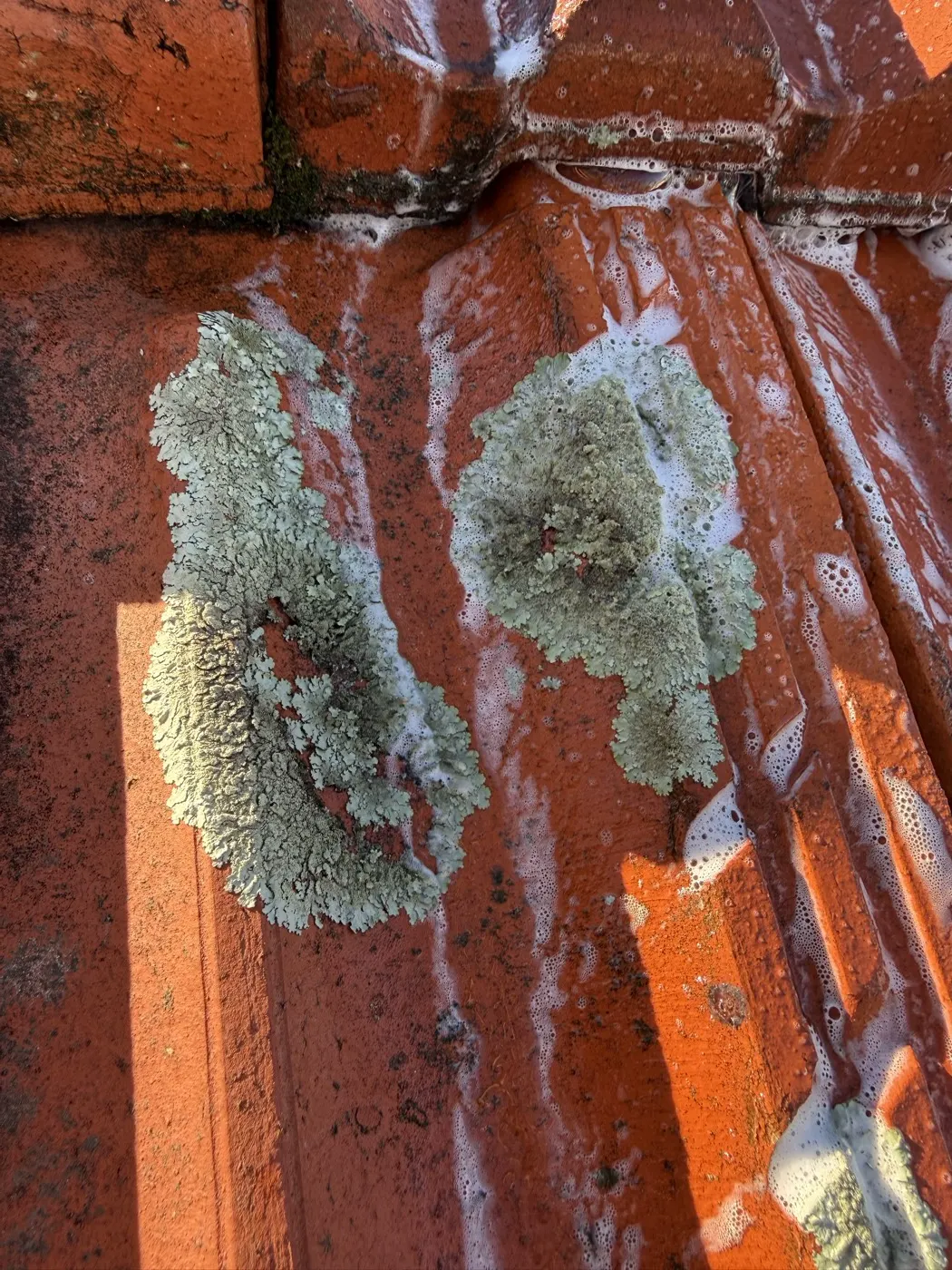
Because dying does not let go. A crust lichen is anchored by its whole underside, with threads grown into the tile. Treatment ends it where it sits, and with it the acid that etches the tile. The dead crust stays put while the weather breaks it down and washes it off over the following months. That is the treatment working.
How a crust lichen holds on
The flat, crusty lichen on a roof is crustose. The Australian National Botanic Gardens describes crustose lichens as firmly attached to the surface by their entire lower surfaces, so the underside can never be seen, and notes that they lack a lower cortex, the skin that leafy lichens have underneath.1 Some go further still: an endosubstratal body develops inside the surface, in finely fissured wood and porous rock, and from above often shows as little more than a slight discolouration.2
On clay roof tiles, the electron microscope shows it directly. Researchers at the University of Novi Sad examined tiles six to ten years old and found lichen hyphae penetrating the tile and filling its fissures and cracks.3 The leafy kinds hold on by rhizines, root-like bundles of threads that anchor them to the surface1, and on rock, rhizines grow into the fissures and press on the stone around them.4
In plain terms A crust lichen is less like a sticker on the tile and more like a stain that has grown roots. There is no edge to lift.
What treatment does, and what it does not
Treatment works on living cells. Quaternary ammonium compounds such as benzalkonium chloride, the active in UNGROW Bailiff, soak into the cell wall, disorganise the membrane beneath and make the cell leak.5 In a laboratory study on the lichen Evernia prunastri, benzalkonium chloride built up in the lichen and held there for the 21 days measured, and it severely impaired the lichen's photosynthesis with no recovery over time.6 The photobiont is the partner that makes the lichen's food, so that is the end of the partnership.
What treatment does not do is pull the threads back out. Yates puts it in one line about its own moss and lichen concentrate: it "kills lichens on roofs but does not remove them", and the dead lichen can be left to weathering or removed by hand a couple of weeks later.7
In plain terms Think of tent pegs left in the ground after the tent has come down. Nothing is pulling on them any more, but they stay exactly where they are until the ground around them gives.
What breaks it down
The weather does. A dead lichen decays where it sits.4 Wet & Forget, whose product works on the same principle, says it "works with the weather to decompose the growth over time", and puts lichen at 8 to 12 months to decompose.8 On the roofs we treat with Bailiff, growth starts coming away over 3 to 18 months. On a Perth roof, three parts of the weather do most of the work.
- Wetting and drying. Treatment does not stop the weather. A dead crust is soaked by every shower and dried out by every warm afternoon, and it decays as it goes.
- Heat and dry. Many lichens are brittle when dry and easily broken into fragments.1 Perth Metro averages daytime highs above 31 °C in January and February9, and a summer roof is about as dry and brittle as a crust gets.
- Rain. Rain carries off what has loosened. More than three quarters of Perth's rain falls from May to September9, so the wet months do most of the carrying.
In plain terms It goes the way an old poster goes on an outdoor wall. The sun bakes it brittle, the showers soften it, the next downpour takes another piece. No single day moves it. Months of weather do.
Why not just scrape it off?
Because there is nothing to get a blade under. A crust lichen is attached by its whole underside1, and on clay roof tiles the electron microscope found its threads inside the tile's fissures, not sitting on top of them.3 To get at threads inside a tile, a blade has to go into the tile.
Hand removal also means someone on the roof. Monier, which makes roof tiles, says "even walking on a tiled roof can risk damaging tiles", and it "strongly advises against the use of pressure washers for roof cleaning" because of the significant risk of tile damage.10 More on that in why nobody needs to walk on your roof.
Yates gives two ways to finish the job: leave the dead lichen to weathering, or remove it by hand a couple of weeks after treatment.7 On a footpath, either works. On a roof, only weathering keeps everyone off the tiles and every blade out of the surface.
In plain terms It is peeling a label off cardboard. To get every last bit of the glue, you take the top layer of card with it.
What you see while it goes
On the roofs we treat, lichen goes chalky and loses its colour before it lets go, and it lets go unevenly, patch by patch. Where a colony has come away, its shape can stay behind, lighter or rougher than the tile around it.
That shape has two parts. One is the patch the lichen shaded from years of sun and weather, and it evens out as the tile weathers to match. The other is where the lichen's acid worked on the tile. Research on clay roof tiles traced the lichen's attack to its oxalic acid, named the calcium oxalate crystal it forms, whewellite, a destructive crystal phase, and linked the reactions to the deterioration and ageing of the tile.3 That part stays. It is a ghost mark: evidence of what the lichen was doing, not a patch that was missed. If you are not sure whether what you are looking at is still alive, start with is the lichen on my roof alive or dead?
What this means for your roof
Dead lichen staying put is the treatment working: the lichen has been ended where it sits, its acid has stopped, and the weather is taking it off a piece at a time. We apply Bailiff from the roofline with a low pressure soft wash pump through non-directional nozzles, so nothing is scraped, blasted or forced under the tiles, and nobody walks on them. The sooner it is treated, the less of the tile carries the etch.
Also asked
If it is still there, how do I know it is dead?
By its colour. Dead lichen stays put for months, so being there is not the test. On the roofs we treat, lichen goes chalky and pale before it lets go, and it lets go a patch at a time rather than all at once.
Can I brush it off once it is dead?
On a path, yes. On a roof, brushing means standing on the tiles, and Monier, which makes roof tiles, warns that even walking on a tiled roof can risk damaging tiles. Brushing a crust also rubs at the surface it is anchored in. The weather does the same job over the months that follow, with nobody up there.
Does dead lichen keep damaging the roof?
Its acid attack ends with it. The oxalic acid that etches a tile is made by the living lichen, so once treatment has ended it, no new etching starts. What it already etched can stay, which is why the shape of an old colony can still show after the crust has gone. The dead crust itself is on its way off: the weather breaks it down and the rain carries it away.
Why has some of it gone and some of it not?
Each patch clears at its own pace. Every patch is its own age and thickness, on a face with its own share of sun and rain, and the weather works each one loose on its own schedule. Uneven clearing is normal, and it is not a sign that a patch was missed.
On the record
- Australian National Botanic Gardens, What is a lichen?
- Australian National Botanic Gardens, Crustose lichens
- Scanning, Evaluation of the effect of lichens on ceramic roofing tiles by scanning electron microscopy and energy-dispersive spectroscopy analyses (2005)
- Australian National Botanic Gardens, Lichen ecology
- Clinical Microbiology Reviews (PMC), Antiseptics and disinfectants: activity, action, and resistance (1999)
- Stresses, Accumulation and Phytotoxicity of Two Commercial Biocides in the Lichen Evernia prunastri and the Moss Brachythecium sp. (2021)
- Yates, Yates Surrender Moss Killer
- Wet & Forget Australia, Roof cleaning information
- Bureau of Meteorology, Climate statistics for Australian locations: Perth Metro (009225)
- Monier, Roof cleaning and maintenance