 Lichen
The ruling
Almost certainly alive, unless it has been treated. Dry lichen shuts down and looks grey and lifeless all summer. When the rain returns it greens up and goes back to work on the tile, anchored into it. Treated lichen stops answering the rain: it fades, bleaches or darkens, and stays put for months until the weather carries it off.
Grey and dry is not dead
A lichen has no roots and no way of holding water in. It takes up water and nutrients straight through its surface, from rain and the air.1, 2 Its water content rises and falls with the weather, which is what poikilohydric means, and it is only active while it is wet. Dry, it shuts down. A dry lichen survives temperatures of 65 to 70 °C that would end it if it were wet.3
Perth gets about 77 per cent of its rain between May and September.4 So through most of a Perth summer, the lichen on a roof spends its days dry, grey, stiff and switched off, and looks it.
In plain terms A dried out kitchen sponge is hard, pale and looks finished. Run it under the tap and it is a sponge again. Summer lichen is the same.
That is why alive matters. When the rain comes back, the lichen goes back to work on the tile right where it left off. Researchers at the University of Novi Sad, studying lichen on ceramic roof tiles, identified what goes on between lichen and ceramic as oxalic acid at work, linked it to the deterioration of the ceramic and the ageing of the tile, and named the calcium oxalate crystal it forms, whewellite, the "destructive crystal phase".5 Every wet season a living lichen spends on a roof is another season of that.
How living lichen answers the rain
The body of a lichen has a skin, the cortex, made of tightly packed fungal threads. Under it sits a layer of the photobiont, the partner that photosynthesises: green if it is an alga, blue green if it is a cyanobacterium.6 When a lichen is dry, the cortex is usually grey or the colour of the fungus. When it is wet, the cortex turns translucent and the colour underneath shows through.1 Lichens with a strongly pigmented fungus, such as the brightly coloured crusts on concrete tiles,7 change less, because the fungus's own colour still shows.1
That is the most useful test there is from the ground. Look at the same patch on a dry afternoon and again on a wet morning. A living grey green lichen goes greener and softer looking. Leafy kinds also show where they are growing: new growth happens at the tips of the lobes around the edge.8
In plain terms A frosted bathroom window goes clear when it is wet. A lichen's skin does the same, and the green behind it shows.
What dead lichen looks like
There is no single look. Sarah Jovan, a lichen specialist with the US Forest Service, puts it plainly: the colour of dead lichen tissue "can be many colors, black, gray, white, or a much darker shade of the lichen's color while alive", and in hot, dry places a white or yellow bleached look is common.9 Tom Carlberg of the California Lichen Society looks for parts of the lichen coloured differently from the rest, especially yellow, blackish or yellow brown in a lichen that was never those colours.9
The tell that matters is change over time. Living lichen keeps answering the rain. A patch that fades, bleaches or darkens, and no longer brightens when it is wet, is dying or dead. Researchers who test treatments on lichen confirm it in the lab: they measure the chlorophyll's fluorescence and stain for dead cells under a microscope.3 From the ground, the rain is your test.
In plain terms A dead pot plant in a dark corner can pass for alive for a week. A dead lichen can keep up the act for months.
What treated lichen does next
On the day of treatment, nothing changes that you can see from the street. The roof is wet with treatment and the lichen looks exactly as it did that morning.
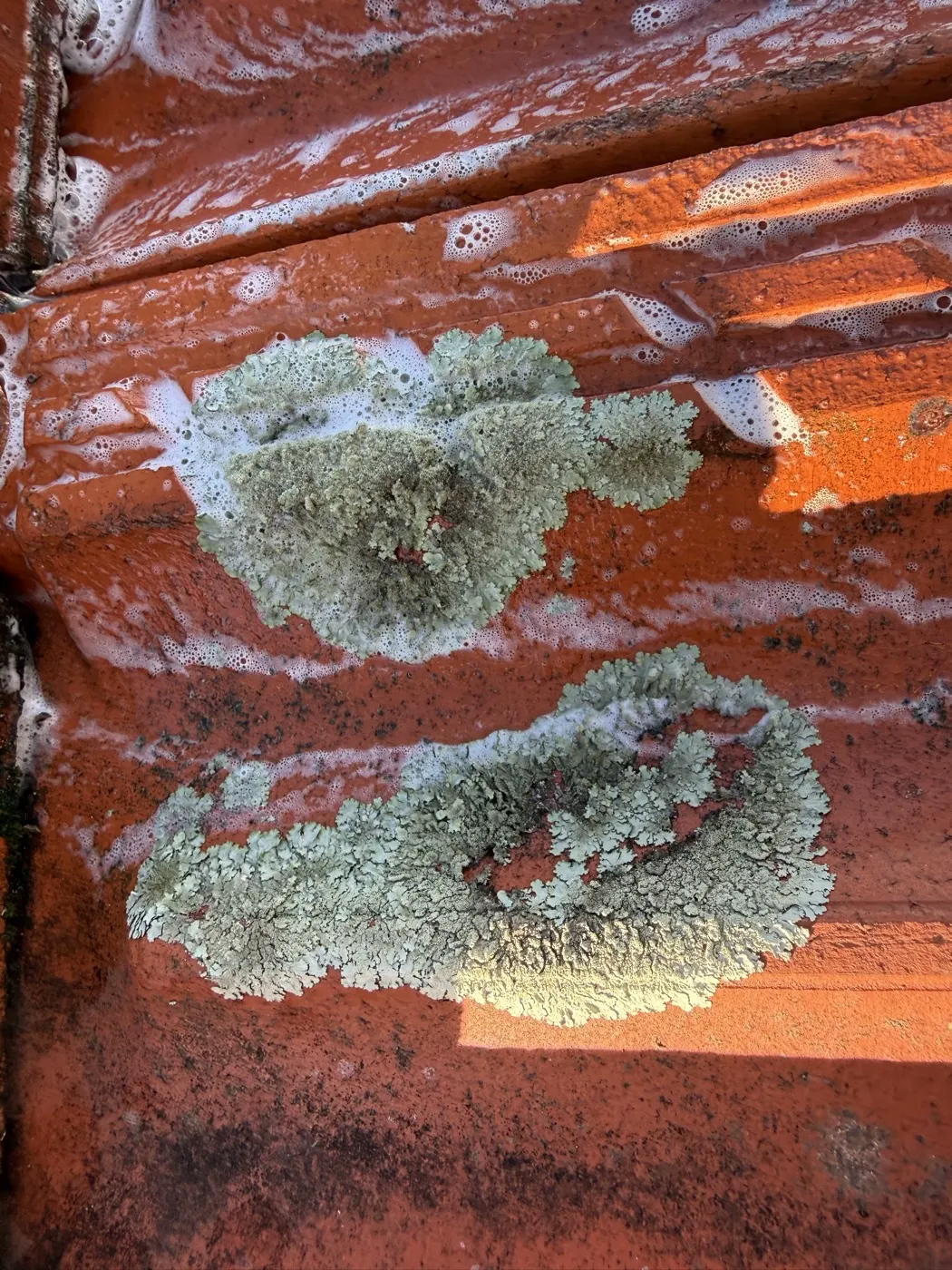
Then it changes slowly. The makers of 30 Seconds, a retail roof treatment, say some lichen, moss, mould and algae may take up to 6 to 8 weeks to show any sign of decay, and that some growth turns orange before it washes away.10 After that comes the fading and bleaching, then the loosening. On the roofs we treat with UNGROW Bailiff, our treatment, growth starts coming away over 3 to 18 months, and the rain sets the pace. The detail is in what a treated roof looks like, month by month.
In plain terms Spray a weed in a paved path and it sits there brown for weeks before it lets go of the crack. Lichen is slower still.
Why the dead crust stays put
A crust lichen is bound so tightly to the surface that its underside is never visible, and its fungal threads, the hyphae, grow down from it into the material and anchor it there. Leafy lichens anchor with rhizines, bundles of those threads that penetrate the surface.6 On clay roof tiles six to ten years old, electron microscopy found lichen threads penetrating the tile and filling its fissures and cracks.5 When the lichen dies, the anchors do not pull themselves out. They stay where they are until they rot and weather away.
That takes a while: in a Chilean forest, fallen leafy lichens took 1 to 3 years to decay.2 The product makers say the same about roofs. In Yates's own words, "Yates Surrender Moss Killer Concentrate kills lichens on roofs but does not remove them".11 Wet & Forget says lichen "will take 8-12 months to decompose".12 Why that is, and why waiting beats scraping, is its own file: why dead lichen stays on the roof.
In plain terms A fence post set in concrete does not fall over the day the timber dies. It stands there until it rots through.
Check from the ground, not the roof
Climbing up to prod it tells you little, because many lichens are brittle when dry13, living or dead, and it puts you and the tiles at risk. Monier, who make roof tiles, recommend against cleaning your own roof tiles because of the risk of falls and tile damage.14 Scraping is worse. A crust has no edge to get a blade under, and on clay tiles its threads sit inside the tile's fissures and cracks5, so a blade works against the tile surface the lichen is bound into and cannot reach the threads inside it. Blasting it off is no better: Monier "strongly advises against the use of pressure washers for roof cleaning".14 That is why we explain in does lichen damage roof tiles that treating it in place is the better route. A phone camera zoomed in from the yard, once dry and once after rain, tells you more than a ladder will.
In plain terms You check a lawn for life by watching it after rain, not by digging it up.
What this means for your roof
Grey lichen on an untreated roof is almost always alive, and every winter it wakes up anchored in the tile and back at work on it. Bailiff ends it where it sits: we apply it from the roofline with a low pressure soft wash pump through non-directional nozzles, covering every face, so nothing is scraped or blasted off the tile, and we photograph the roof on the day to check it against that photo at twelve months. The weather then carries the dead crust away. Growth recurs, so UNGROW Sentry, our preventative, keeps the roof treated after that.
Also asked
Does lichen die off in summer?
No. It dries out and shuts down. A lichen's water content follows the weather, and a dry lichen can sit out heat that would end a wet one. Through a Perth summer it looks grey, stiff and finished. With the first winter rains it takes up water and carries on where it left off, still anchored in the tile.
Why is the lichen on my roof turning white?
If the roof has been treated, bleaching is one of the ways dying lichen shows it, along with fading and darkening. If it has not been treated, look again at the edge and the texture. A flat white crust with a defined edge is most likely a pale lichen. A flat, even whitish film with no edge is often efflorescence, salt from the concrete itself.
Can I tell by touching it?
Not reliably. Living lichen is stiff and brittle when it is dry, exactly like dead lichen, and a crust has no edge to lift either way. Touching it also means a ladder and boots on the tiles. Look from the ground instead, once on a dry afternoon and once after rain, and compare.
How long does dead lichen stay on the roof?
Months. The makers of retail roof products give figures from 6 to 8 weeks before any sign of decay up to a year to decompose. On the roofs we treat with UNGROW Bailiff, the growth starts coming away over 3 to 18 months. The weather does the removing, a little at a time, so the rain sets the pace.
Can dead lichen come back to life?
Dead is dead. What comes back is new growth, carried in on the wind as spores and fragments from untreated surfaces nearby, including other parts of the same roof if they were missed. That is why every face gets treated, and why staying treated, not a single clean, is what keeps a roof clear. That is the job of UNGROW Sentry, our preventative.
On the record
- U.S. Forest Service, Lichen Biology
- Australian National Botanic Gardens, Lichen ecology
- Environmental science & technology, Heat shock treatments: a new safe approach against lichen growth on outdoor stone surfaces (2012)
- Bureau of Meteorology, Climate statistics for Australian locations: Perth Metro (009225)
- Scanning, Evaluation of the effect of lichens on ceramic roofing tiles by scanning electron microscopy and energy-dispersive spectroscopy analyses (2005)
- Australian National Botanic Gardens, Form and structure
- Australian National Botanic Gardens, Urban lichens in Canberra
- NERC Open Research Archive, Growth of foliose lichens: a review
- Bay Nature, How Can You Tell If a Lichen Is Dead? (2014)
- 30 Seconds Australia, Roof Treatment
- Yates, Yates Surrender Moss Killer
- Wet & Forget Australia, Roof cleaning information
- Australian National Botanic Gardens, What is a lichen?
- Monier, Roof cleaning and maintenance