The ruling
Day one looks the same as the day before: UNGROW Bailiff ends the growth where it sits, still anchored in the tile. Within weeks lichen pales and moss browns. From about three months it starts to thin and wash off, north faces first and fastest in Perth's winter rain. At twelve months we check it against the day's photo.
Every roof moves at its own pace, so this is a sequence, not a timetable. Each stage below says where it comes from. On the roofs we treat means our own field observation, from the roofs we photograph on the day and check again at twelve months. Anything with a source number comes from published work. The window in which growth starts coming away, 3 to 18 months, is ours, and the guarantee is built on it.
| When | What you see | Where that comes from |
|---|---|---|
| The day | Nothing different | On the roofs we treat |
| The first weeks | Up close, lichen starting to pale and moss browning | On the roofs we treat, consistent with laboratory work |
| About three months | Lichen chalky, moss drying and thinning, algae and mould lightening in patches | On the roofs we treat |
| About six months | Most roofs visibly different, some well ahead, a few slow | On the roofs we treat |
| Through winter | The fastest change, as rain carries dead growth off | Rainfall from the Bureau of Meteorology, and the roofs we treat |
| Twelve months | The check against the day's photo | Our guarantee |
| Eighteen months and on | The last of it still weathering off on slower faces | On the roofs we treat |
The day
The roof looks exactly as it did that morning. That is correct. UNGROW Bailiff, our treatment, has gone onto every face at low pressure and soaked into the growth, and none of that changes the colour or the shape of anything. Yates says it about its own roof product: it "kills lichens on roofs but does not remove them".1
A roof that looks different by the afternoon has been soft washed with bleach or pressure cleaned, and a pressure clean takes surface off with the growth. Monier, which makes roof tiles, "strongly advises against the use of pressure washers for roof cleaning"2, and Marley, the UK tile maker, says high powered jet washing "can damage the surface of the slate or tile".3
Before we leave we photograph the roof from a fixed position, so the check at twelve months compares like with like.
In plain terms The day of treatment is the day the notice is served, not the day anyone moves out.
The first weeks
What changes first is invisible from the ground. Bailiff's active is benzalkonium chloride, a quaternary ammonium compound. In a laboratory test on a tree lichen, Evernia prunastri, and a Brachythecium moss, benzalkonium chloride built up in both and severely impaired their photosynthesis, with no recovery over the 21 days measured, and the moss was the more sensitive of the two.4 On the roofs we treat, the first thing you might notice up close is colour: lichen starting to pale, moss turning brown. From the ground at two weeks there is usually nothing to see.
In plain terms The growth stops feeding itself in the first weeks. Everything you see after that is a dead body letting go.
One catch with moss. In climates with wet winters and dry summers, mosses spend much of the summer dormant and dry5, and a dormant moss can become active again with just a little water.6 So brown moss in January proves nothing on its own. On the roofs we treat, the difference shows when the rain comes: dormant moss greens up, treated moss stays brown and thins.
In plain terms Brown moss in summer is a lawn in a drought. Brown moss after a week of rain is a dead lawn.
About three months
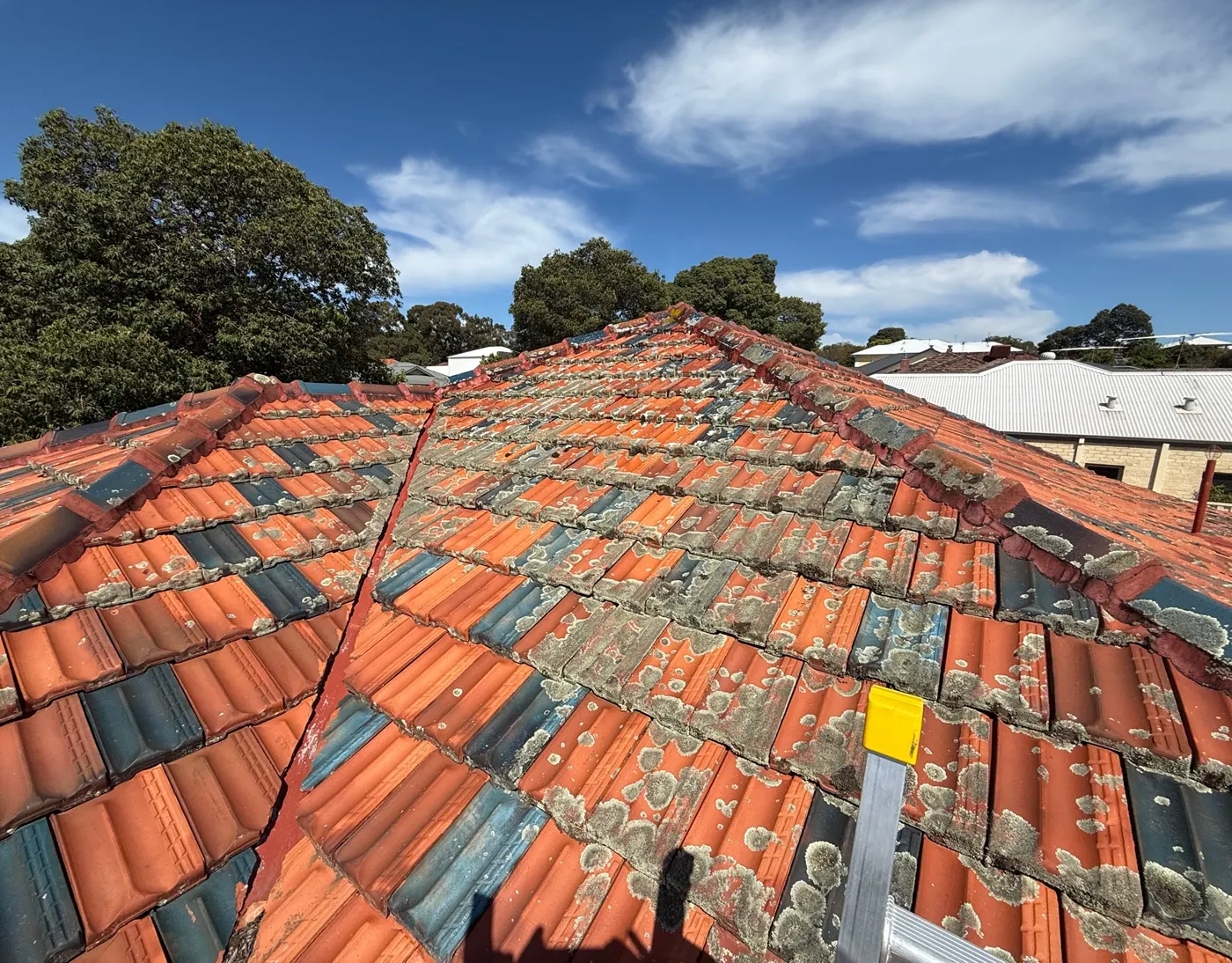
On the roofs we treat, three months is the first point worth a proper look. Lichen goes chalky and loses its colour before it lets go. Moss dries out, thins and starts to lift at the edges. Algae and mould lighten and break up in patches. Whichever you had, uneven is normal, because each patch clears at the pace of its own face, its own thickness and its own share of the rain.
Lichen holds on because it was never sitting on the tile. A crust lichen's hyphae grow down into the surface and anchor it so tightly that its underside cannot be seen.7 Dead or alive, those threads stay put until weather works them loose, which is why dead lichen stays on the roof for months.
Wet & Forget describes a similar pace for its own retail product: black mould "will noticeably improve within 6-8 months", and can take up to 12 months where it is heavy.8
In plain terms It does not clear the way a wash clears, all at once. It clears the way weather clears things, because that is exactly what is happening.
About six months, and the ghost marks
On the roofs we treat, most roofs are visibly different by six months. Some are well ahead. A few are slow, and slow is still inside the window.
Where lichen has come away you may see its shape left behind, lighter or rougher than the tile around it. Part of that is shading: the patch the lichen kept out of the sun and rain for years, which evens out as it weathers. Part is etching. On clay roof tiles, electron microscopy found lichen threads penetrating the tile and filling its fissures and cracks. The same study traced how lichens act on ceramic to their oxalic acid: in its lab tests the acid changed the texture of the ceramic and formed whewellite, a calcium oxalate crystal it names as destructive.9 That part can stay as a ghost mark, and it was under the colony the whole time.
A ghost mark is the receipt: proof the growth was never just sitting on the surface. The acid is made by the living lichen, so once the lichen is treated, no new etching starts.
In plain terms Lift a pot plant that has sat on a paved step for years. The mark under it is partly shade, which weathers back, and partly a dull ring etched into the stone, which does not.
North faces first, winter fastest
Two things set the order: which face, and which month.
The face. In Australia the sun's path is to the north, and in winter it sits low.10 On the roofs we treat, north faces usually change first and south faces last, and the south faces usually carried the most growth to begin with.
The month. About 77% of Perth's rain falls from May to September.11 Rain is what carries the dead growth off, so the month you treat sets how soon the removal starts. Using the Perth Metro monthly averages11:
| Treated in | Rain in the months that follow | What it means |
|---|---|---|
| October | About 84 mm from November to March | The growth is treated and waiting; the visible change comes with the first winter rains |
| April | About 480 mm from May to August | The winter does the heavy work early |
A roof treated before summer changes slowly until the rain arrives. It is not stalled. The growth is dead, and it is waiting for weather. For your own face and your own month, see When will it clear?
In plain terms Summer dries it out. Winter washes it off.
Twelve months, and after
At twelve months we come back and compare the roof against the photo from the day. If it looks the same as that photo, we treat it again with Bailiff, free. The test is whether it is changing, not whether it is finished.
On slower faces, growth can still be weathering off at eighteen months and beyond, and that is the treatment working, not failing. On the roofs we treat, lichen is the slowest of the four to come away. Wet & Forget puts lichen at 8 to 12 months to decompose with its own product8, and a thick crust on a shaded south face can take longer than that. Growth recurs on any roof that stays damp, so once it has cleared, UNGROW Sentry, our preventative, keeps the roof treated after that.
In plain terms The check asks whether the tenant is packing, not whether the house is empty yet.
What this means for your roof
Every stage on this page is dead growth letting go of a tile it had anchored into, with rain doing the removal and nothing blasted off the surface. That is why we apply Bailiff from the roofline with a low pressure soft wash pump through non-directional nozzles, every face at the label rate, and photograph the roof on the day. The sooner it is treated, the less of the roof lichen's acid etches into ghost marks.
Also asked
When should I first go and look?
At about three months. Before that the change is happening inside the growth, where you cannot see it from the ground. Put a reminder in your phone and look from the same spot each time, roughly where the photo was taken on the day.
My roof looks patchier than before. Is that normal?
Yes. A treated roof clears the way weather clears things: a bit at a time and never evenly. One face moves ahead of another, thin growth goes before thick, and for a while the roof can look more uneven than it did. That is the middle of the process, not the end of it.
It has rained a lot and nothing has moved. Why?
Because the first rains are loosening it. Early on, the dead growth is still anchored in the tile, so the first rains soften and weather it before they carry it off. On the roofs we treat, the change comes in steps through the winter rather than after any single downpour.
Is the moss dead or just dry?
In summer you cannot tell from colour alone, because untreated moss browns in dry weather too. The test is the rain. Dry moss greens up again once it is wet, because dormant moss can become active with just a little water. Treated moss stays brown and starts to thin.
What happens at twelve months?
We come back and compare the roof, from the same fixed position, against the photo we took on the day. If it looks the same as that photo, we treat it again with UNGROW Bailiff, free. If it has changed, it simply keeps clearing on the same path.
On the record
- Yates, Yates Surrender Moss Killer
- Monier, Roof cleaning and maintenance
- Marley (UK), Can I clean or jet wash my roof tiles?
- Stresses, Accumulation and Phytotoxicity of Two Commercial Biocides in the Lichen Evernia prunastri and the Moss Brachythecium sp. (2021)
- Australian National Botanic Gardens, Bryophyte ecology
- Australian National Botanic Gardens, What is a bryophyte?
- Australian National Botanic Gardens, Lichen form and structure
- Wet & Forget Australia, Roof cleaning information
- Scanning, Evaluation of the effect of lichens on ceramic roofing tiles by scanning electron microscopy and energy-dispersive spectroscopy analyses (2005)
- Your Home (Australian Government), Orientation
- Bureau of Meteorology, Climate statistics for Australian locations: Perth Metro (009225)