 Lichen
The ruling
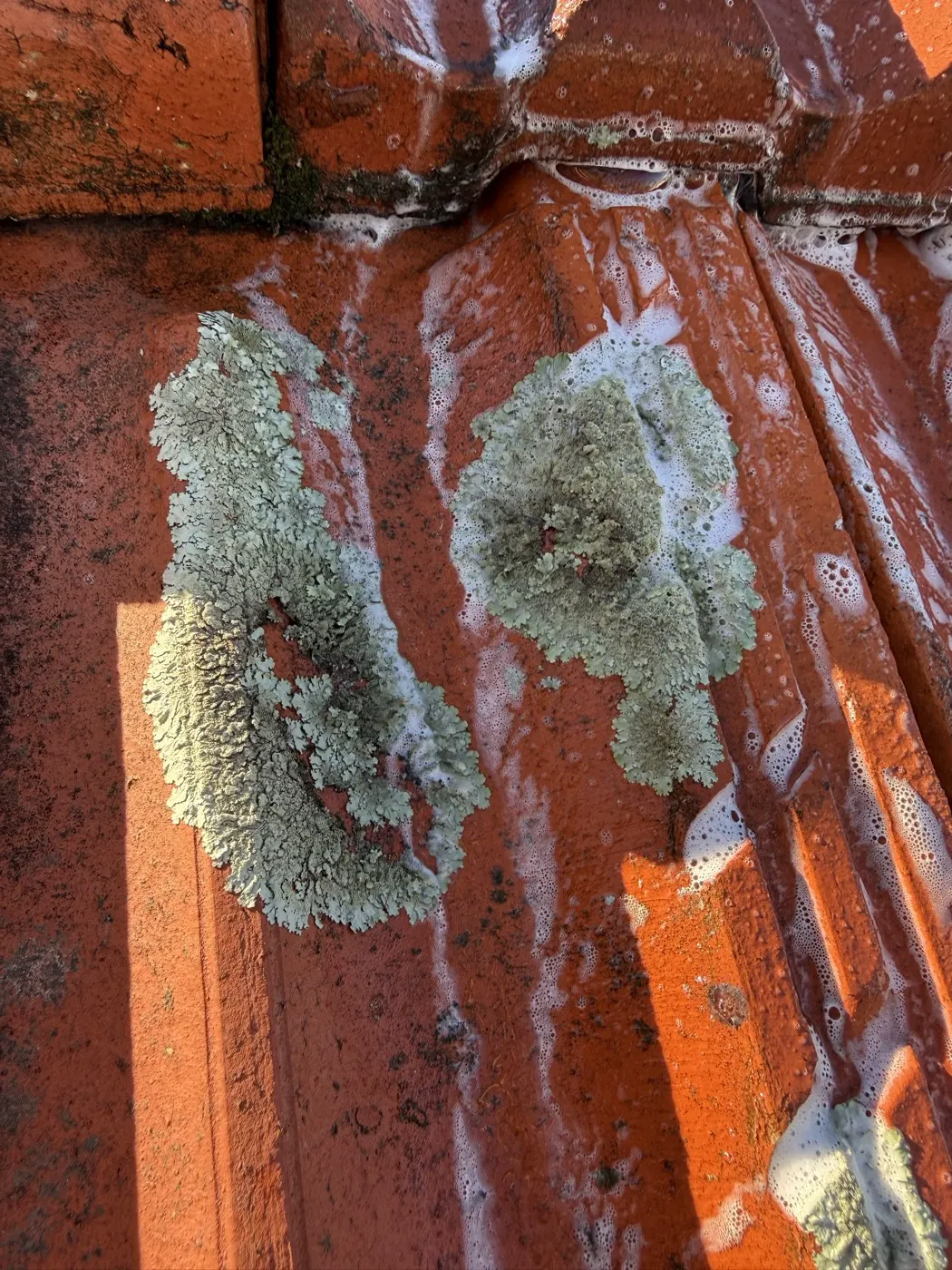
Slowly, and that is the problem. Most leafy lichens spread 1 to 5 mm a year across their radius once established, and crust lichens are the slowest growing of all. A coin sized patch has been on that tile for years, its threads worked into the surface and its acid on the same spot the whole time.
The numbers
Lichens are slow, and how slow depends on the growth form.
| Growth form | What it looks like on a roof | How fast it spreads |
|---|---|---|
| Leafy (foliose) | Rosettes of lobes, edges that lift | Most mature patches 1 to 5 mm a year across the radius1 |
| Crust (crustose) | Flat, paint like patches | The slowest growing of all lichens2 |
The leafy figure comes from a review of measured growth across many species: young patches are usually recognisable by 15 months to 4 years, and mature ones mostly add 1 to 5 mm a year to their radius.1
Crusts range from exceptionally slow in harsh places to considerably faster where conditions suit them.2 The crust most used to date rock, the yellow green Rhizocarpon geographicum, grew on average 0.64 mm a year across its diameter on a moraine in southern Iceland, and about 0.8 mm a year in patches 10 to 40 mm across, the size that grew fastest.3 That is diameter, so its edge moved about a third of a millimetre a year.
In plain terms Mark the edge of a patch with a pencil today, and next winter you would want a ruler to see how far it had moved.
Slow to start, then steady
A lichen does not grow at one speed. Before anything shows, a fungal spore that lands on a roof has to find the right photosynthetic partner, while fragments and granules shed by other lichens arrive with both partners on board.4 Once established, small patches speed up and then hold a steady rate. In leafy lichens the rate rises and then levels off; in crusts it climbs to a peak and can ease again in the largest patches.2 In the Icelandic Rhizocarpon study the rate climbed fast in patches under 10 mm across, stayed high, and eased off gradually in patches over 50 mm.3 In a leafy lichen the growing happens at the tips of the lobes around the edge.1
In plain terms Like a lawn sown from seed. Nothing for a while, then it fills in at a steady pace, year after year.
What the size of a patch says about its age
Geologists date bare rock by measuring the biggest lichens on it. The method is called lichenometry, and it works because crust lichens grow slowly and live a long time.2 It assumes the lichen moved in as soon as the surface was exposed.3
The same arithmetic works on a roof. Take a leafy rosette 6 cm across. Its radius is 30 mm. At 1 to 5 mm a year that is 6 to 30 years of growth at the mature rate, before counting the 15 months to 4 years it took to form.1 Young patches grow slower than mature ones, so that sum undercounts the early years.2 Where it sits on the roof moves the number too: growth answers to the microclimate on each face and to the texture and chemistry of the surface.1
What a patch's size gives you is a minimum. The largest patch on a roof is among the oldest, and it has been there for years, not months.
In plain terms Like judging a tree's age by the thickness of its trunk. A fat trunk is an old tree, before you count a single ring.
Lichen grows in the wet months
A lichen is poikilohydric: its water content follows the weather.5 Dry, it is usually grey; wet, the colour of its algal partner shows through.6 Wet time is what drives its growth. The same crust species grew about two thirds faster at its peak in north Wales than in southern Iceland, and its researchers put that down to more frequent rain days and a longer growing season.3
Perth Metro gets about 77 per cent of its yearly rain from May to September.7 So the lichen on a Perth roof does its growing in winter, and the faces that stay wet longest after rain give it the most time. How aspect, shade and trees decide that is in what causes lichen on roof tiles, and how to tell a dry patch from a dead one is in is the lichen on my roof alive or dead.
In plain terms A lichen is a lawn that only grows on the days it is watered, and Perth waters it from May to September.
Why the slow pace matters for a roof
The growth is slow. The damage starts early and adds up. On clay roof tiles six to ten years old, electron microscopy found lichen threads penetrating the tiles and filling their fissures and cracks, and the researchers traced the lichen's attack on the ceramic to oxalic acid, a process they link to deterioration of the ceramic and ageing of the tiles.8 On rock, lichens secrete organic acids, oxalic acid above all, that dissolve minerals, and many rock-forming minerals under lichen show extensive surface corrosion.9 A lichen does this on the same spot every year it is there, so a heavily covered roof is a roof where it has been happening for a long time. The full case is in does lichen damage roof tiles.
Treatment ends it in place, and the weather then carries it off over the months that follow. Yates says its Surrender concentrate "kills lichens on roofs but does not remove them", and Wet & Forget says lichen treated with its product takes 8 to 12 months to decompose.10, 11
And growth comes back from the growth around it. In a 54 month Italian study on engraved sandstone, biocide applied after cleaning gave the best results through two growing seasons, regrowth came in from the untreated surfaces around the treated patches, and in the shadiest zone moss and dark microbial films came back quickly.12 That is why every face of a roof gets treated, and why staying treated is what keeps it clear: that is the job of UNGROW Sentry, our preventative. How often a roof needs it is in how often does a roof need treating.
In plain terms A slow leak in a tap costs nothing in a day and plenty in a decade.
What this means for your roof
The patches on your roof have been working on their tiles for years, and they keep working until they are treated. We treat them with UNGROW Bailiff from the roofline, through a low pressure soft wash pump and non-directional nozzles, so each patch is ended where it sits and weathers off over the following months, with nothing scraped or blasted off the tile. Every face is covered, because new patches start from the growth nearby, and the roof is checked against its photo at twelve months. Growth recurs, so UNGROW Sentry keeps the roof treated after that.
Also asked
How long does it take lichen to appear on a new roof?
Lichens are among the first things to colonise bare surfaces, freshly tiled roofs and new footpaths among them. Once one has settled, a recognisable young leafy patch forms in about 15 months to 4 years, and once it matures it spreads 1 to 5 mm a year across its radius. The climate, the microclimate on that face of the roof and the surface itself all set the pace.
Does lichen grow faster in winter?
It grows when it is wet, and on a Perth roof that means winter. About three quarters of Perth's rain falls between May and September, and through the dry summer the lichen dries out and switches off. Rain days are what count. The same crust lichen grew about two thirds faster at its peak in north Wales than in southern Iceland, and its researchers put that down to more rain days and a longer growing season.
How long does lichen live?
A very long time. Crust lichens grow so slowly and live so long that geologists use them to date rock surfaces, a method called lichenometry. That is why the patches on a roof are rarely new. The largest one tells you the least time the roof has been growing it, and the real figure is longer, because young patches grow slower than mature ones.
Will lichen spread across my whole roof?
It spreads two ways. Each patch grows outward from its edge, up to a few millimetres a year. Meanwhile lichens shed fragments and powdery granules, each carrying both partners, that start new patches elsewhere, carried by wind, water and birds. So a roof fills in with more patches as well as bigger ones, and the faces that stay wet longest fill first.
If it grows so slowly, why treat it now?
Because the slow part is the growth, not the damage. On clay roof tiles six to ten years old, electron microscopy found lichen threads already filling the tiles' fissures and cracks. Every year a patch stays, its threads stay anchored in the surface and its acid keeps working on the same spot. A year's wait barely changes how the roof looks. It does add another year of acid on the same spots, and that etching is what shows as ghost marks once the lichen has gone.
On the record
- NERC Open Research Archive, Growth of foliose lichens: a review
- Geografiska Annaler: Series A, Physical Geography, Growth of crustose lichens: a review (2010)
- Journal of Quaternary Science (NERC Open Research Archive), Growth rates of Rhizocarpon geographicum: a review with new data from Iceland (2007)
- Australian National Botanic Gardens, Reproduction and dispersal
- Environmental science & technology, Heat shock treatments: a new safe approach against lichen growth on outdoor stone surfaces (2012)
- U.S. Forest Service, Lichen Biology
- Bureau of Meteorology, Climate statistics for Australian locations: Perth Metro (009225)
- Scanning, Evaluation of the effect of lichens on ceramic roofing tiles by scanning electron microscopy and energy-dispersive spectroscopy analyses (2005)
- Catena, Weathering of rocks induced by lichen colonization: a review (2000)
- Yates, Yates Surrender Moss Killer
- Wet & Forget Australia, Roof cleaning information
- The Science of the total environment, Lithobiontic recolonization following cleaning and preservative treatments on the rock engravings of Valle Camonica, Italy: A 54-months monitoring (2023)