 Lichen
The ruling
Lichen spores and fragments land on every roof, carried on wind, water and birds. They settle where the tile stays wet longest, sees the least winter sun and is rough enough to hold water, and nearby trees and untreated roofs keep the supply coming. Once settled it anchors into the tile, so we treat every face where it sits.
It arrives on the wind
A lichen is a fungus in partnership with an alga or a cyanobacterium.1 It spreads two ways. The fungus makes spores, which have to find the right partner after they land. And lichens shed pieces of themselves that carry both partners: fragments of the body, powdery soredia and tiny breakaway isidia, moved by wind, water and animals, including on birds' feet.2 Moss spores travel mostly on the wind too.3
So lichen reaches every roof. Monier, who make roof tiles, put it simply: "Moss and lichen spores can settle on roofing materials where moisture and dirt accumulate."4 The question is never whether it arrives. It is whether it can stay.
In plain terms Weed seeds land all over a gravel driveway. They only come up where there is enough water and a crack to hold them.
It needs wet time
A lichen has no roots and no waxy skin. It takes up water and nutrients through its surface, from rain and the air,5, 6 and it photosynthesises only while it is wet.7 Its water content follows the weather, poikilohydric in the jargon: as it dries it goes dormant, and it waits for the next rain or dew.7, 8 It wets fast and dries slowly. Many lichens reach 70 to 100 per cent of their full water load within 30 seconds of being wetted, and they always lose it far more slowly than they take it up.7 What feeds lichen is not rain in a gauge but hours of wetness on the tile.
A roof makes some of that wet time itself. On clear nights it cools below the air around it, and when the humidity is high, dew forms on it.9 Morning dew is enough to rehydrate a dry lichen and give it time to photosynthesise.7
Perth Metro averages 726.9 mm of rain a year, about 77 per cent of it from May to September, and the 9am humidity averages 78 to 80 per cent in June and July.10 Those winter months are lichen's working season here. How rain, dew and drying time play out across Perth, the hills and the coast is in why your roof grows it and where Perth roofs grow most.
In plain terms Lichen only grows on the days it is wet. A face that dries by mid morning gives it a few hours. A face that stays damp until noon gives it the day.
Shade and the south face
Lichen ecologists list the same handful of factors that decide where a lichen grows: climate, the chemistry of the surface, its texture, how much shade it gets, the plants around it and the level of pollution.6 On a roof, shade and aspect do most of the sorting.
In Australia the sun's path is to the north, so north facing surfaces get the most sun in winter.11 A south facing roof face gets the least, dries slowest and stays wet longest. The effect is large. In a study of three desert sites in North America, the slopes facing away from the sun carried from four to more than eighty times the lichen cover of the sunny ones.12 On cleaned sandstone in northern Italy, moss and a dark film of cyanobacteria rapidly came back across every plot in the shadier zone.13 Trees add shade of their own, and they add dirt: Monier notes that "roofs under trees may show dirt and debris more quickly without regular cleaning".4 Moisture and dirt are exactly where Monier says the spores settle.
In plain terms Hang washing on both sides of the house on a winter morning. The north side is dry first, every time.
The tile: chemistry, roughness and age
Chemistry. Concrete is alkaline, and some lichens grow only on alkaline surfaces, so they turn up on concrete walls and concrete roof tiles. On a clay brick wall, the same lime loving lichens grow on the mortar and not on the bricks.14 The orange-brown and yellow crusts on old concrete footpaths are most likely the lichens Caloplaca and Candelariella, and the same species grow on concrete roof tiles.15 Other lichens avoid concrete altogether: few species of the common leafy Xanthoparmelia tolerate it.12 So terracotta and concrete roofs tend to carry different lichens, not just more or less of them. The comparison is in terracotta or concrete tiles.
Roughness. Rough surfaces trap spores and hold water better than smooth ones with the same aspect and chemistry.12 In laboratory tests on cement mortars, how fast algae fouled the surface was governed by its roughness and porosity.16 Out in the weather, the same researchers found the conditions counted for even more than the material,17 which brings it back to wet time. Roof tiles are particularly prone to microbial colonisation because they are porous: their pores take up the liquid water microbes need and let the microbes into the material.18 Tiles are colonised soon after they go out into the weather, and that first film of bacteria, algae and fungi makes it easier for moss to settle.18
Age. Lichens are among the first things to colonise freshly tiled roofs.6 So lichen is not a sign of an old roof. An older roof has had more years for it to arrive and spread. Lichen grows slowly, so the patches on an older roof are often many years old, anchored to the same spot all that time; the rates are in how fast does lichen grow.
In plain terms A smooth glass shower screen and a rough grout line get the same water. The grout goes black first.
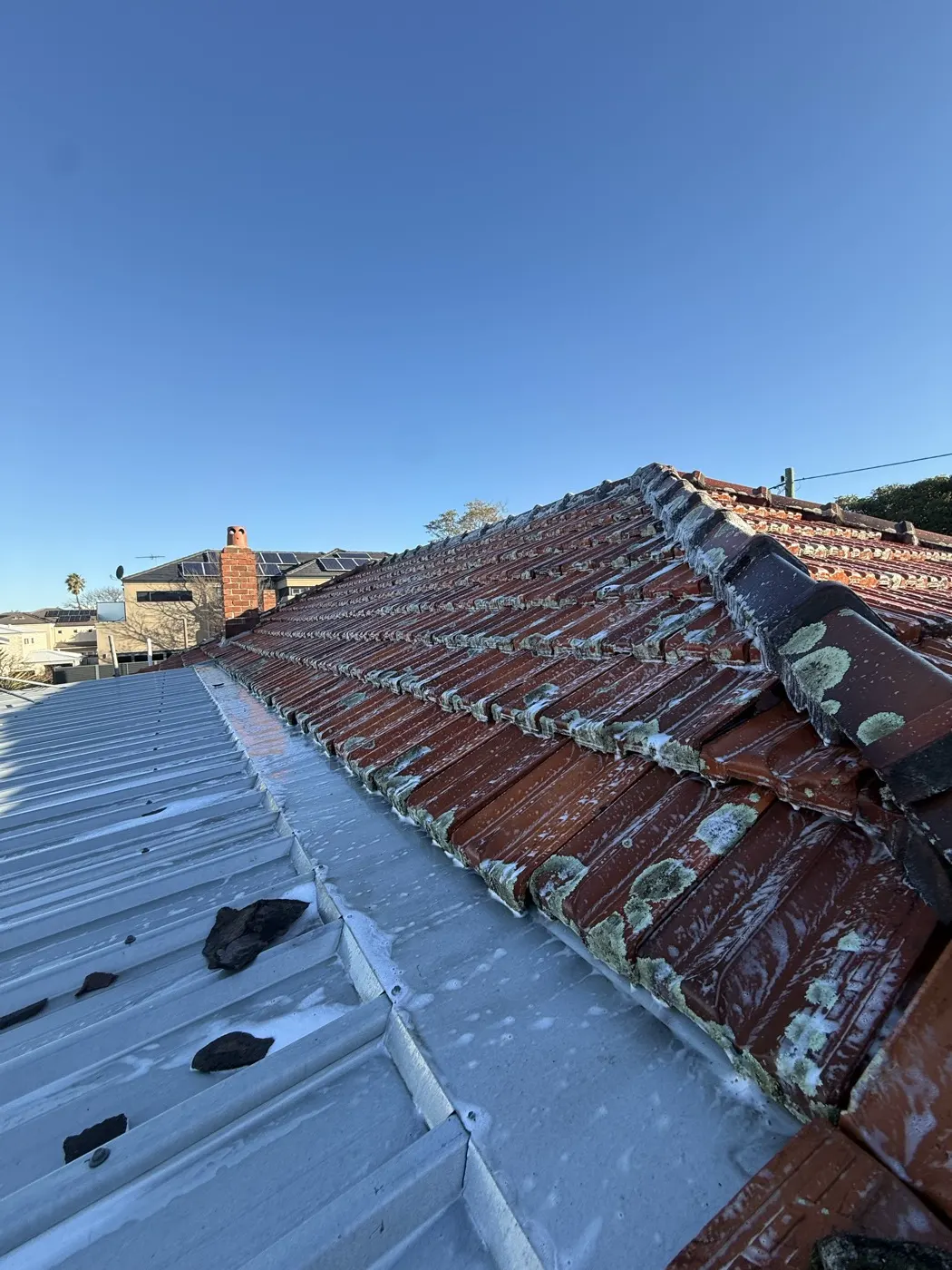
The neighbours
Spores and fragments come from somewhere, and the nearest supply matters. In a 54 month study of cleaned and treated rock surfaces in Italy, new growth came in mainly from the uncleaned surfaces around the cleaned plots.13 Trees carry their own lichens, and most people have seen lichen on a tree trunk.6 An overhanging tree, a lichen covered fence, or an untreated roof upwind keeps a roof supplied.
Some neighbours work the other way. Copper and zinc leach in rain and hold growth back below them. Lichen ecologists see bare stripes below bronze plaques on boulders and below galvanised handrails,19 and roof researchers note that in some cases staining does not occur near copper and galvanised flashings.9 Whether strips of zinc do enough across a whole roof is a question for do zinc strips stop roof moss.
In plain terms One dandelion gone to seed in the yard next door is enough to seed the street.
A wet roof, not a failing one
Lichen is not a sign of a dirty house or a failing roof. It is a sign that part of the roof stays wet long enough for lichen to settle. What it does once it has settled is the reason to deal with it. On clay roof tiles six to ten years old, electron microscopy found lichen threads penetrating the tile and filling its fissures and cracks, and the researchers traced the attack on the ceramic to the lichen's oxalic acid.20 The microbes that colonise tiles profoundly alter the tile's composition.18 The full case is in does lichen damage roof tiles, and the order in which a roof gets colonised, film first and lichen and moss after, is in what lives on a roof.
In plain terms Lichen on a roof means the roof gets wet and stays wet. It is not a verdict on the house, but it is a lodger that works on the tile every wet day it stays.
What this means for your roof
The wind keeps bringing spores, the south faces and shaded corners stay wet, and the trees and roofs around you keep supplying more. New growth comes in mainly from the untreated surfaces around it13, so we treat every face of the roof with UNGROW Bailiff, not just the worst patch, mixed to the label rate and applied from the roofline through a low pressure soft wash pump. The lichen ends where it is anchored, the weather carries it off, and we check the roof against the day's photo at twelve months. The spores keep landing after that, so UNGROW Sentry, our preventative, keeps the roof treated and the lichen in check.
Also asked
Why does lichen grow on one side of my roof?
Because that side stays wet longer. In Australia the sun's path is to the north, so north facing roof faces get the most winter sun and dry fastest, and south facing faces get the least. Lichen only grows while it is wet, so the face that is still damp at noon in July gets far more growing time than the one that dried by nine.
Can lichen spread from trees or the neighbours' roof?
Yes. Lichens reproduce by spores and by fragments and powdery granules that carry both partners, and these travel on wind, in water and on birds. In a 54 month study of cleaned rock surfaces in Italy, new growth came in mainly from the uncleaned surfaces around the cleaned plots. A tree covered in lichen, or an untreated roof next door, is a standing supply.
Does lichen mean my roof is old or failing?
No. It means that part of the roof stays wet long enough for lichen to settle. Lichens are among the first things to colonise freshly tiled roofs, so a new roof gets it too. What matters is what lichen does once it is there. On clay roof tiles, electron microscopy found its threads penetrating and filling the tile's fissures and cracks. The longer it stays, the longer it works on the same spot.
Does lichen on my roof mean the air is clean?
Partly. Lichens absorb what lands on them, and many are sensitive to pollutants such as sulphur dioxide, so cities with dirty air once had almost none. But some species tolerate pollution, alkaline surfaces like concrete buffer acid pollution, and nitrogen tolerant lichens do well where nitrogen pollution is high. A lichen covered roof is a weak air test.
What causes white spots on roof tiles?
Usually a pale crust lichen or efflorescence. Lichen comes in round patches with a defined edge. Efflorescence is a flat, even whitish film of salts from the concrete itself, with no edge, and it fades on its own over time.
On the record
- Australian National Botanic Gardens, What is a lichen?
- Australian National Botanic Gardens, Reproduction and dispersal
- Australian National Botanic Gardens, What is a bryophyte?
- Monier, Roof cleaning and maintenance
- U.S. Forest Service, Lichen Biology
- Australian National Botanic Gardens, Lichen ecology
- Australian National Botanic Gardens, Ecology - arid habitats
- Environmental science & technology, Heat shock treatments: a new safe approach against lichen growth on outdoor stone surfaces (2012)
- Lawrence Berkeley National Laboratory, Weathering of Roofing Materials: An Overview
- Bureau of Meteorology, Climate statistics for Australian locations: Perth Metro (009225)
- Your Home (Australian Government), Orientation
- Australian National Botanic Gardens, Microhabitats
- The Science of the total environment, Lithobiontic recolonization following cleaning and preservative treatments on the rock engravings of Valle Camonica, Italy: A 54-months monitoring (2023)
- Australian National Botanic Gardens, Lichen habitats
- Australian National Botanic Gardens, Urban lichens in Canberra
- The Science of the total environment, Bioreceptivity evaluation of cementitious materials designed to stimulate biological growth (2014)
- The Science of the total environment, Evaluation of natural colonisation of cementitious materials: effect of bioreceptivity and environmental conditions (2015)
- Microorganisms, Methyl Potassium Siliconate and Siloxane Inhibit the Formation of Multispecies Biofilms on Ceramic Roof Tiles: Efficiency and Comparison of Two Common Water Repellents (2021)
- Australian National Botanic Gardens, Pollution and lichens
- Scanning, Evaluation of the effect of lichens on ceramic roofing tiles by scanning electron microscopy and energy-dispersive spectroscopy analyses (2005)