 Lichen
The ruling
Usually lichen: the same crusty patches as the grey ones, in a sunscreen colour. Orange crusts on concrete tiles are most likely Teloschistaceae, long filed under Caloplaca, and yellow ones Candelariella. They love lime, so concrete suits them, and they anchor into the tile. Treated where they sit, they end in place and the weather carries them off.
Usually a lichen
Walk along a concrete footpath a few years old and you will often see yellow or orange brown stains. The Australian National Botanic Gardens' lichen pages are direct about it: sometimes they are stains, but most likely they are lichen colonies, the orange brown ones Caloplaca and the yellow ones Candelariella, and both grow on concrete roof tiles too.1 On concrete roofs in Israel, tiles 60 to 70 years old were covered mainly by four lichens, among them the orange Caloplaca aurantia and the yellow Candelariella aurella.2
They are crust lichens: thin, flat and bound to the surface by their whole underside.3 Up close the colony is a crust with small discs on it, the apothecia where the fungus makes its spores. In Candelariella the body is often scanty and the discs, up to about 1.5 mm across, are most of what you see. You need a hand lens to see them clearly.1 How lichen lives in general is in lichen on roof tiles.
In plain terms It is the same orange that freckles an old concrete path, on your roof. It is alive, and it is a lichen.
The names have moved. Caloplaca in the old, broad sense held a thousand or more species. A 2013 classification of its family, the Teloschistaceae, recognised 39 genera, 31 of them new or brought back, and much of the old Caloplaca now sits under names like Flavoplaca, Xanthocarpia and Variospora.4 Older guides, the Canberra pages included, use the old name. The crust on the tile has not changed.
Why concrete
Some lichens grow only on alkaline surfaces. One that needs lime can live on limestone but never on an acid rock like basalt, and in town it turns up on concrete walls and concrete roof tiles, because concrete is alkaline too. On a clay brick wall you find the lime lovers on the mortar between the bricks, not on the bricks.5 It works the other way as well. In one Canberra suburb a Xanthoparmelia covered a metal inspection lid but not the concrete around it, because few Xanthoparmelia species tolerate an alkaline surface.6
Age helps them. On west facing concrete roofs in Israel, Caloplaca aurantia covered about 2.5 percent of the tiles at 30 years, 23 percent at 45 and 48.5 percent at 60: nine times the cover in fifteen years, then double again. The researcher linked the jump to the weathering of the tile surface, because pits and ruts trap dust, bird droppings, water, algae and spores.2 Rough patches catch propagules and water better than smooth ones, which is why orange crusts can often be seen following cracks.6
In plain terms A concrete tile ages like a chopping board. The more it is scored, the more it holds, and an orange lichen needs something to hold it.
Why orange
The colour is chemistry. Lichens make pigments, and the yellows, oranges and reds are among them.7 Caloplaca and Xanthoria carry carotenoids, yellow to red pigments that help capture light and protect against damage from ultraviolet light. Thalli in the sun make more: one Xanthoria held 25 micrograms of carotenoid per gram of dry thallus in a shady site and 71 in a sunny one.7
The family also makes anthraquinones, in both the body and the fruiting discs, compounds known to protect against ultraviolet light. A 2015 study traced the family's great burst of new species, about 100 million years ago, to a shift from bark to rock and from shade to sun, probably made possible by those pigments.8 In Xanthoria parietina, the pigment parietin sits in the lichen's skin and shields its photosynthesis from high light: strip it out and the lichen is damaged by light it would normally shrug off.9 Its production is switched on by UV-B.7 Lichenologists confirm the anthraquinones with a drop of potassium hydroxide, which turns them red to purple.7
In plain terms The orange is a tan. The more sun the tile gets, the deeper the colour the lichen wears.
Lichen, tile colour or rust
Colour alone will not settle it, so go by form and texture.
| Look for | Orange lichen | The tile's own colour | Rust |
|---|---|---|---|
| Shape | Rounded patches that grow outward from where they started, merging as they meet.10 | Even across the tile, following its shape and edges. | A streak running downhill from metal: a nail, a bracket, a flashing. |
| Texture | A crust you can see and feel, often with tiny discs on it.1 | As smooth or as rough as the tile. | A flat stain in the surface, nothing raised. |
| Under it | A thin skin over a layer of green photosynthetic cells.11 | Colour fired into the tile, on terracotta.12 | Iron oxide, the same as on any rusting steel.13 |
Terracotta's colour is baked into the tile when it is fired, and it does not fade.12 On a terracotta roof the orange is the tile, and the growth is whatever sits on top of it.
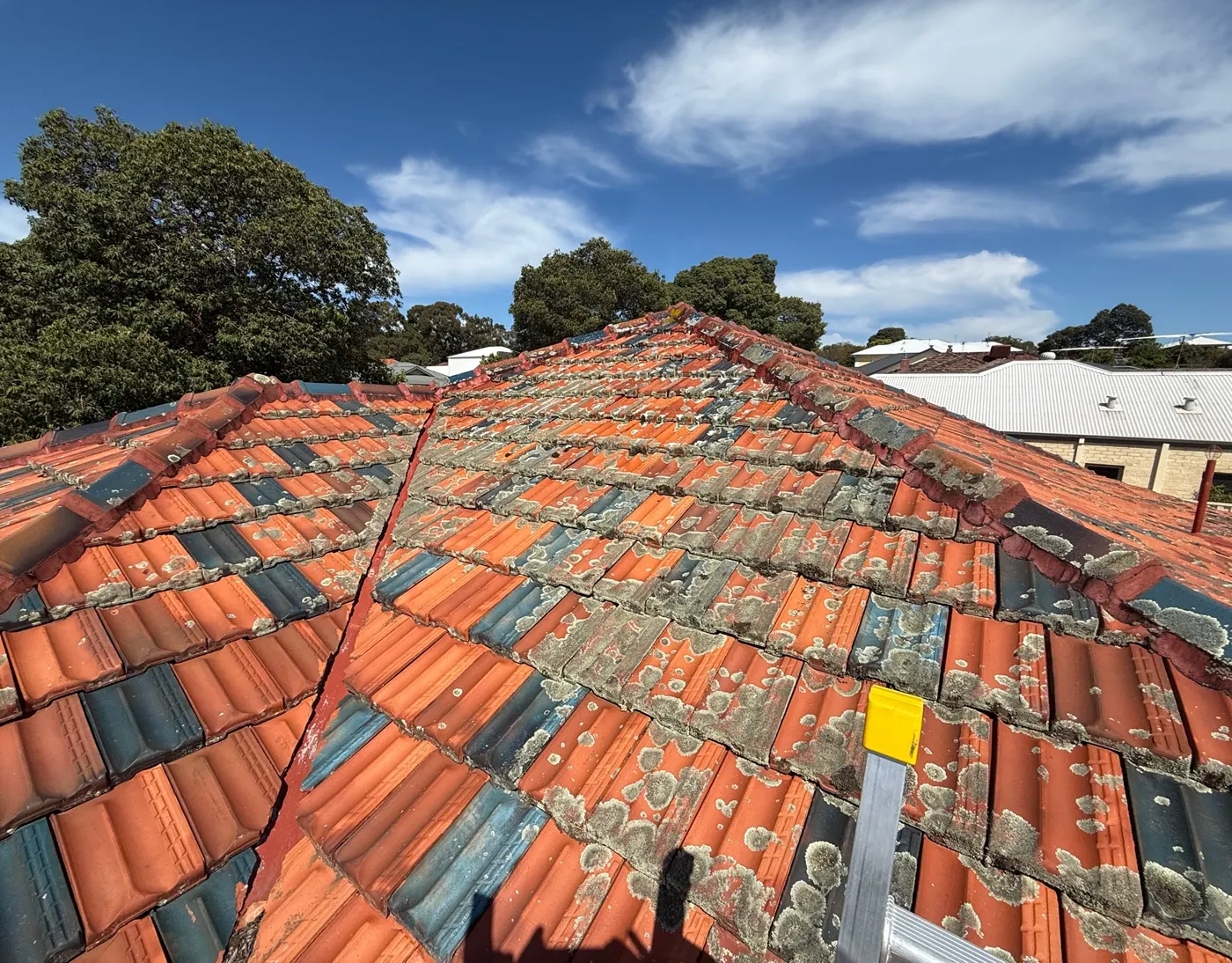
A painted concrete roof is different. Monier says a repaint needs redoing every five years or so to keep its look12, and a worn coat shows as broad, even loss of colour across the most exposed faces, not as round patches with an edge.
If there is an orange crust on a garden wall or a path, you can see the inside of a lichen for yourself. Scrape the coloured skin gently and the photobiont layer shows underneath, green if the partner is an alga.11 Do it at ground level. The roof is not a place to kneel with a fingernail, which is why nobody needs to walk on it.
In plain terms Rust is a stain, tile colour is the tile, and lichen is a living thing on the tile. If it has thickness, an edge and a texture of its own, it is lichen.
What it does to a concrete tile
An orange crust is not resting on the tile. In a crust lichen, hyphae grow down from the body into the surface and anchor it very tightly.11 On clay roof tiles, electron microscopy found lichen threads penetrating the tile and filling its fissures and cracks.14
Lime rich surfaces are where lichen acid does the most15, and a concrete tile is one: it is alkaline and carries carbonates in its surface.5, 2 The fungi of many lichens secrete oxalic acid, and a review of the research found that lime rich, calcareous rock suffers much more severe weathering from lichens than other rock, with oxalic acid dissolving its minerals, as many studies have confirmed. On limestone and dolomite, four lichens studied all dissolved the calcite with oxalic acid. Where lichen met rock the calcite was completely gone, and calcium oxalate had formed in the lichen and along that boundary. On building mortar, a mix of calcite and quartz, the attack showed on the surface and inside it as micropitting and etching, and the lichens' threads and fruiting bodies pitted its face.15
In plain terms A lime rich surface is to lichen acid what kettle scale is to vinegar. A concrete tile is that kind of surface, and an orange crust sits on it for decades.
The electron microscope showed the work on the concrete roofs in Israel too. Free cells of a green alga, probably Trebouxia, the partner inside Caloplaca aurantia's fruiting discs, sat in pits in the weathered tile, and where they sat the surface was worn smooth, which the researcher put down to their chemical action on the carbonates of the concrete. Each patch also seeds the next. The established colonies carried numerous fruiting discs that throw out large numbers of spores, and on the bare tile between colonies those spores lay in the pits, often in clusters of eight, with fungal threads and algal cells in the same pits. The researcher read that as new lichen starting.2
In plain terms Every orange patch is a seed tray. Its spores fall into the scratches of the bare tile beside it, and the next patch starts there.
An etch does not grow back, which is why a cleared patch can leave a ghost mark. How lichen acid works on a roof is in what growth does to a roof, and the full case, from clay tiles to building stone, is in does lichen damage roof tiles.
What this means for your roof
An orange crust on a concrete tile is anchored in it, sitting on the kind of surface lichen acid attacks hardest, and every fruiting disc on it is seeding the bare tile around it. The sooner it is treated, the less of the roof it marks and the fewer new patches it starts. We treat it where it sits with UNGROW Bailiff, applied from the roofline through a low pressure soft wash pump and non-directional nozzles, so nothing is blasted off the tile, and the weather carries the dead crust away. Weathered, pitted concrete is where the next spores lodge, so UNGROW Sentry, our preventative, keeps the roof treated after that.
Also asked
Is orange lichen bad for roof tiles?
Yes. It is a crust lichen like the grey ones, anchored by threads grown down into the tile. It favours concrete, and lime rich surfaces are where lichen acid does the most. On limestone and building mortar, lichen acid dissolves the calcite and etches the surface. Its spores lodge in the weathered pits of the bare tile around it, so one patch starts the next. Treated where it sits, it ends in place, and the weather carries the dead crust away.
What is the yellow lichen on my roof?
Most likely Candelariella, a yellow lichen that grows on concrete alongside the orange ones. Its body is often scanty, so what you notice are its fruiting discs, each up to about a millimetre and a half across. A magnifying glass on an old concrete path shows the same thing at ground level.
What causes yellow moss on roof tiles?
Usually a yellow lichen, not a moss: most likely Candelariella, which grows on concrete roof tiles alongside the orange crusts. English once used the word moss for lichens too, and some still carry it in their common names. A moss is a plant with tiny leaves on stems. This is a flat crust bound to the tile. The cause is the tile: concrete is alkaline, which suits lime loving lichens, and its weathered pits trap water and spores. More in lichen, moss, algae or mould.
Why does orange lichen grow on some roofs and not others?
Concrete, sun and time. Orange lichens favour alkaline surfaces like concrete, and their pigments let them live in full sun. They take hold as the tile weathers and its surface pits. On concrete roofs in one study they covered a few percent of the tile surface at thirty years and about half at sixty.
Can orange lichen grow on terracotta tiles?
It can turn up, but concrete is what the lime lovers favour. On a brick wall they grow on the mortar between the bricks and not on the bricks themselves. On a terracotta roof the cement is in the ridges, in the mortar bedding under the ridge and hip caps.
On the record
- Australian National Botanic Gardens, Urban lichens in Canberra
- Studia Geobotanica, Some observations on the establishment of the lichen Caloplaca aurantia on concrete tiles in Israel (1988)
- Australian National Botanic Gardens, What is a lichen?
- Nordic Journal of Botany, A new taxonomy of the family Teloschistaceae (2013)
- Australian National Botanic Gardens, Lichen habitats
- Australian National Botanic Gardens, Ecology - microhabitats
- Australian National Botanic Gardens, Lichen chemistry
- Proceedings of the National Academy of Sciences of the United States of America, The adaptive radiation of lichen-forming Teloschistaceae is associated with sunscreening pigments and a bark-to-rock substrate shift (2015)
- Oecologia, Parietin, a photoprotective secondary product of the lichen Xanthoria parietina
- Geografiska Annaler: Series A, Physical Geography, Growth of crustose lichens: a review (2010)
- Australian National Botanic Gardens, Form and structure
- Monier, Roof cleaning and maintenance
- Lawrence Berkeley National Laboratory, Weathering of Roofing Materials: An Overview
- Scanning, Evaluation of the effect of lichens on ceramic roofing tiles by scanning electron microscopy and energy-dispersive spectroscopy analyses (2005)
- Catena, Weathering of rocks induced by lichen colonization: a review (2000)