The ruling
Roof moss and lichen treatments are built on benzalkonium chloride, a quaternary ammonium compound that breaks open the cells of moss, lichen and algae. Measured to the roof and applied at the label rate to every face, it ends the growth within hours, where it sits. The weather breaks the growth down and carries it off, over months.
What is in a roof treatment
The products sold as roof moss and lichen treatments are built on one active constituent: benzalkonium chloride.1 Yates Surrender carries 500 grams a litre of it,2 and 30 Seconds Roof Treatment is built on it too.3 So is ours: UNGROW Bailiff, the treatment we apply from the roofline, is built on benzalkonium chloride. Bleach based outdoor cleaners work differently. 30 Seconds Outdoor Cleaner contains sodium hypochlorite and lists algae, moss, mould and mildew, with no lichen among them.4 Every way to clean a roof covers those cleaners and the acid based weedkillers.
Benzalkonium chloride is a quaternary ammonium compound: a nitrogen atom at the centre with four groups attached, carrying a positive charge that a chloride ion balances.5 What is sold under the name is a mixture of close relatives that differ in the length of one oily carbon chain, mostly 12 or 14 carbon atoms long in roof products.1
| Product | How it is sold | Mixed for a roof | Coverage the maker gives |
|---|---|---|---|
| Yates Surrender Mosskiller | Concentrate, 500 g/L | 20 mL to a litre of water | No area rate: spray to just wet |
| Wet & Forget concentrate | Concentrate | 1 part to 5 of water | A minimum of 100 m² per 5 L |
| Wet & Forget Rapid Application | Hose end, a more concentrated active | Set by the hose end | A minimum of 100 m² per 2 L |
| 30 Seconds Roof Treatment | Concentrate | 1 part to 4 of water | 250 m² per 5 L |
| 30 Seconds Spray & Walk Away Hose End | Hose end | Set by the hose end | About 350 m² per 2 L |
Each row is the maker's own direction for its own product, as published in October 2026.6, 7, 8, 9, 10, 11
It is not an exotic chemical. Benzalkonium chloride is the most frequently used preservative in eye drops,12 found in about 70 percent of them at well under a tenth of a percent.13 It is sold as a swimming pool algaecide,14 and quaternary ammonium compounds are the everyday disinfectants for floors, furniture and walls in hospitals.15 What changes is the strength. Yates' own data sheet for Surrender gives 20 mL per litre of water for a tiled roof and 10 mL per 100 litres for algae in a swimming pool,6 so the roof spray is two hundred times stronger than the pool dose. Handling it is a job for the right gear: when the container is opened and the product used, the label requires elbow-length PVC gloves, a face shield or goggles and impervious footwear.2
In plain terms It is the same chemical that preserves eye drops, from the same family that disinfects hospital benches. On a roof it is mixed far stronger and pointed at moss and lichen instead of germs.
How it breaks a cell open
Benzalkonium chloride is a surfactant in its own right. Quaternary ammonium compounds are cationic detergents: they lower surface tension and form micelles, which is how they disperse in water.5 Each molecule has two ends, a water-repelling hydrocarbon tail and a charged, water-attracting head.16
That shape is how it works. The standard review of how antiseptics and disinfectants act describes quaternary ammonium compounds as membrane-active agents and sets out the sequence: the compound adsorbs to the cell wall and penetrates it, reacts with the membrane underneath and disorganises it, the cell's small molecules leak out, and then its proteins and nucleic acids break down.16
In plain terms Think of washing-up liquid on a greasy pan. The detergent's oily end pushes into the grease and breaks it up. A cell's membrane is a thin skin of fat, and a quaternary ammonium compound does to it what detergent does to grease. The cell leaks, and it dies.
On a roof, the label sets the spectrum. Surrender's label lists moss, algae, lichen and liverwort,2 and 30 Seconds lists algae, lichen, moss and mould for its roof treatment.10 A lichen is two partners living as one, a fungus and an alga or a cyanobacterium,17 and quaternary ammonium compounds act on both kinds of cell: they are generally fungicidal,15 and algae are within their spectrum.5 In a laboratory test on a lichen and a moss, a commercial benzalkonium chloride biocide severely impaired the photosynthesis of both, with no recovery over time, and the moss was more sensitive than the lichen.18
Strength matters. At low concentrations these compounds only hold growth back; at higher concentrations they destroy the cells.5 Under the right conditions and application rates, Yates says of Surrender that "death will occur for algae and liverwort in minutes and moss and lichen within hours".6
In plain terms The treatment does its work on the first day. Everything you see after that is the weather.
What the rest of the formula does
A pesticide product is its active ingredient plus inert ingredients, which have no pesticidal activity of their own. Makers add them to carry the active and to improve how well the product applies, handles and stores.19 Yates describes Surrender as a soluble concentrate,6 and an active that dissolves readily in water forms a solution that does not settle out or separate.19
The safety data sheet shows only part of the recipe. The sheet for 30 Seconds Roof Treatment names three ingredients: benzalkonium chloride at under 10 percent, a dye at under 0.01 percent and water at over 80 percent.3 The "Added sticking agents" its maker describes on the product page are not named on it.10
A well formulated roof treatment has three jobs beyond the active, and one rule.
Wetting into a water repellent target. Water beads on water repellent surfaces, and the waxier the surface, the more it beads. A droplet that sits in a bead and fails to spread does little.20 Lichens and mosses are partly water repellent. In the lichen Xanthoria parietina, an outer skin that takes up water surrounds inner threads with water-repelling walls,21 and the moss Funaria hygrometrica carries a waxy cuticle like other land plants, though at the low end of the range found on them.22 A wetting agent, or wetter-spreader, lowers the surface tension of a spray droplet so it flattens and spreads over a larger area instead of sitting in a bead, and some wetters also help the active penetrate.20 Benzalkonium chloride does some of this itself, and Yates describes Surrender as having "a powerful penetrating and wetting action".6 Wet & Forget says its formula "includes a unique blend of surfactants designed to penetrate deeper",7 and that on lichen a first spray "dissolves the waxy coating" before a second one soaks in.23
Staying on a slope. A roof is a slope, and a thin spray runs off it. Thickeners raise a spray's viscosity, which controls drift and slows evaporation, so the active has longer to be absorbed.24 Some of the polymers that thicken a spray also reduce the chance that its droplets bounce, shatter or run off.20 On a vertical surface, xanthan, added to a decontamination foam as a stabilising agent, delayed and then slowed the foam's drainage, which kept it in contact for longer.25 30 Seconds says its roof treatment is formulated "to not immediately runoff your sloped surfaces".10
Showing where it has been. A foam marker leaves a visible mark so the applicator knows where the product has gone, which avoids skipped patches and doubled ones.24 Foam also holds liquid on a sloped or vertical surface. In the decontamination study above, the foam and the plain liquid worked at a similar speed,25 so foam is about placement and contact time, not strength.
Nothing else goes in. Yates says Surrender "should be applied alone and not mixed with wetting agents or foliar fertilisers",6 and as tank additives, cationic and anionic surfactants are not generally used with pesticides.24 So the formula is the maker's job, settled before the bottle is filled. The applicator's job is to use it exactly as the label says.
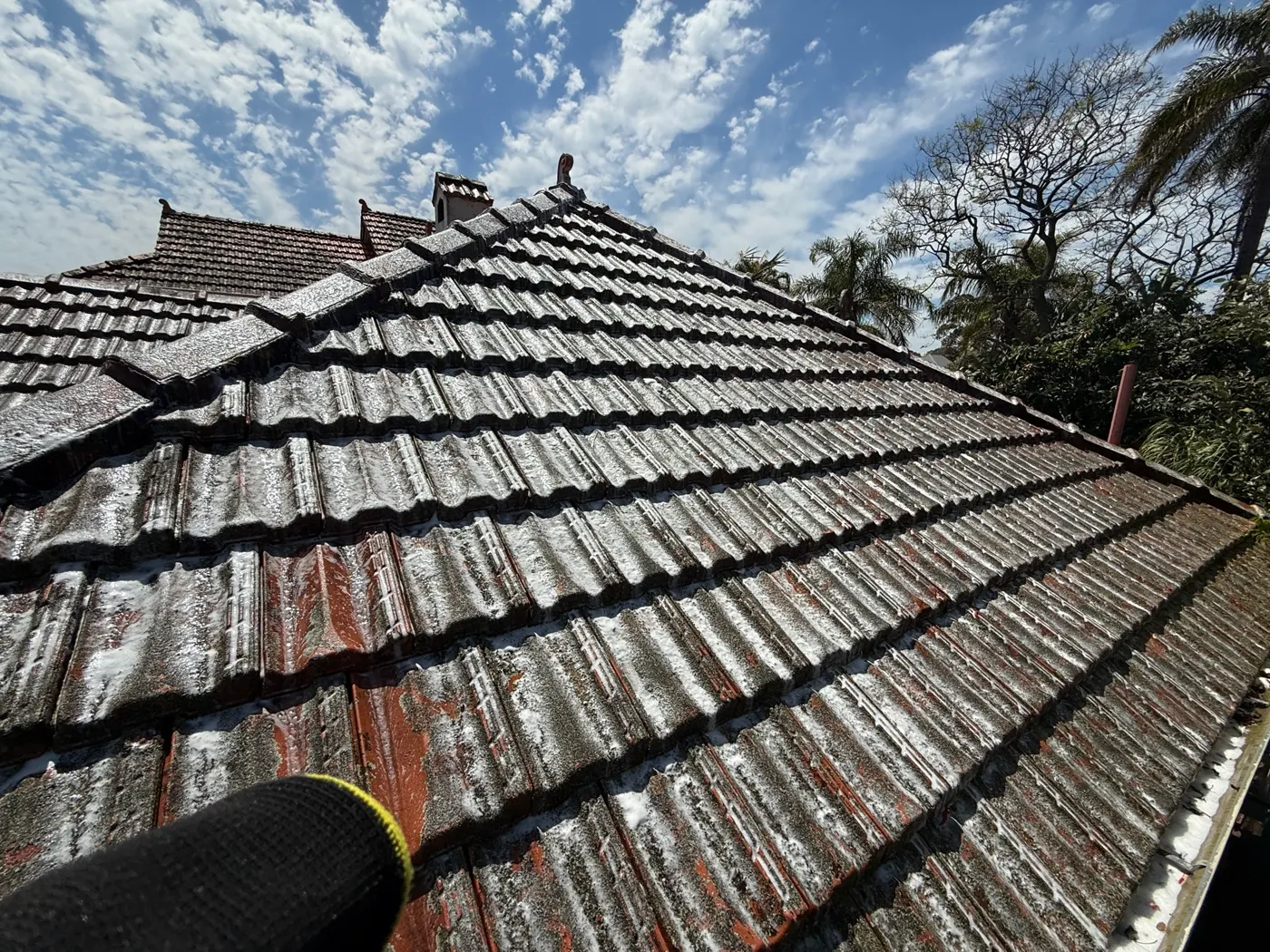
In plain terms A well formulated treatment is like sunscreen. The active ingredient is a small part of the bottle. The rest is what makes it spread evenly, stay on, and show you the patch you missed.
Dose per square metre, and what blunts it
A label's dilution sets how strong the spray is. What decides whether the growth on a given tile ends is how much of the active reaches it. Montana State University's extension guide to calibrating home and garden sprayers makes the same point: a product has to go on uniformly at the label rate, as the correct amount of solution per unit area, and too little product means poor management of pests.26 For quaternary ammonium compounds, strength and time trade off: halving the concentration requires doubling the contact time.27 With these compounds the usual failure is in the application, not the chemical. A review of quaternary ammonium biocides finds that in use most problems turn out to be apparent resistance or user error, such as overdilution or incorrect handling of the product, and that their non-specific action, on many targets in a cell at once, makes true resistance unlikely.5
The bottle is only the start. Surrender at 20 mL per litre of water2 mixes its 500 grams a litre down to about 10 grams of benzalkonium chloride per litre of spray, or 1 percent. The other makers set their own dilutions, shown in the table above, and the strength in the bottle differs even between one maker's products: Wet & Forget's hose end product carries its active more concentrated than its concentrate does,8 and 30 Seconds asks buyers to use its hose end product sparingly "due to its high concentration".11
Then there is how much goes on each square metre. Surrender's label gives no area rate for roofs. It says spray to just wet.2 The retail makers give bottle-per-area figures instead. Wet & Forget says its 5 litre concentrate covers a minimum of 100 square metres. For a 150 square metre tiled roof it says two 5 litre bottles for black mould, because the undulations in the tiles make the real surface larger than the plan, and three for lichen, which is sprayed twice.23 30 Seconds says its 5 litres covers 250 square metres.10 Worked through, Wet & Forget's lichen figure puts about 600 mL of mixed spray on each square metre of roof, and the 30 Seconds figure about 100 mL: six times the volume of spray. Each is the maker's direction for its own product.
Real coverage moves with things the bottle cannot see. Wet & Forget says coverage depends on how porous the surface is,23 and 30 Seconds says the coverage of its hose end product depends on water pressure and on "the application style of the person using the product".11 The same sprayer guide notes that homeowners may be tempted to skip calibrating their sprayers for the sake of time or for lack of technical knowledge.26
None of this needs a stronger chemical. Surrender, at 500 grams a litre, is sold through the special orders desk at Bunnings.28 What a professional application changes is the measuring and the coverage. We price a roof from aerial imagery of the address, so its area is known before the day. Bailiff is mixed on the day to the label rate for that area and goes onto every face, from the roofline, with nobody walking the tiles.
In plain terms Two people can paint the same fence from the same tin. One measures the fence and reads the coverage on the tin first; the other paints until it looks done. The paint is identical. The fence is not.
Three things blunt a quaternary ammonium compound on the day.
- Hard water. The calcium and magnesium in hard water form insoluble precipitates with the disinfectant and slow it down,27 and hard water decreases the activity of the older quaternary ammonium compounds.29 The twin chain quaternaries, a newer kind than benzalkonium chloride, are the ones described as staying active in it.15 Perth's mains water varies a long way across the city: Water Corporation's mean hardness figures for 2024-25 are 54 mg/L at Melville, 106 at Mount Hawthorn and 228 at Two Rocks.30
- Detergent. Soaps, fatty acids and other anionic substances inactivate quaternary ammonium compounds,29 so a sprayer that last held a house wash is the wrong sprayer.
- Dirt. Organic matter can shelter organisms by acting as a physical barrier,27 and heavy organic loads may need greater concentrations,5 so a roof thick with leaves soaks up treatment meant for the growth.
Why the roof looks the same on the day
Yates says it plainly: Surrender "kills lichens on roofs but does not remove them".31 A treated roof looks exactly as it did that morning, because ending the growth does not loosen it. Crust lichens are attached to the surface by their entire lower surface,17 with hyphae that grow down into the material beneath and anchor them very tightly, and leafy lichens anchor with rhizines, bundles of hyphae that penetrate the surface.32 On clay roof tiles, electron microscopy found lichen hyphae penetrating the tile and filling its fissures and cracks.33 Moss anchors with rhizoids.34 None of that lets go when it dies.
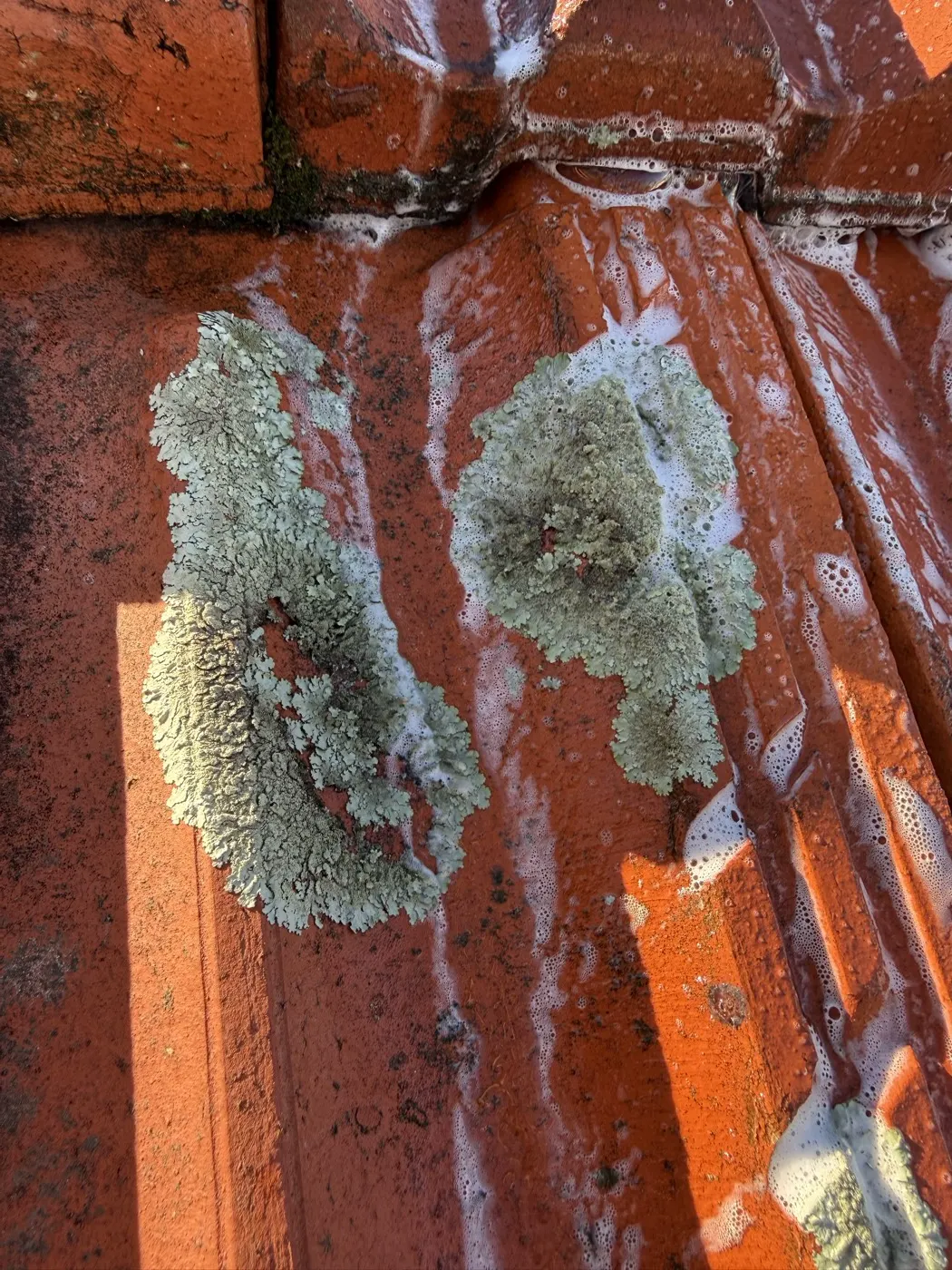
The makers' own timelines for mould and lichen run in months. Wet & Forget says green algae usually goes within days, black mould can take 2 to 4 months and heavy lichen 6 to 12 months "as the rain slowly weathers away the dead organic matter".7 30 Seconds says some growth may take up to 6 to 8 weeks to show any sign of decay, and heavily contaminated surfaces up to 6 months to come clean.10 Wet & Forget's hose end product page puts it best: "'Rapid' refers to the application speed, not the cleaning speed!"9 Some conservators of heritage objects work the same way. After a biocide treatment they leave the object untouched for several months, then lightly brush away whatever is detaching.35
On the roofs we treat, growth starts coming away over 3 to 18 months. Rain, which way each face points, the kind of growth and how thick it is set the pace, and nobody can promise a date. How long it takes and a treated roof, month by month go through it, and why dead lichen stays on the roof explains the wait. It is also why our guarantee reads the way it does: we photograph the roof on the day, and if it looks the same as that photo at twelve months, we treat it again, free.
Two things on the day help the treatment get in. The Surrender label says not to apply if rain is expected within 12 hours,2 which gives it time to soak in before rain arrives. And the lichen's own moisture matters: in a study on a leafy lichen, how hydrated the lichen was influenced how much biocide it absorbed.36
In plain terms A tree does not fall over the day it dies. It stands until the weather brings it down. Treated growth does the same, on the scale of a tile.
Where it goes afterwards
A roof treatment is left on the roof to do its work. Wet & Forget says rinsing its product off would stop it working.7 Much of it then breaks down where it sits. A pilot study in France treated test roofs outdoors with roof biocide products and followed them for a year, and its mass balance found that a large part of what was applied was lost on the roof, probably to biodegradation.1 Quaternary ammonium compounds biodegrade where there is oxygen, and show strong sorption to sediment and sludge.37 What the rain does carry off is at its most in the first rains after treatment, and falls away with each rain after that.1
That is why a rainwater tank comes off for the first few weeks. The label asks for a connected tank to be disconnected for three to four weeks, with at least 6 mm of rain over that time, before it is reconnected,2 and rainwater tanks and roof treatment walks through that step. The label also says not to contaminate streams, rivers or waterways with the chemical or its used containers.2
In plain terms A treated roof behaves like a used tea bag. The first rain draws out the most and each rain after draws out less, which is why the tank sits out the first few weeks and rains.
What this means for your roof
Lichen left on a tile keeps its threads anchored in the cracks and keeps etching the surface with oxalic acid, so the sooner it is treated, the less time it has to work on the tile.33, 38 The active does its work within hours; what decides the result is the label rate reaching every face. We measure the roof from aerial imagery before the day, mix Bailiff to the label rate for that area, and treat every face from the roofline with a low pressure soft wash pump through non-directional nozzles, so nothing is forced under the tiles and nobody walks on them. Then the weather carries the dead growth off, we check the roof against the photo from the day at twelve months, and UNGROW Sentry, our preventative, is how it stays treated after that.
Also asked
Is benzalkonium chloride what is in Wet & Forget and 30 Seconds?
Yes. The roof moss and lichen treatments from Wet & Forget, 30 Seconds and Yates all use benzalkonium chloride as the active constituent; 30 Seconds Outdoor Cleaner is bleach based, a different chemical. The treatments differ in bottle strength, up to 500 grams a litre in Surrender's concentrate, in how much water the maker says to add, and in the rest of the formula. The active and its strength are printed on every label.
Is a professional treatment stronger than the Bunnings products?
Strength in the bottle is not what decides the result. Surrender carries 500 grams a litre of benzalkonium chloride, and Bunnings sells it through its special orders desk. What a professional changes is the measuring, getting every face covered at the label rate from the roofline without anyone walking the tiles, handling the tank and gutter detail, and coming back to check at twelve months. That is how we apply UNGROW Bailiff.
Can I add detergent or a wetting agent to make it work better?
No. Yates says Surrender should be applied alone and not mixed with wetting agents, and soaps and other anionic detergents inactivate quaternary ammonium compounds, so a splash of detergent weakens the treatment instead of helping it. Adding anything to a product also takes it outside its label directions. Use a clean sprayer that has never held soap or a house wash.
Why can it not rain for 12 hours after treatment?
The Surrender label says not to apply if rain is expected within 12 hours, and 30 Seconds gives the same window. The treatment needs time on the growth to soak in. Rain inside that window carries some of it off the roof and into the gutters before it has done its work.
Does it work on lichen as well as moss?
Yes. The roof products' labels list lichen among the growths they control, alongside moss and algae. Lichen is slower to show it. The treatment ends it within a day, but a crust lichen is anchored into the tile, so it stays where it is, dead, until the weather breaks it down and carries it off over the following months.
On the record
- Water research, Benzalkonium runoff from roofs treated with biocide products - In situ pilot-scale study (2015)
- Yates / Hortag, Surrender Mosskiller label (10 L)
- 30 Seconds Ltd, 30 Seconds Roof Treatment Concentrate: safety data sheet (2019)
- 30 Seconds Australia, Outdoor Cleaner
- Applied and environmental microbiology, Quaternary ammonium biocides: efficacy in application (2015)
- Yates Australia, Surrender Mosskiller: Technical Data Sheet
- Wet & Forget Australia, Remove Mould, Moss, Lichen & Algae Outdoor
- Wet & Forget Australia, Wet & Forget Or Rapid Application?
- Wet & Forget Australia, Rapid Application Mould Removal inc Moss, Lichen & Algae
- 30 Seconds Australia, Roof Treatment
- 30 Seconds Australia, Spray & Walk Away
- Progress in retinal and eye research, Preservatives in eyedrops: the good, the bad and the ugly (2010)
- Eye, Ocular benzalkonium chloride exposure: problems and solutions (2022)
- Chemosphere, Identification of novel disinfection byproducts in pool water: Chlorination of the algaecide benzalkonium chloride (2020)
- US Centers for Disease Control and Prevention, Chemical Disinfectants
- Clinical Microbiology Reviews (PMC), Antiseptics and disinfectants: activity, action, and resistance (1999)
- Australian National Botanic Gardens, What is a lichen?
- Stresses, Accumulation and Phytotoxicity of Two Commercial Biocides in the Lichen Evernia prunastri and the Moss Brachythecium sp. (2021)
- University of Florida IFAS Extension, Pesticide Formulations
- Purdue Extension, Adjuvants and the Power of the Spray Droplet: Improving the Performance of Pesticide Applications (PPP-107)
- Fungal Genetics and Biology, Interfacial self-assembly of fungal hydrophobins of the lichen-forming ascomycetes Xanthoria parietina and X. ectaneoides (2000)
- Annals of Botany, The moss Funaria hygrometrica has cuticular wax similar to vascular plants, with distinct composition on leafy gametophyte, calyptra and sporophyte capsule surfaces (2016)
- Wet & Forget Australia, Roof cleaning information
- Penn State Extension, Spray Adjuvants
- Frontiers in Microbiology, New Biocide Foam Containing Hydrogen Peroxide for the Decontamination of Vertical Surface Contaminated With Bacillus thuringiensis Spores (2018)
- Montana State University Extension, Calibrating Home and Garden Sprayers
- US Centers for Disease Control and Prevention, Factors Affecting the Efficacy of Disinfection and Sterilization
- Bunnings, Yates 10L Surrender Moss Killer
- MSD Veterinary Manual, Surface-active Compounds (Surfactants) as Antiseptics and Disinfectants for Use With Animals
- Water Corporation, Drinking Water Quality Annual Report Data 01/07/2024 to 30/06/2025 (Perth Region, aesthetic variables) (2025)
- Yates, Yates Surrender Moss Killer
- Australian National Botanic Gardens, Form and structure
- Scanning, Evaluation of the effect of lichens on ceramic roofing tiles by scanning electron microscopy and energy-dispersive spectroscopy analyses (2005)
- Australian National Botanic Gardens, What is a bryophyte?
- Microorganisms, The Control of Cultural Heritage Microbial Deterioration (2020)
- International Biodeterioration & Biodegradation, The application protocol impacts the effectiveness of biocides against lichens (2020)
- The Science of the total environment, Quaternary ammonium compounds (QACs): a review on occurrence, fate and toxicity in the environment (2015)
- Catena, Weathering of rocks induced by lichen colonization: a review (2000)