 Lichen
The ruling
Lichen is a fungus in partnership with an alga or a cyanobacterium, living as one body. On a roof it grows as a crust, a leafy rosette or a tuft. Its threads grow into the tile and anchor it, it works on the surface with oxalic acid whenever it is wet, and it seeds new patches close by.
A fungus and a partner, living as one
A lichen is not a single organism. It is a symbiosis: a fungus, the mycobiont, living with a partner that photosynthesises, the photobiont, which is either a green alga or a cyanobacterium. Fungi cannot make their own sugars, so the fungus takes a share of what its partner makes in the light. More than 20,000 lichens are known worldwide and over 3,000 from Australia.1
Together they build a body neither could build alone, the thallus. In a typical leafy lichen it is layered like a sandwich: a skin of tightly packed fungal threads, the cortex, then a band of photobiont cells, then a looser fungal layer that stores food, and often a lower skin. Lichens also make more than 800 chemical substances, many found nowhere else in nature.1 Lichens are classified with the fungi. They are quite distinct from mosses, which are plants.1
In plain terms A lichen is a joint venture. The fungus puts up the building and holds the lease, and the alga runs the kitchen on solar power.
What does lichen on a roof look like?
Lichen on a roof takes one of three shapes: a flat crust, a rosette of small leafy lobes, or small upright tufts. Lichenologists sort lichens by growth form, and those three forms cover most of what anyone sees.1
| Growth form | What it looks like on a roof | How it holds on |
|---|---|---|
| Crustose | A thin, flat crust, grey, white or yellow. From a distance it can pass for a splash of paint or dried cement.2 | Bound to the surface by its whole underside. Threads grow down from it, penetrate the surface and anchor it very tightly. There is no edge to lift.3 |
| Foliose | A rosette of small, flat lobes, often grey green, lifting slightly at the margins. | Anchored by rhizines, root like bundles of fungal threads that penetrate the surface. Some are held only at the centre.3 |
| Fruticose | Small upright tufts, or beards hanging from an edge. | Upright or hanging, and markedly three dimensional, so most of it stands clear of the surface.1 |
The forms blend. Some lichens are a crust in the middle with lobed edges, and a few form scatters of small flakes.1 In cities the crusts are the hardiest: crustose lichens are the most resistant to air pollution and fruticose lichens the least.1 On ceramic roof tiles left uncoated through a six year exposure trial in France, the lichens that grew were grey leafy ones typical of the genus Physcia.4
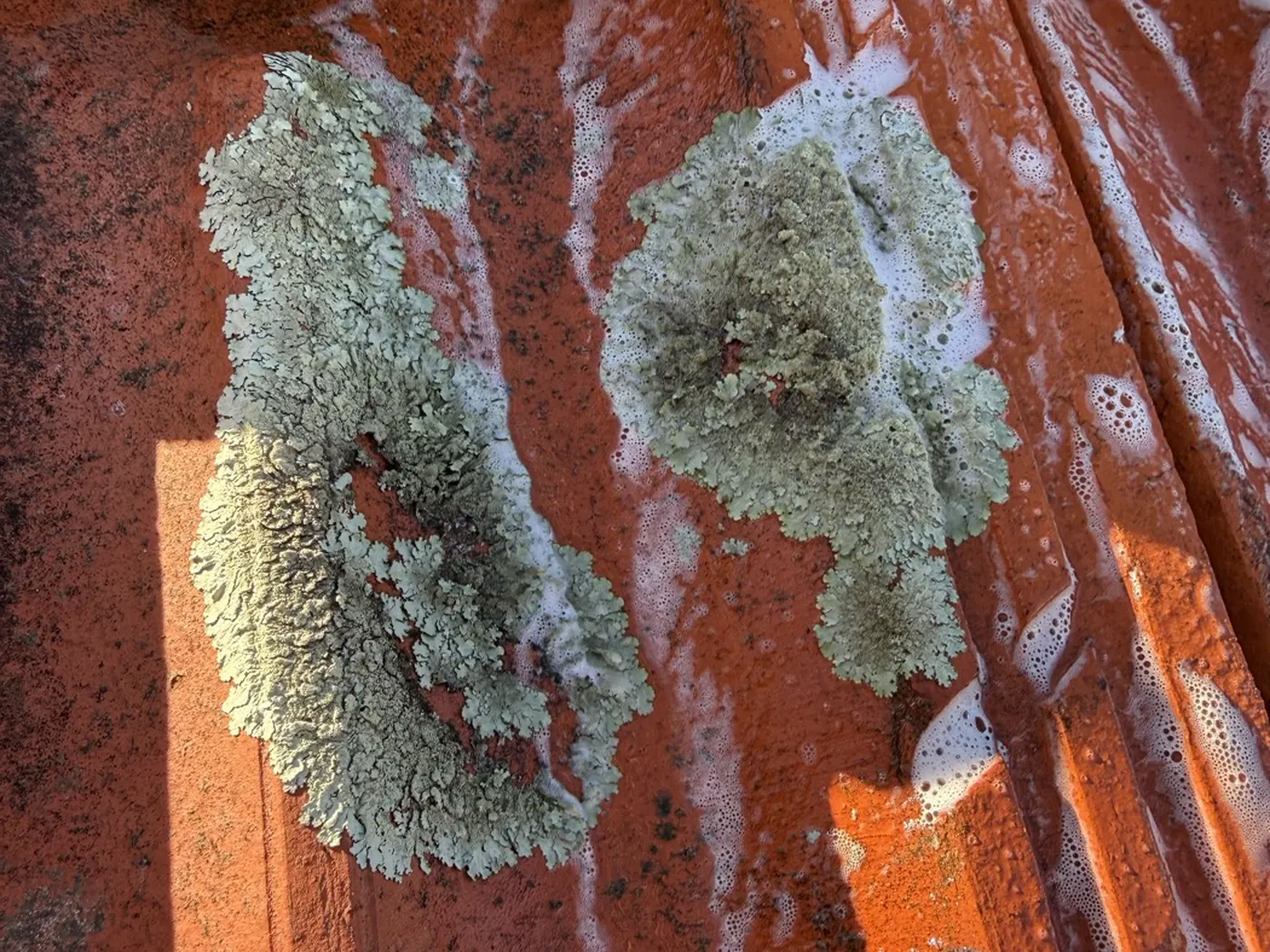
In plain terms Crustose is paint, foliose is a scatter of tiny lettuce leaves pressed flat, fruticose is a tuft of steel wool. All three are the same partnership in a different shape.
However it is attached, a lichen is anchored into the surface, not sitting on it, which is why it does not hose off. On rock, rhizines growing into fissures press on the stone around them, and so does the wetting and drying of a lichen bound tightly to it: studies have shown lichens can cause "appreciable weathering in a relatively short time".5 On clay roof tiles six to ten years old, electron microscopy found the threads of the lichen Verrucaria nigrescens penetrating the tile and filling its fissures and cracks.6 The same team traced the way lichen works on a tile to oxalic acid. In their lab tests on tile ceramic, oxalic acid changed the texture of the surface and formed whewellite, a calcium oxalate crystal they call a "destructive crystal phase", and they concluded that this acid action can deteriorate the ceramic and age roofing tiles.6 The full case is in does lichen damage roof tiles, and every mechanism side by side is in what growth does to a roof.
In plain terms A lichen on a tile is less like a sticker and more like a weed in the crack of a paver. Its threads are in the surface, and the surface is what it works on.
Switched on by water
Lichens are poikilohydric: they cannot regulate their own water content, so they wet and dry with their surroundings. Dry, a lichen tolerates heat up to 65 to 70 °C. Wet, it is sensitive to it.7 That matters on a roof. Roofs get hot: a black one in full sun can run 34 to 50 °C above the air.8 A dry lichen rides a Perth summer afternoon out switched off, and wakes with the dew. Lichens absorb water and nutrients straight through their surfaces.5
Too much water is a stress as well. Prolonged waterlogging can break the partnership down, and a lichen on a vertical face runs less risk of sitting in water than one on a flat surface.9
Colour shifts with water and light. Lichens come in greens, yellows, oranges, reds, browns, greys, whites and black, and those colours are chemicals the lichen makes.10 Some look quite different wet: one leafy species curls up dry and lies flat and darker when moist.3 Some carry pigments in the cortex that filter light for the photobiont, and lichens in exposed spots make more of them than lichens in shade.10 That is the story behind the orange ones, which have their own file.
In plain terms A lichen is a clock that only ticks when it is wet. On a Perth roof that means winter, dew and rain, and it sits out the summer afternoons stopped.
How it spreads, and how fast
Only the fungal partner reproduces sexually. It makes spores, often in small saucer shaped apothecia on the surface, and a spore that lands has to meet a suitable photobiont before a new lichen can form.11 The shorter routes carry both partners at once: powdery soredia, 20 to 100 micrometres across, small outgrowths called isidia, or simply a broken fragment.11 Wind, water and animals do the carrying, migratory birds included.1
Most of it does not go far. The majority of propagules are likely to land close to the parent. On vertical surfaces, lichens that shed soredia spread in downward streaks that suggest rainwash, extending downwards faster than upwards or sideways.12 On a pitched roof, downhill is the direction to watch.
A roof is good ground to land on. Freshly tiled roofs are among the bare surfaces lichens colonise5, and on old concrete roof tiles researchers have found lichen spores lodged in the pits of the weathered surface, often in clusters of eight, beside free living green algae.13
Then it grows, slowly. Crust lichens are the slowest growing of all, which is why their size is used to date exposed surfaces, a method called lichenometry.14 Leafy lichens usually form a recognisable young thallus within 15 months to 4 years, and most mature ones grow 1 to 5 mm a year at the edge.15 The detail is in how fast does lichen grow.
In plain terms A leafy rosette 8 cm across, growing 1 to 5 mm a year at its edge, has been anchored in that tile for somewhere between eight and forty years, working on it every wet season.
What it looks like as it dies
A treated lichen dies where it sits, and the weather takes it off. On the roofs we treat, growth starts coming away over 3 to 18 months. The makers describe the same process: Yates says its roof product "kills lichens on roofs but does not remove them"16, and Wet & Forget says lichen treated with its product will "take 8-12 months to decompose".17
The colour goes first. The photobiont layer contributes to a lichen's colour, and where it is missing the thallus shows paler.3 The fungus cannot survive without its partner, so when the photobiont dies the whole lichen dies with it.1 On the roofs we treat, a dead crust goes pale and chalky, then loosens and comes away with the weather. The rest of that story is in why dead lichen stays on the roof.
Sometimes it leaves a mark. On a coloured metal fence at Wallangarra, on the Queensland and New South Wales border, eye catching patterns turned out to hold remnant fragments of lichen. The Australian National Botanic Gardens calls them "the ghosts of departed lichens".18 What those marks are, and why a patch the lichen etched can stay marked, is in ghost marks.
In plain terms A dead lichen is like a dead leaf still on the branch. It is finished long before it falls.
What this means for your roof
The lichen on your tiles is not sitting on them. It is anchored into the surface, working on it whenever it is wet, and seeding new patches close by. We treat it where it sits with UNGROW Bailiff, applied from the roofline with a low pressure soft wash pump through non-directional nozzles, so nothing is blasted off the tile or forced under it. The lichen dies in place, starts coming away with the weather over 3 to 18 months, and the roof is checked against its day one photo at twelve months.
Also asked
Is lichen a mould or a mildew?
Neither, though it is part fungus. A mould is a fungus on its own, living off organic matter. A lichen is a fungus that carries its own photosynthetic partner, so it makes its own food from sunlight and does not depend on whatever organic matter lands on the tile, the way a mould does.
What are the three types of lichen?
Crustose, foliose and fruticose. Crustose lichens are flat crusts with no underside you can see. Foliose lichens are leafy, with lobes that lift at the edges. Fruticose lichens stand up from the surface or hang from it in tufts and beards. In a city the crusts are the hardiest of the three.
Does lichen have spores?
The fungus does. Many lichens make spores in small discs on their surface, and the wind carries them. A germinating spore still has to meet the right alga to become a lichen again. Many lichens also shed tiny granules that carry both partners at once, which is the shorter route.
What does lichen grow on?
A wide variety of surfaces, natural and man made. The Australian National Botanic Gardens lists soil, rock and tree trunks, leaves, glass, plastic, rubber, bone and old metal. In towns lichens take to concrete, bitumen and brick in place of rock, and to wooden seats and poles in place of bark. They are often among the first organisms to colonise bare surfaces, freshly tiled roofs included. Why your tiles suit them is in what causes lichen on roof tiles.
Is the lichen on my roof alive or dead?
Not by eye alone. A living lichen changes colour between wet and dry, and a dormant crust in summer looks lifeless. A dead one stays anchored where it sits until the weather breaks it down, and as its partner dies it loses colour and goes pale. That paling, then the crust loosening, is how a treated roof shows the lichen has ended.
On the record
- Australian National Botanic Gardens, What is a lichen?
- Australian National Botanic Gardens, Urban lichens in Canberra
- Australian National Botanic Gardens, Form and structure
- Microorganisms, Methyl Potassium Siliconate and Siloxane Inhibit the Formation of Multispecies Biofilms on Ceramic Roof Tiles: Efficiency and Comparison of Two Common Water Repellents (2021)
- Australian National Botanic Gardens, Lichen ecology
- Scanning, Evaluation of the effect of lichens on ceramic roofing tiles by scanning electron microscopy and energy-dispersive spectroscopy analyses (2005)
- Environmental science & technology, Heat shock treatments: a new safe approach against lichen growth on outdoor stone surfaces (2012)
- Lawrence Berkeley National Laboratory, Weathering of Roofing Materials: An Overview
- Australian National Botanic Gardens, Lichen habitats
- Australian National Botanic Gardens, Lichen chemistry
- Australian National Botanic Gardens, Reproduction and dispersal
- Australian National Botanic Gardens, Propagule dispersal
- Studia Geobotanica, Some observations on the establishment of the lichen Caloplaca aurantia on concrete tiles in Israel (1988)
- Geografiska Annaler: Series A, Physical Geography, Growth of crustose lichens: a review (2010)
- NERC Open Research Archive, Growth of foliose lichens: a review
- Yates, Yates Surrender Moss Killer
- Wet & Forget Australia, Roof cleaning information
- Australian National Botanic Gardens, Unusual substrates