The ruling
Yes, with a roof treatment from the hardware store used exactly to its label: a dry roof, a 12 hour dry window, the tank's downpipe off, plants protected and every face wetted. Reaching every face is ladder work. A professional treatment covers every face from the roofline, measured to the roof, with nobody on the tiles.
Can you clean your own roof?
Yes, with the method that needs no force: a leave-on treatment from the hardware store, used exactly as its label says. Yates Surrender, 30 Seconds Roof Treatment and Wet & Forget are all sold for moss and lichen on roofs, and the two whose roof directions speak to rinsing say to leave it on: 30 Seconds says "DO NOT RINSE OFF", Wet & Forget "DO NOT hose off".1, 2, 3 The methods that take growth off today, a jet, a scraper or a bleach wash that is scrubbed and rinsed, all put someone on the roof, as every way to clean a roof sets out.
Monier, which makes roof tiles, recommends that you do not attempt to clean your own roof tiles "due to the risk of falls and potential tile damage".4 Oregon State University Extension's safety advice opens: "Roof moss removal is not for everyone."5
In plain terms The bottle is the easy part. Doing it yourself means doing everything around the bottle, and the part that decides the result, getting it onto every face, happens at the top of a ladder.
How to clean your roof yourself: what the label asks
Surrender's label says the product "must be used strictly as directed".1 Across the shelf, that means:
- A dry roof on a still, dry day. Spray onto a dry surface, on an overcast day with little wind and out of direct sun, with no rain expected for 12 hours.2, 1, 3
- The tank off. Surrender's label says to disconnect a rainwater tank and leave it off for 3 to 4 weeks, with at least 6 mm of rain.1 30 Seconds counts rainfalls instead.2 More in rainwater tanks and roof treatment.
- The garden below. Surrender's label says to keep the spray off the foliage of wanted plants, except lawns. 30 Seconds and Wet & Forget say to wash plants down before and after, or cover them.1, 2, 3
- The gear. Surrender's safety directions call for cotton overalls buttoned to the neck and wrist, a washable hat, elbow-length PVC gloves, a face shield or goggles, and impervious footwear.1
- A full dose on every square metre. The directions say to wet or saturate the area treated.1, 2, 3 Wet & Forget says an average three bedroom tiled roof of about 150 square metres with lichen takes three of its 5 litre bottles, and that the undulations in the tiles make the area treated larger than 150 square metres.6 The mix starts with knowing how big your roof is, as how roof treatment works explains.
In plain terms It is like painting a house. The directions on the tin are short, and nearly all of the work is in the preparation and the reaching.
How do you apply a roof moss treatment?
With a pump sprayer. Yates says to apply Surrender preferably with a pressure or knapsack sprayer, 30 Seconds says a pump sprayer, and Wet & Forget a garden or backpack sprayer.1, 2, 3 A pump sprayer reaches as far as the arm holding the wand, so it goes up the ladder, and often onto the roof. Wet & Forget tells customers to be "safely harnessed to your roof", and never to walk on a section just sprayed because "it will be slippery until it is dry".3
With a hose end bottle. A hose end mixes the concentrate into the water as it sprays, so you stay on the ground. Wet & Forget says its hose end applies "up to 4 metres high".7 30 Seconds says its coverage depends on the water pressure "and the application style of the person using the product".8
Not with a powder from the garden aisle. The moss products sold here by the bag are made for lawns. Manutec's "Moss Killer & Lawn Food" is a crystalline powder, about half iron sulphate, recommended for moss and weeds in lawns, ovals and greens,9 and its maker says not to apply it near concrete, slate, stone or brick, because the iron can leave rusty stains.10 A concrete roof tile is concrete. Even the zinc sulphate powder in Oregon State University's roof moss guidance is mixed into water and put on with a pump sprayer.5
A soft wash is a clean, not a treatment: bleach and water put on gently, left on for minutes and rinsed off.11, 12 A bleach cleaner from the hardware store adds a scrub: "Spray, Scrub, Rinse", in the words of 30 Seconds, which says its Outdoor Cleaner, made with sodium hypochlorite, does not treat lichen.13 On a roof, the scrub and the rinse are done standing on it. More in soft wash or pressure wash.
In plain terms A pump sprayer puts the dose where your arm can reach, and a hose end puts it where the water happens to land. Neither one knows how big your roof is.
The ladder is where it goes wrong
Falls on and from ladders accounted for 6,230 hospitalisations in Australia in 2024 to 25.14 Victoria's trauma registry shows who gets hurt at home: of 576 domestic ladder falls serious enough to count as major trauma between 2005 and 2013, 91.5 percent were men and 70.5 percent were aged 60 or over, and cleaning gutters, windows and roofs was the second most common job they were doing.15
In WA in October 2024, a worker cleaning gutters and roof tiles at a house died when he fell through the roofing of a patio. Among the common factors in that year's fatal roof falls, WorkSafe WA found that alternative work methods to eliminate the need to enter the fragile roof were not considered.16 Underfoot, WA Health's guidance on asbestos cement roofs, quoting the code of practice for asbestos removal, warns that lichen "can be slippery, especially when it is wet".17 More in why nobody needs to walk on your roof.
In plain terms The risk in doing it yourself is not in the bottle. It is in the climb, made each time the roof is treated, with a full sprayer in one hand.
The faces you cannot see from the lawn
From the lawn you see the faces that tilt towards you. Growth is heaviest where a roof stays damp longest, and shade keeps it damp: Oregon State says moss depends on shade to thrive.5 In Australia the winter sun sits low and to the north,18 so the south faces see least of it, and on the roofs we treat they carry the most growth. Add the faces under trees, the valleys and the laps, and much of the growth is where a hose aimed from the lawn reaches least.
A missed face is not a small miss. On engraved sandstone in Italy, monitored for 54 months after cleaning, regrowth came mainly from the uncleaned surfaces around each treated patch.19 Growth left on one face reseeds the faces around it. To see every face of your own roof from above, and where growth settles first, run the Roof Report.
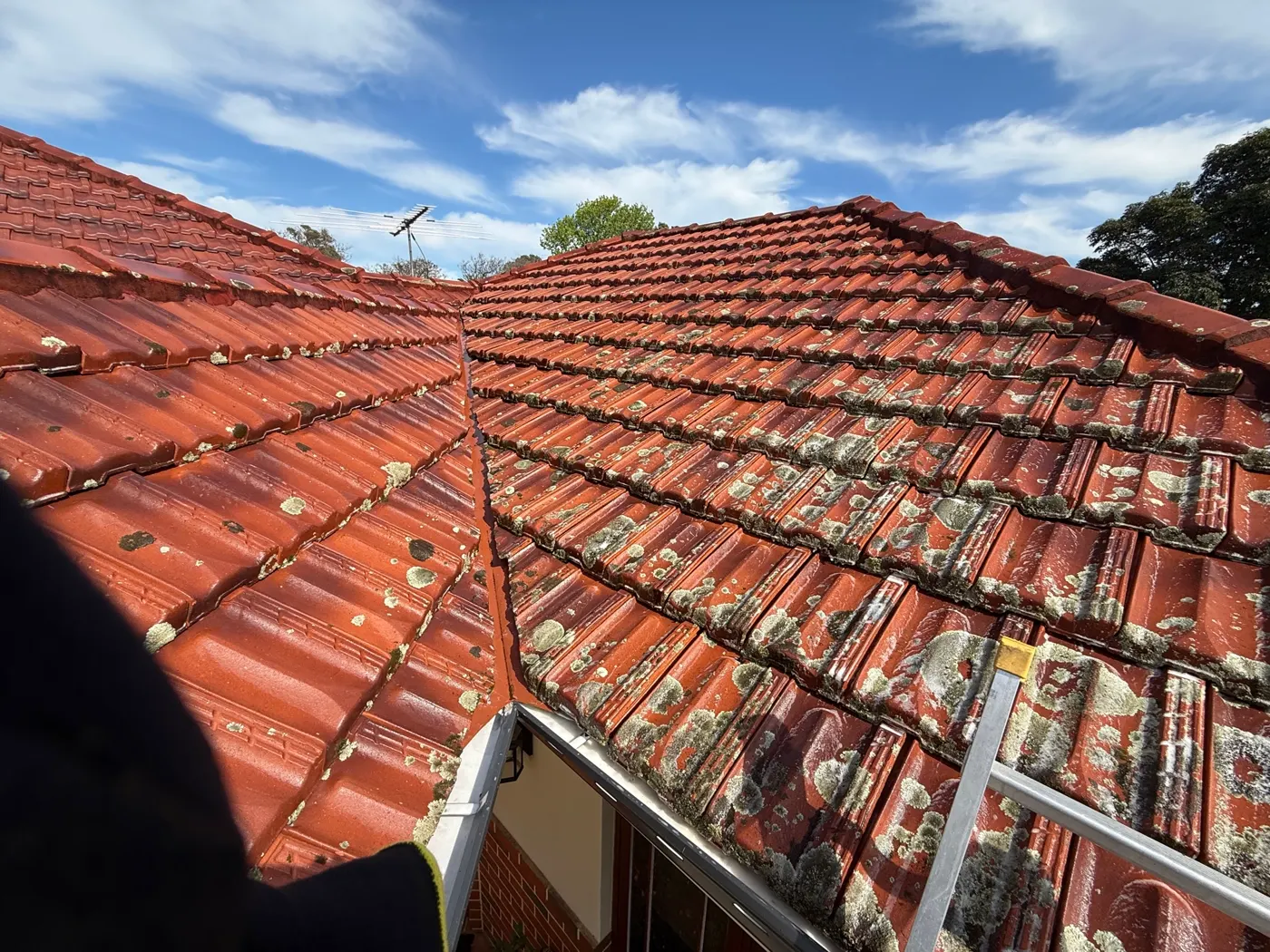
In plain terms Spraying a roof from the lawn is like painting a fence from one side. The side you can see looks done.
What we do instead
We measure the roof before we arrive, from aerial imagery of the address. The price is built from that area, with set additions for a second storey, difficult access and outer suburbs: a first treatment with UNGROW Bailiff is from $539 including GST, a fixed price, with no site visit.
On the day, Bailiff is mixed to the label rate for that area and applied with a low pressure soft wash pump through non-directional nozzles, from ladders at the roofline. Every face gets its dose, including the ones you cannot see from the lawn, and nobody walks on the roof. We spray around solar panels, not on them. We treat the roof, not the gutters: dead growth washes into them over the months after, so they are worth clearing after the first winter. We are fully insured, and if we break something, we fix it at our cost.
The roof is photographed on the day from a fixed position. Growth starts coming away over 3 to 18 months, and if the roof looks the same as that photo at twelve months, we treat it again, free. What a roof like yours typically does, month by month, is in When will it clear?
In plain terms You can service your own car with a manual and a weekend. What a mechanic adds is the hoist, the parts in bulk, and someone to come back to if it is not right.
What this means for your roof
What a professional treatment gives you is every face of your roof dosed for its measured area, including the ones you cannot see from the lawn, with no ladder for you and nobody on the tiles. You can treat it yourself to the label, but a face you miss keeps its growth, and it reseeds the ones you treated. We treat it with UNGROW Bailiff from the roofline, and UNGROW Sentry, our preventative, keeps it treated after that.
Also asked
Can you spray a moss treatment on a roof yourself?
Yes. The roof treatments at the hardware store are made to be sprayed, and each maker says how: Yates says Surrender is best applied with a pressure or knapsack sprayer, 30 Seconds says a pump sprayer, and Wet & Forget a garden or backpack sprayer, or its hose end bottle. Spray a dry roof with no rain expected for 12 hours, and leave it on. The hard part is getting it onto every face without standing on the tiles.
Can you sprinkle moss powder or granules on a roof?
Not the moss products sold here by the bag. They are made for lawns. Manutec's is about half iron sulphate, recommended for moss in lawns, ovals and greens, and its maker says to keep it away from concrete, slate, stone and brick because the iron can leave rusty stains. Even the zinc sulphate powder used on roofs in North America is mixed into water and sprayed on, in Oregon State University's guidance.
How do you soft wash a roof yourself, without a ladder?
A soft wash is bleach sprayed on at low pressure, left on for minutes and rinsed off. A hardware store bleach cleaner adds a scrub: 30 Seconds sums up its Outdoor Cleaner as "Spray, Scrub, Rinse". On a roof, the scrub and the rinse put someone on the tiles, and the same maker says its bleach cleaner does not treat lichen. From the ground, the closest thing is a leave-on treatment in a hose end bottle, which reaches only the faces the water can land on.
Can I clean moss off my roof myself?
Yes, with a treatment rather than a scraper. Scraping or brushing it off means standing on the roof, and Monier, which makes roof tiles, recommends you do not clean your own roof tiles because of the risk of falls and of damaging tiles. A treatment sprayed on and left ends the moss where it sits, and the weather carries it off over the following months, some of it into the gutters, which are worth clearing after the first winter.
Is it cheaper to do it myself?
A bottle costs less than a treatment, and leaves the whole job to you. What a professional treatment adds is that job: the roof measured, the dose mixed for that area, every face covered from the roofline with nobody on the tiles, and a twelve month check. A first treatment with UNGROW Bailiff is from $539 including GST, built from your roof's area measured from aerial imagery, with set additions for a second storey, difficult access and outer suburbs, as a fixed price.
On the record
- Yates / Hortag, Surrender Mosskiller label (10 L)
- 30 Seconds Australia, Roof Treatment
- Wet & Forget Australia, Lichen or black mould on your roof?
- Monier, Roof cleaning and maintenance
- Oregon State University Extension Service, How to control roof moss and prevent long-term damage
- Wet & Forget Australia, Roof cleaning information
- Wet & Forget Australia, Rapid Application Mould Removal inc Moss, Lichen & Algae
- 30 Seconds Australia, Spray & Walk Away
- Manutec, MSDS: Manutec Moss Killer & Lawn Food (2025)
- Manutec, Moss Killer & Lawn Food 2.5kg
- Asphalt Roofing Manufacturers Association, Algae discoloration of roofs
- BlueScope, TB-27: Identification of fungus in the field and recommendations for its removal (2022)
- 30 Seconds Australia, Outdoor Cleaner
- Australian Institute of Health and Welfare, Injury in Australia: Falls (2026)
- Monash University Injury Research Institute, for the Victorian Department of Health, Report on the reduction of major trauma and injury from ladder falls (2014)
- WorkSafe WA, Health and Safety Bulletin No. 17: Falls through fragile roofs and roof openings (2024)
- WA Department of Health, Guidance Note on Asbestos Cement Roofs
- Your Home (Australian Government), Orientation
- The Science of the total environment, Lithobiontic recolonization following cleaning and preservative treatments on the rock engravings of Valle Camonica, Italy: A 54-months monitoring (2023)