 Moss
The ruling
Treat it where it sits and let the weather take it off. A roof moss treatment soaks into the cushion and ends it in place, and the dead moss loosens and washes away over the following months. Scraping breaks and scars tiles, a pressure jet erodes their surface, and both put someone on the roof.
Why moss does not just come off
Moss is a bryophyte, a small plant with no true roots. It holds on with rhizoids, anchoring threads that, unlike roots, do not draw water up from what they grow on.1 Wienerberger, the tile maker, says it grows within the joints and interlocks of tiles, blocking the channels that drain them, and thrives on the ridge mortar, cracking it as it penetrates the cement.2
A moss is also more than the green you can see. In a cushion, the older leaves lower down the stems die, "leaving a living green layer atop a mass of brown, dead material".3 Bryophytes absorb water quickly and release it slowly,4 and Sandtoft, the tile maker, says the primary effect of moss on a roof "is that it holds water" against the tiles.5 Why that matters is in is moss on the roof a problem.
In plain terms A moss cushion is the thatch in an old lawn. A thin green top over a deep mat of dead stems, and the mat is most of it.
Can you scrape or brush moss off a roof?
You can, and the tile makers say not to. Sandtoft does not recommend scraping: it "will inevitably result in broken or damaged tiles and consequent roof leaks", leaves scrape marks, and "No matter how carefully it is done, it will have to be done again in due course because the moss will return."5 Scraping also breaks moss into fragments, and a fragment that lands somewhere suitable can grow into a new plant.1
Wienerberger also says to avoid walking on roof tiles, because even one that does not break underfoot can develop hairline cracks that go unnoticed.2 Monier recommends homeowners do not try to clean their own roof tiles at all, because of the risk of falls,6 and falls on and from ladders accounted for 6,230 hospitalisations in Australia in 2024 to 25.7 More in why nobody needs to walk on your roof.
In plain terms Scraping moss off a tile is scrubbing a non-stick pan with steel wool. It comes up clean, and the surface you were looking after comes up with it.
Can you pressure wash moss off a roof?
Pressure cleaning is the fast way to a clean looking roof, and the tile makers advise against it in writing. Monier "strongly advises against the use of pressure washers for roof cleaning".6 Marley says high powered jet washing "can damage the surface of the slate or tile, thus reducing its expected life considerably".8 The UK Roof Tile Association says a high pressure jet should never be used to clean moss off concrete tiles, because it erodes the surface and shortens the tile's life.9
What the jet leaves behind fouls faster: in laboratory tests on cement mortars, the fouling rate was governed by roughness and porosity.10 And a jet scatters what it blasts off across the roof, the gutters and the garden, and a fragment that lands somewhere damp can grow into a new plant.1 On an asbestos cement roof in WA, high pressure water is prohibited outright.11 The full case is in does pressure cleaning damage roof tiles.
In plain terms A jet on a mossy roof is a leaf blower on a pile of grass clippings. The pile is gone, and the clippings are everywhere.
What about bleach and a soft wash?
A soft wash swaps pressure for chemistry, usually sodium hypochlorite, bleach. 30 Seconds Outdoor Cleaner, a bleach cleaner sold for algae, moss, mould and mildew, is typical: its directions are to leave it on for up to 10 minutes, "then give the surface a good scrub and rinse clean".12 On a roof, the scrub is someone on the tiles, and the rinse sends everything into the gutters and the garden. A leave-on treatment is the opposite: sprayed on and not rinsed at all.13 Vinegar, borax and the rest of the kitchen cupboard are in home remedies.
In plain terms A soft wash is the bathroom cleaner routine. Spray, wait, scrub, rinse. On a roof, the scrub and the rinse are the hard parts.
What gets rid of moss on a roof without scraping it
A roof moss treatment, left on. Most roof moss products on Australian shelves are benzalkonium chloride, a quaternary ammonium compound, as the products at Bunnings show. Yates says Surrender, its 500 g/L concentrate, is "taken up by moss, algae and liverwort within minutes", and that under the right conditions and rates moss dies within hours. On tiled roofs it is sprayed to just wet, with no rain expected within 12 hours.14 In a laboratory study of a commercial benzalkonium chloride biocide, the active accumulated in a moss, stayed there without significant change for up to 21 days, and severely impaired the machinery the moss makes its food with, with no recovery.15
Nothing comes off on the day. The moss dies where it sits, still anchored, and Sandtoft says the dead growths "will eventually weather off and disappear".5 On the roofs we treat, growth starts coming away over 3 to 18 months; the month by month version is in how long roof treatment takes, and When will it clear? works it through for the month your roof is treated. Every face matters: on sandstone in Italy, regrowth after cleaning came in mainly from the uncleaned surfaces around each treated patch.16
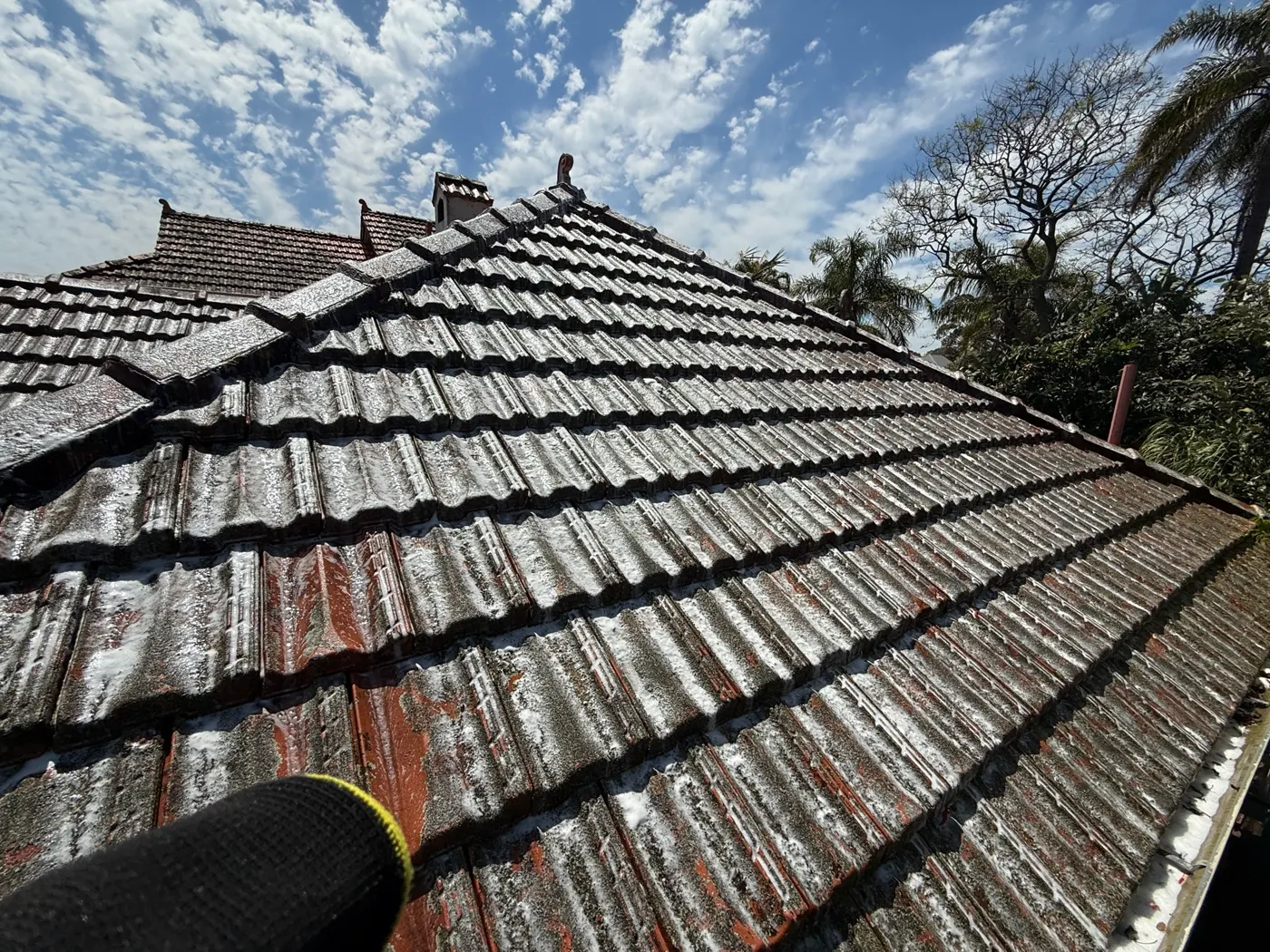
We do it with UNGROW Bailiff, our benzalkonium chloride treatment. The roof is measured from aerial imagery, Bailiff is mixed on the day to the label rate for that area, and every face gets it, from ladders at the roofline, with a low pressure soft wash pump through non-directional nozzles, so nothing is forced under the tiles or laps. Nobody walks on the roof. We spray around solar panels, not on them. A first treatment is from $539 including GST, priced from the roof's measured area, with set additions for a second storey, difficult access and outer suburbs.
In plain terms A dry moss cushion drinks a treatment the way a dry sponge drinks a spill. What it drinks stays in it, and the rain does the rest.
How to remove heavy moss from a roof
Heavy moss is treated the same way, where it sits, from the roofline. It simply has more to shed. The cushions are deep, and they sit where the roof drains: along the laps and interlocks, on the ridge mortar, and in the valleys and gutters.2, 5 The Roof Report shows your own roof from above, face by face, and where moss settles first. Three things to expect.
- More than one pass. For heavy infestations, Yates says repeat applications of its roof concentrate may be required.14
- More dead matter to go. Much of a thick cushion was dead before it was treated: the brown mass under the green.3 And moss is slow to rot. In a two year experiment in subarctic Sweden, litter from 27 mosses and liverworts broke down at about a fifth of the rate of vascular plant litter.17
- It goes where the water goes. Dead moss washes down a little with each rain, into the valleys and the gutters. Monier calls clearing gutters, downpipes and valleys "the number one maintenance issue" on a roof.18
Gutters are not part of our job: we treat the roof, and we do not clean gutters. The dead moss washes into them over the months after a treatment, so on a heavily mossed roof they are worth clearing after the first winter. Moss in gutters and valleys has the detail.
On heavy moss, the guarantee earns its keep. We photograph the roof on the day from a fixed position, and if it looks the same as that photo at twelve months, we treat it again, free.
In plain terms Heavy moss is a lawn that has not been dethatched in years. The spray works fast. Raking out the thatch takes the time, and on a roof the rain does the raking.
What this means for your roof
No blade, no jet and nobody on your tiles: UNGROW Bailiff, sprayed from the roofline, ends the moss where it sits, and over the following months the weather carries it off, and with it the water it held against your tiles. Growth recurs, so UNGROW Sentry, our preventative, keeps the roof treated after that, and how to stop moss growing back on a roof explains how.
Also asked
Is it OK to brush moss off the roof?
Not from on top of it. Brushing or scraping means standing on the tiles, and Wienerberger, the tile maker, says even a tile that does not break underfoot can develop hairline cracks nobody sees. Sandtoft says scraping "will inevitably result in broken or damaged tiles", and that it has to be done again as the moss returns. A brush also breaks moss into fragments, and a fragment that lands somewhere damp can grow. Treat it first, and the dead moss loosens and washes off with the rain.
What can I spray on my roof for moss?
A roof moss treatment whose label names moss and roofs. Most on the Australian shelf are benzalkonium chloride, from 99 to 500 grams a litre. Spray it onto a dry roof with no rain expected for 12 hours, at the rate on the label, on every face, and do not rinse it off. Vinegar, bleach and detergent are not the same thing, and detergent works against a benzalkonium chloride treatment in the sprayer.
How long does it take for dead moss to come off a roof?
Months, not days. Treated moss dies where it sits, still anchored by its threads, and comes away as the weather loosens it, a little with each rain. On the roofs we treat, growth starts coming away over 3 to 18 months. Thick cushions along the laps and in the valleys take longest, because much of a deep cushion is dead matter already, and dead moss is slow to rot.
How do you get rid of moss on concrete roof tiles?
The same way as on terracotta: treat it where it sits and let the weather take it. Concrete needs more care with the alternatives. The UK Roof Tile Association says a high pressure jet should never be used to clean moss off concrete tiles, because it erodes the surface, and Wienerberger says a jet can strip the colour from them. Vinegar is an acid, and acid attacks the cement a concrete tile is made with.
What is the easiest way to get moss off a roof?
Let the weather do it. A leave-on treatment, sprayed onto a dry roof at the label rate, ends the moss where it sits, and the rain carries it off over the following months. Nobody scrapes, nobody blasts and nobody walks the tiles. The best tool for removing moss from a roof is a sprayer, not a scraper. The hard part is getting the right dose onto every face from the roofline, and that is the part we do.
How do you remove and prevent moss on a roof?
In that order. Remove it by treating it where it sits: UNGROW Bailiff, sprayed from the roofline at the label rate, ends the moss in place, and the weather carries the dead moss off over the following months. Then keep it treated. Spores keep landing on every roof, so moss comes back on any face that stays damp. UNGROW Sentry, our preventative, keeps the roof treated once it is clear, and letting the sun in and keeping the valleys clear helps too.
On the record
- Australian National Botanic Gardens, What is a bryophyte?
- Wienerberger UK, How to Clean Roof Tiles
- Australian National Botanic Gardens, What is a moss
- Australian National Botanic Gardens, Bryophyte ecology
- Sandtoft (Wienerberger UK), The growth of mosses & lichens on tiled roofs (2008)
- Monier, Roof cleaning and maintenance
- Australian Institute of Health and Welfare, Injury in Australia: Falls (2026)
- Marley (UK), Can I clean or jet wash my roof tiles?
- Roof Tile Association (UK), Care, Maintenance & Repair of Clay and Concrete Roof Tiles (2016)
- The Science of the total environment, Bioreceptivity evaluation of cementitious materials designed to stimulate biological growth (2014)
- WorkSafe WA, Safety alert 12/2018: high pressure water cleaning of asbestos cement prohibited
- 30 Seconds Australia, Outdoor Cleaner
- 30 Seconds Australia, Roof Treatment
- Yates Australia, Surrender Mosskiller: Technical Data Sheet
- Stresses, Accumulation and Phytotoxicity of Two Commercial Biocides in the Lichen Evernia prunastri and the Moss Brachythecium sp. (2021)
- The Science of the total environment, Lithobiontic recolonization following cleaning and preservative treatments on the rock engravings of Valle Camonica, Italy: A 54-months monitoring (2023)
- Journal of Ecology, An experimental comparison of chemical traits and litter decomposition rates in a diverse range of subarctic bryophyte, lichen and vascular plant species (2009)
- Monier, FAQs