 Moss
The ruling
Keep every face of the roof treated, let the sun in, and keep the valleys and gutters clear. Spores land on every roof, so the answer is to meet them as they land: a preventative across the whole roof, topped up before growth builds, so they land on a treated surface.
Why does moss keep coming back on a roof?
Because the supply never stops. Most mosses and their relatives rely on the wind to spread their spores, typically 5 to 50 micrometres across, and broken fragments of moss can grow into new plants.1 Lichens shed soredia and isidia, tiny packets carrying both partners, by wind, water and animals2, and algae are carried through the air too.3
Researchers who followed cleaned marble monuments for nine years describe recolonisation as a natural process that occurs sooner or later after cleaning, at a pace set by water, light and the products used.4 A roughened surface speeds it up: in lab tests on cement mortars, how fast algae fouled a surface was governed by its roughness and porosity.5 Monier, which makes roof tiles, "strongly advises against the use of pressure washers for roof cleaning".6
In plain terms Weed seed blows into every garden in the street. Whether a bed stays clear depends on what the seed lands on, not on keeping the seed out.
What stops moss growing on a roof?
Fewer wet hours. Jay Pscheidt, a plant pathologist with the Oregon State University Extension Service, says: "You can clean all you want but to keep moss at bay, the environment needs to change. You've got to let the sun in or it will return."7
- Let the sun in. In Australia the sun's path is to the north, so north facing surfaces get the longest winter sun8, and the south faces and anything under a tree stay wet longest (why roofs grow moss and lichen). Trim back what shades the roof. Run the Roof Report to see which faces of your roof get the least sun.
- Cut the debris. Monier says trimming overhanging branches and fitting leaf guards can reduce debris, and advises cleaning gutters and valleys at least once a year, more often where trees surround the roof.6 A valley packed with leaves holds water against the tiles either side (moss in gutters and valleys). Gutter cleaning is not part of our roof treatment. After a treatment, the gutters are worth clearing after the first winter, once dead growth has washed down.
- Look every couple of years. A New Zealand roofing firm's maintenance schedule for concrete and terracotta tile roofs lists an inspection for moss and lichens every two years.9
Conditions come first. On engraved sandstone in Italy, monitored for 54 months after cleaning, the more shaded zone filled back in fastest, and regrowth moved in mainly from the uncleaned rock around each cleaned patch.10 No pruning turns a south face into a north one, and growth left on one face is the supply for the next. That is why a preventative goes on every face of the roof, not only the faces that show growth.
In plain terms The corner of the courtyard under the tree is the one that goes green. Cutting the tree back does more for it than any amount of scrubbing.
Do zinc or copper strips stop moss?
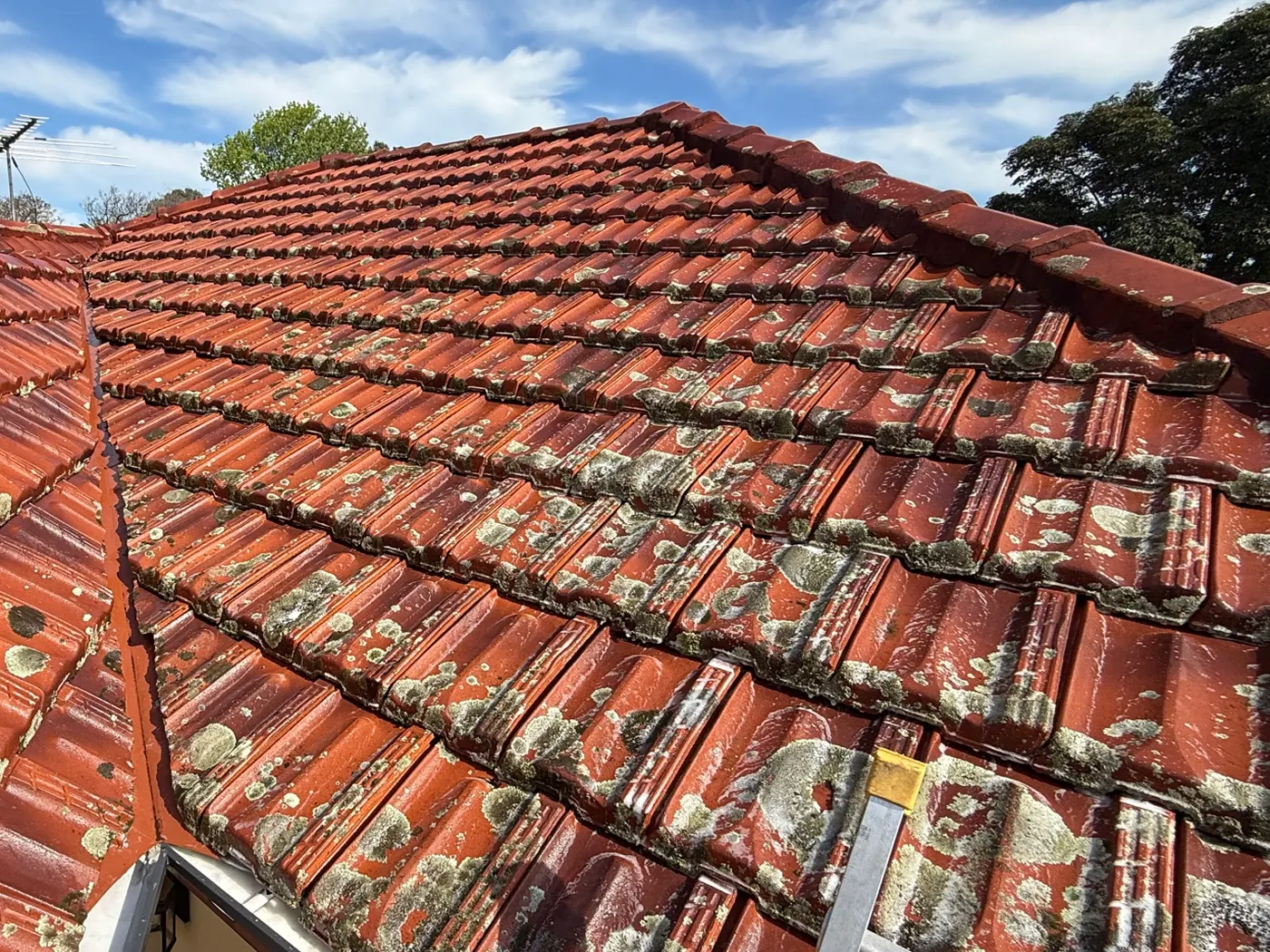
In a band below them. A zinc strip along the ridge releases zinc with every rain. Oregon State guidance, quoted by the University of Washington, says strips appear to have effect up to 15 feet (about 4.6 metres) below them, are considered effective for up to a year for most brands, and work best once the existing moss is removed.11 Copper works the same way, as zinc and copper ions can inhibit biological growth12, but Lysaght lists copper draining onto Colorbond or Zincalume steel as not compatible.13 More in do zinc strips stop roof moss.
In plain terms A zinc strip is a porch light. It lights the steps under it and leaves the side path dark.
Is there a spray that stops moss growing on a roof?
Yes: a preventative, applied to a clear roof so whatever lands next meets a treated surface. On the Italian rock, biocides applied after cleaning gave the best results through two growing seasons10, and Wet & Forget says one application of its product "creates a protective environment that keeps new growth at bay for up to a year".14
That residual effect is measured in seasons, not forever, so a preventative is a top up, repeated before growth builds again.
Ours is UNGROW Sentry, built on benzalkonium chloride. It goes on every face from the roofline, measured to the roof's area, through a low pressure soft wash pump and non-directional nozzles, and nobody walks on the tiles. We spray around solar panels, not on them. It is priced off the address from aerial imagery, at a fixed price. It suits two roofs:
- A roof cleared with UNGROW Bailiff, our treatment. We check it at twelve months against the photo from the day, then get in touch about a Sentry top up at around two years, sooner under trees and on metal roofs, where smooth painted steel holds less of the treatment than a porous tile. See how often does a roof need treating.
- A roof with nothing showing yet. Ceramic roof tiles are rapidly colonised by microbes that form biofilms15, and lichens are often among the first organisms to colonise a freshly tiled roof.16
A roof already carrying moss or lichen needs Bailiff first: see how to get rid of moss on a roof. When will it clear? works through how it comes away for the month it is treated. A coloured respray is no substitute. Monier says "respraying your roof is aesthetic only and will not repair your roof".17
In plain terms A preventative is a pre-emergent for the roof. It goes onto clean ground so the next seed fails to take, and it gets topped up, because the seed keeps coming.
How do you prevent lichen on a roof?
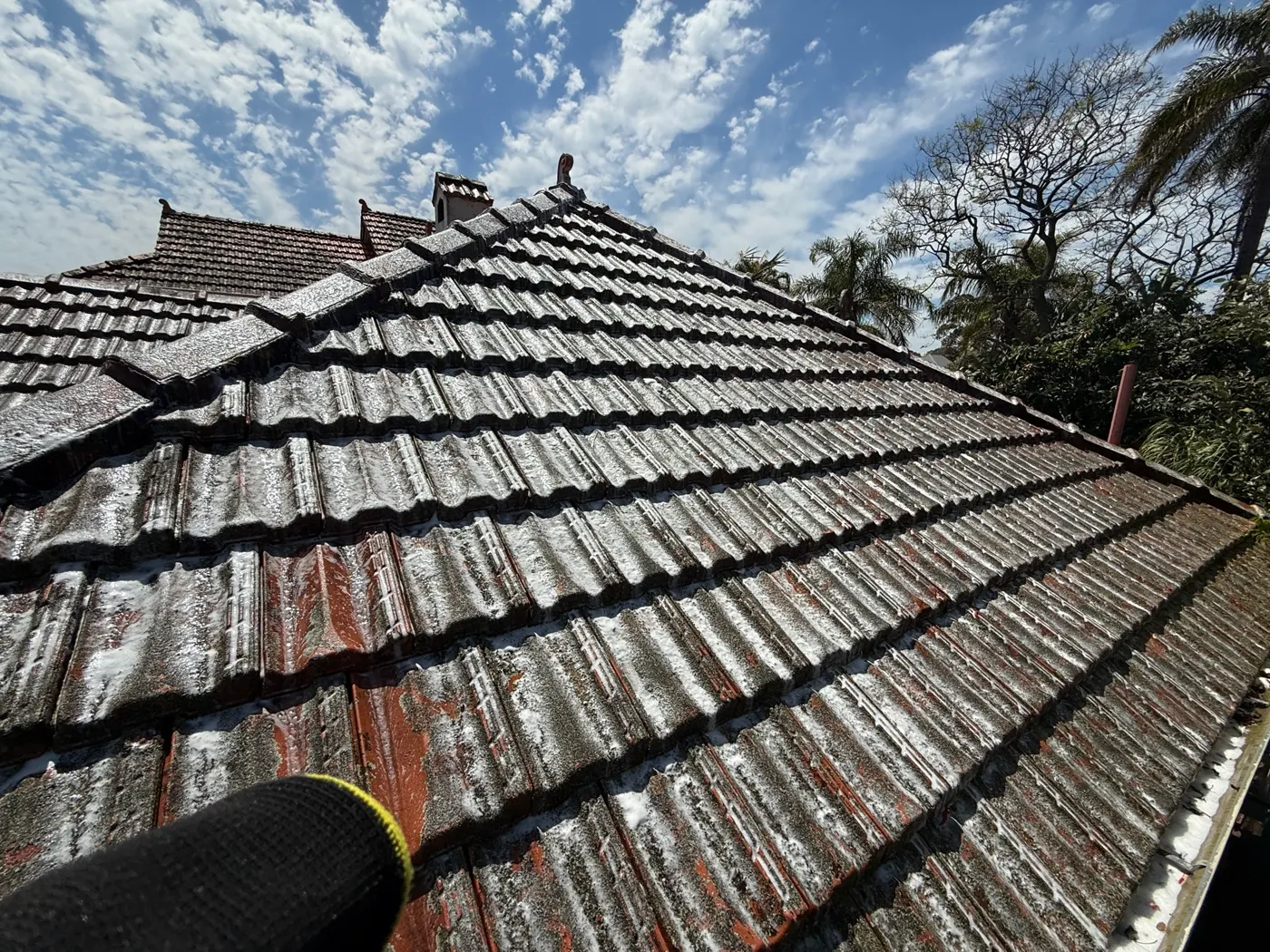
Catch it before it anchors. On clay roof tiles six to ten years old, electron microscopy found lichen threads penetrating the tile and filling its fissures and cracks.18 Crust lichens are the slowest growing of all lichens19, so a speck that settles now can sit on the tile a long time before it catches your eye, with its threads working into the tile all that time. A preventative meets lichen as soredia and fragments land. An established crust needs Bailiff (how to get rid of lichen on roof tiles), and its etch can stay as a ghost mark.
Keeping water out of the tile helps too. In a six year outdoor trial in France, grey leafy lichens colonised only the clay roof tiles left without a water repellent.15
In plain terms Lichen is a tenant on a long lease. Stopping one moving in is far easier than evicting one that has been there for years.
How do you prevent algae, mould and black streaks on a roof?
Keep the film off, and you take away the layer that helps moss settle. Researchers studying clay roof tiles note that these films of bacteria, algae and fungi "promote the settlement of macroorganisms such as plants and mosses".15 Research on roofing granules found the most frequent cause of black staining to be a cyanobacterium, Gloeocapsa magma.12
Metal holds the film back. Patents describe cuprous oxide, alone or with zinc compounds, in roofing granules to stop the growth of cyanobacteria such as Gloeocapsa and fungi12, and the American shingle makers say algae resistant shingles are commercially available.3 Tile and steel roofs carry no such granules, so on those the job falls to a preventative on every face. Bleach is not prevention: the same makers say the effectiveness of bleach cleaning "is only temporary, and the discoloration may recur".3
Under some trees the black is sooty mould, growing on the honeydew that sap sucking insects drip below. The University of California's pest management program says its control "begins with managing the insect creating the honeydew".20 More in roof algae, black streaks and mould on a roof.
In plain terms The film is the topsoil of a roof. Stop it forming and the moss that would follow has nothing to settle into.
What this means for your roof
What you get is a roof that stays clear because it stays treated. Spores will keep landing, so give them less to work with: more sun, clear valleys and gutters, and every face kept treated. If growth is already there, we treat it with UNGROW Bailiff from the roofline, and the weather carries it off over the following months. After that, UNGROW Sentry keeps the whole roof treated, topped up before growth builds back, and nobody walks on the tiles.
Also asked
How long does it take for moss to grow back on a roof?
It depends on the face, not the calendar. A shaded south face under trees fills in first and an open north face last. Researchers who followed cleaned monuments for nine years found the pace was set by water, light and what was applied. A New Zealand maintenance schedule for tile roofs calls for an inspection for moss and lichens every two years. We check at twelve months against the photo from the day, and get in touch about a Sentry top up at around two years.
Is there a natural way to stop moss growing on a roof?
Sunlight is the closest thing. A plant pathologist at Oregon State University puts it plainly: to keep moss at bay the environment has to change, and you have to let the sun in or it returns. Trimming trees and clearing the valleys cut the wet hours moss needs. Spores keep landing on any face that stays damp, so staying treated is what keeps it off.
Will painting or sealing the roof stop moss coming back?
Keeping the roof treated is what does that. A coloured respray changes the colour: Monier says respraying a roof is aesthetic only and will not repair it. A clear water repellent works another way, by limiting how much water the tile takes up: in a six year outdoor trial on clay roof tiles in France, only the uncoated tiles grew grey leafy lichen. Neither one moves the shade or the rain that bring growth to a roof, so the preventative still does the work.
How do you stop moss and algae on roof shingles?
On algae resistant shingles, the defence against algae is built in. The research on roof weathering describes cuprous oxide, alone or with zinc compounds, added to roofing granules to stop cyanobacteria such as Gloeocapsa and fungi growing, and the American shingle makers say algae resistant shingles are commercially available. Moss is another matter: a zinc strip reaches only a band below it. Tile and steel roofs carry no such granules, so on those the job falls to a preventative on every face.
Can a preventative go on a roof that already has moss?
It follows the first treatment. Moss cushions and anchored lichen crusts are ended where they sit by UNGROW Bailiff, our treatment, and the weather carries them off over the following months. That is from $539 including GST, priced from the roof's area measured from aerial imagery, with set additions for a second storey, difficult access and outer suburbs. Once the roof is clear, UNGROW Sentry, our preventative, keeps it treated from then on.
On the record
- Australian National Botanic Gardens, Dispersal
- Australian National Botanic Gardens, Reproduction and dispersal
- Asphalt Roofing Manufacturers Association, Algae discoloration of roofs
- Science of the Total Environment, Recolonization dynamics of marble monuments after cleaning treatments: A nine-year follow-up study (2024)
- The Science of the total environment, Bioreceptivity evaluation of cementitious materials designed to stimulate biological growth (2014)
- Monier, Roof cleaning and maintenance
- Oregon State University Extension Service, How to control roof moss and prevent long-term damage
- Your Home (Australian Government), Orientation
- Roofing Systems Ltd (New Zealand), for Monier tiles, Maintenance schedule for concrete and terracotta tiles roofs
- The Science of the total environment, Lithobiontic recolonization following cleaning and preservative treatments on the rock engravings of Valle Camonica, Italy: A 54-months monitoring (2023)
- Elisabeth C. Miller Library, University of Washington, On roof moss removal
- Lawrence Berkeley National Laboratory, Weathering of Roofing Materials: An Overview
- Lysaght (BlueScope), Compatibility of Materials for Direct Contact and Drainage
- Wet & Forget Australia, Remove Mould, Moss, Lichen & Algae Outdoor
- Microorganisms, Methyl Potassium Siliconate and Siloxane Inhibit the Formation of Multispecies Biofilms on Ceramic Roof Tiles: Efficiency and Comparison of Two Common Water Repellents (2021)
- Australian National Botanic Gardens, Lichen ecology
- Monier, FAQs
- Scanning, Evaluation of the effect of lichens on ceramic roofing tiles by scanning electron microscopy and energy-dispersive spectroscopy analyses (2005)
- Geografiska Annaler: Series A, Physical Geography, Growth of crustose lichens: a review (2010)
- UC Statewide IPM Program, University of California, Sooty Mold