The ruling
Two main suspects. Efflorescence is a white bloom of calcium carbonate that comes out of concrete tiles and weathers off on its own. Pale crust lichen is alive: a round, sharp edged patch anchored into the tile, etching it with acid and spreading every year until it is treated. Droppings, chalking paint and salt are the rest.
Something from inside, something alive, or something that landed
White on a roof comes from one of three places. It can come out of the tile itself, it can be growing on the tile, or it can have landed on it. The first is efflorescence, the second is lichen, and the third is bird droppings, salt or the powder from ageing paint. They look alike from the street, and they could hardly be more different. One goes away on its own, one stays and spreads, and the rest depend on what put them there.
In plain terms A tide mark, a weed and a fallen leaf can all be the same colour on a garden path. Only the weed has roots, and only the weed keeps growing.
Efflorescence: salt from inside the tile
Monier, which makes roof tiles, answers this exact question in its FAQ. Occasionally, it says, the natural salts in a concrete tile move to the surface as a whitish grey discolouration called efflorescence or bloom. It has no effect on the performance of the tile, does not always occur, and should disappear naturally over time.1
The chemistry is simple. As the cement in a tile cures it forms calcium hydroxide, which dissolves a little in water. Rain or dew soaks into the tile and draws it to the surface, where it reacts with carbon dioxide in the air to form white calcium carbonate.2, 3 On concrete this is often called lime bloom, and it is more noticeable on dark colours.2, 3
In plain terms It is the white tide mark on a terracotta pot saucer. Water carried the salts out of the material, then left them behind when it dried.
It weathers off by itself. Carbon dioxide and water slowly turn the calcium carbonate into calcium hydrogencarbonate, which dissolves, so rain carries it away.2 Oxerra, which makes pigments for concrete, says that where there is decent rainfall it should be mostly gone after about 12 months of exposure. The LBNL review of roof weathering says that left in place it often weathers in about two years, and the original appearance returns.2, 3
Clay tiles are not immune. Efflorescence is a problem of porous materials generally, and there is a standard test for it in clay roof tiles.3 It is most familiar on concrete.
What it looks like: Monier describes a whitish grey film.4 It lies flat, as a haze or soft edged patches, with no texture of its own. It does not need treating, and it is not a reason to pressure clean a roof.
Lichen: the white spots that are alive
Lichens come in shades of white and grey as well as greens, yellows, reds, oranges and browns.5 The pale spots in the photo below are crust lichens, crustose: threads grow down from the lichen into the surface and anchor it so tightly that its underside cannot be seen.6 Crust lichens that grow on the surface, apart from the powdery kinds, have well defined boundaries, and on some a dark fringe runs round the margin, a little ahead of the rest of the lichen as it expands.7
A lichen grows outward from where it started. Crust lichens are the slowest growing lichens of all, and the leafy kinds mostly spread 1 to 5 mm a year across their radius.8, 9 So a lichen makes a round or lobed patch with a definite edge, and year on year the patches get bigger.
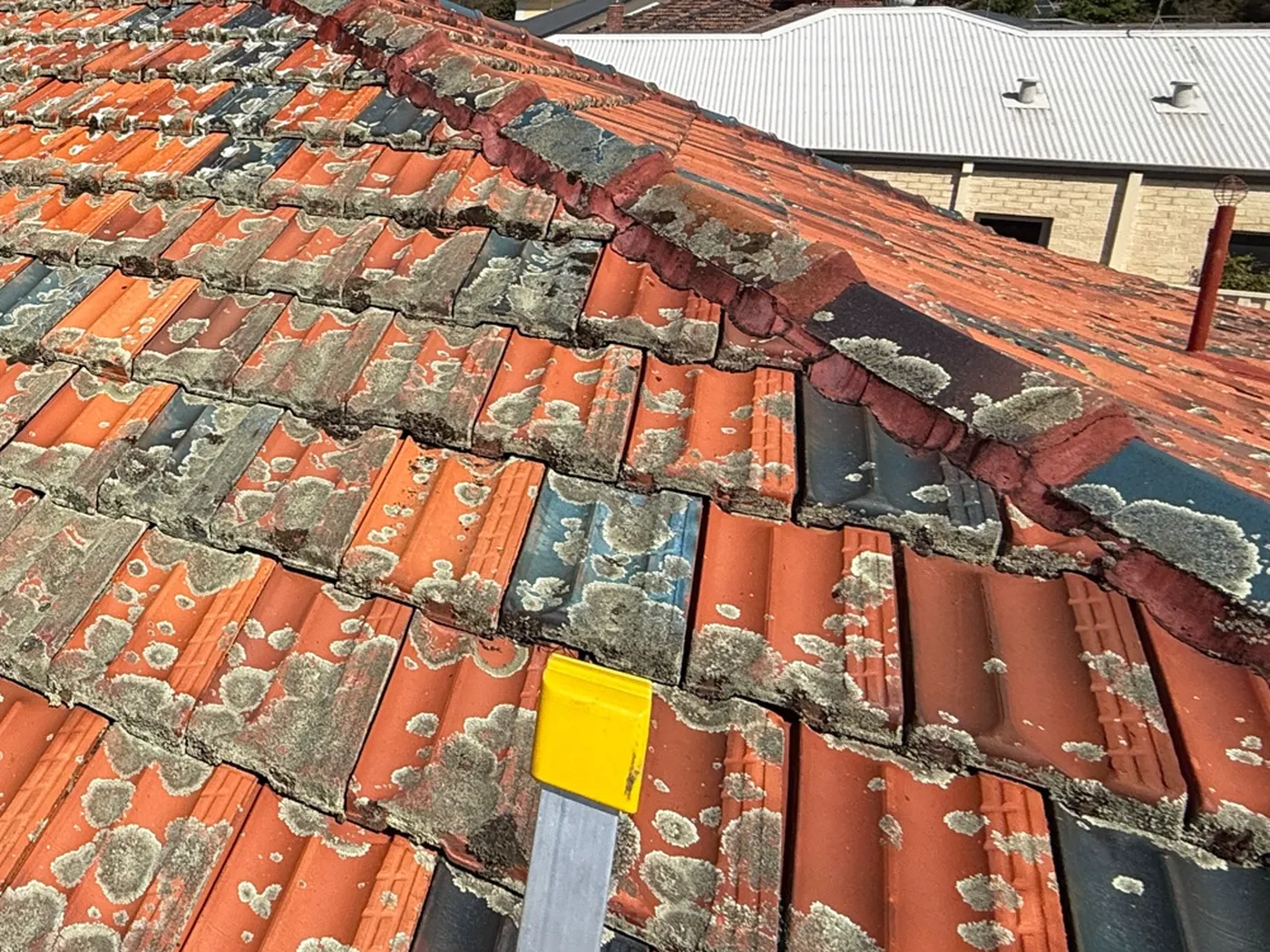
In plain terms Efflorescence sits on the tile like breath on a window. Lichen is in the tile, like a weed growing out of a crack in the footpath.
Lichen is not just sitting there. On clay roof tiles six to ten years old, researchers at the University of Novi Sad used electron microscopy and found lichen threads penetrating the tile and filling its fissures and cracks.10 Lichens secrete organic acids, above all oxalic acid, which dissolves minerals11, and on ceramic tile material in the same team's lab it changed the texture of the surface and formed whewellite, a calcium oxalate crystal they identified as destructive.10 The full case is in does lichen damage roof tiles.
It does not weather off while it is alive. Treated, it ends where it sits and the weather carries it off over the following months. Where it etched the tile, the patch can leave its outline behind: that is a ghost mark.
Bird droppings, paint and salt
Bird droppings. The white in a dropping has long been put down to uric acid. A University of Texas study of six bird species found none: the white was ammonium urate, struvite and two unknown compounds, which the lead researcher says are probably the result of gut bacteria breaking uric acid down before it is excreted.12 Droppings land where birds sit, under the antenna, along the ridge, beneath a branch. They are splashes, not circles, and they sit on top of the tile.
Chalking paint. A roof that has been restored and painted carries a coat that wears. Monier says repainted concrete tiles need redoing every five years or so to keep their look.4 As paint ages, UV light breaks down the binder that holds the pigment, and a loose fine powder forms on the surface. Some chalking is expected of every paint, it is more obvious on dark colours, and it comes off when wiped.13 It shows as a whole face going pale and powdery, not as spots.
Salt. Near the coast, sea salt is among the deposits that settle on a roof out of the air. It is water soluble, and the LBNL review expects rain to leave roofs short of anything water can carry off.3 So salt does not stay: what settles between rains dissolves and goes with the next good rain.
In plain terms Droppings are a splash, chalking is a whole face, salt is a film. Only lichen makes neat round spots that grow.
How to tell them apart
| Shape | Texture | Where | Over time | |
|---|---|---|---|---|
| Efflorescence | Even haze or soft edged patches | Flat, smooth, no relief | Concrete tiles, most visible on dark colours | Weathers off within a year or two |
| Lichen | Round or lobed spots with a sharp edge | Crusty or leafy, anchored into the tile | Any tile, heaviest on damper faces | Spreads outward, every year |
| Bird droppings | Splashes and drips | A crust sitting on top | Under perches | Softens and washes off slowly |
| Chalking paint | Whole faces at once | Powder that wipes off | Painted roofs, sunniest faces worst | Builds as the paint ages |
| Salt | A thin film | Dissolves in water | Near the coast | Washes off with the rain |
The single best tell is the edge. Salts that come out of a tile, or settle on it, have no edge: they fade into the surface around them. A lichen has a margin you could trace with a pencil, and next year it will be further out. If a white patch is round, sharp edged and growing, it is alive.
In plain terms Salt fades out at its edges like a watercolour wash. Lichen grows like a fairy ring in a lawn, with a clear rim that sits a little further out every year.
Which other growth is on the roof with it, and how to tell all four apart, is in lichen, moss, algae or mould.
What this means for your roof
A flat white haze on concrete tiles weathers off by itself and needs nothing. Round, sharp edged white spots that get bigger each year are lichen anchored into the tile, and every year they stay they spread further and mark more of the surface. We treat them where they sit with UNGROW Bailiff, from the roofline, with a low pressure soft wash pump through non-directional nozzles, so nothing is blasted off the tile or forced under it, and the weather carries the dead lichen away. Growth recurs, so UNGROW Sentry, our preventative, keeps the roof treated after that.
Also asked
Will the white marks on my concrete tiles go away?
If they are efflorescence, yes, on their own. Monier says the bloom is temporary and should disappear naturally over time. Rain and the air slowly turn the white deposit into a compound that dissolves and washes off, which takes about a year or two depending on the rain. It does not need treating. White spots with a clear edge that get bigger each year are a different matter.
Is white lichen bad for my roof?
Yes. It is anchored into the surface. On clay roof tiles, electron microscopy found lichen threads penetrating the tile and filling its fissures and cracks, and in lab tests oxalic acid, the main acid lichens secrete, changed the texture of ceramic tile material and formed a destructive crystal. It does not leave on its own while it is alive. Treated where it sits, it ends and weathers off over the following months, and the sooner it is treated, the less of the tile carries its outline.
Can efflorescence happen on terracotta tiles?
It can. Efflorescence happens in porous materials generally, and there is a standard test for it in clay roof tiles. It is a common issue on concrete, and most noticeable on dark colours. On any tile, a flat haze with no edge points to salts, and a round crust with a sharp edge points to lichen.
What is the white powder on my roof?
On concrete tiles, a flat, whitish grey haze is efflorescence: salts drawn out of the tile to the surface, and it weathers off on its own. On a painted roof, a fine powder that wipes off on a finger, across a whole face, is chalking: UV breaking down the binder in ageing paint. A white crust with a sharp, round edge is lichen, anchored into the tile and alive. Powder spread on a roof on purpose, against moss, is covered in do zinc strips stop roof moss.
How do I get rid of white spots on roof tiles?
First tell which white it is. A flat haze on concrete tiles is efflorescence: leave it, and the rain carries it off over a year or two. Round, sharp edged spots that grow each year are crust lichen anchored into the tile, and they do not leave on their own. We treat them where they sit with UNGROW Bailiff, from the roofline, and the dead lichen weathers off over the following months. The method is in how do you get rid of lichen on roof tiles.
Should I pressure clean the white spots off?
No. If it is efflorescence, it weathers off by itself. If it is lichen, a blast takes the tile surface with it, and Monier, which makes roof tiles, strongly advises against pressure washers on roofs. Lichen is treated where it sits, and the weather carries it off over the following months.
On the record
- Monier, FAQs
- Oxerra Australasia, Efflorescence Explained (2024)
- Lawrence Berkeley National Laboratory, Weathering of Roofing Materials: An Overview
- Monier, Roof cleaning and maintenance
- Australian National Botanic Gardens, Lichen chemistry
- Australian National Botanic Gardens, Lichen form and structure
- Australian National Botanic Gardens, Crustose lichens
- Geografiska Annaler: Series A, Physical Geography, Growth of crustose lichens: a review (2010)
- NERC Open Research Archive, Growth of foliose lichens: a review
- Scanning, Evaluation of the effect of lichens on ceramic roofing tiles by scanning electron microscopy and energy-dispersive spectroscopy analyses (2005)
- Catena, Weathering of rocks induced by lichen colonization: a review (2000)
- Jackson School of Geosciences, The University of Texas at Austin, Bird Droppings Defy Expectations (2019)
- Dulux New Zealand, How to Fix Paint Chalking