 Lichen
The ruling
Treat it where it sits and let the weather carry it off. Lichen anchors its threads into the tile, so a pressure washer or a scraper takes the surface with it, and bleach lightens it without treating it. A benzalkonium chloride treatment, sprayed on every face, ends it in place, and the dead crust weathers off over months.
Why lichen will not wash off a tile
The flat, crusty grey and white patches on a tiled roof are usually crust lichens, attached by their entire lower surface, so there is no underside to lift.1 On clay roof tiles six to ten years old, researchers in Novi Sad, Serbia, found lichen hyphae penetrating the tile and filling its fissures and cracks under the electron microscope, and traced the lichen's attack on the tile to its oxalic acid.2 The full case is in does lichen damage roof tiles.
That decides how it has to go. A review of how conservators control microbial growth on cultural heritage puts it plainly: when organisms grow into pores, fissures and cracks, "it is hard to reach them mechanically", and what is left behind, down to single living cells, is "a source for a rapid substrate recolonization".3
In plain terms Lichen on a tile is a weed in a paving crack. Pull off the top and the roots stay in the crack, ready to grow again.
Can you clean lichen off with a pressure washer, scraper, bleach or vinegar?
Each of the usual tries works on the part you can see.
- Pressure washing. Monier, which makes roof tiles, "strongly advises against the use of pressure washers for roof cleaning",4 the jet can "push microorganisms deep into" the material it hits,3 and in WA it is prohibited on asbestos cement.5 See does pressure cleaning damage roof tiles.
- Scraping. There is no edge to get a blade under, so a scraper takes the top of the tile and leaves the threads in it, and Monier recommends that you "do not attempt to clean your own roof tiles due to the risk of falls and potential tile damage".4 See why nobody needs to walk on your roof.
- Bleach. 30 Seconds says the sodium hypochlorite in its Outdoor Cleaner "will cause bleaching", and asked whether that cleaner treats lichen, it answers "No".6 See soft wash or pressure wash.
- Vinegar. Household vinegar is about 5 percent acetic acid, which "impacts only the parts of the plant it touches",7 and acid attacks cement: in laboratory tests, acetic acid decalcified Portland cement mortar.8 See vinegar, bleach and home remedies.
In plain terms It is mowing a weed. The lawn looks better on Sunday, and the weed is back by spring.
How to treat lichen on roof tiles, and what gets rid of it
The products made for lichen on roofs are built on benzalkonium chloride, a quaternary ammonium compound. In Australia, Yates Surrender carries 500 grams a litre of it, labelled "For control of moss, algae, lichen and liverwort" on paths, roofs and other hard surfaces,9 and 30 Seconds lists lichen for its roof treatment.10 In a laboratory test on a lichen, a commercial benzalkonium chloride biocide severely impaired its photosynthesis, with no recovery over time.11 The chemistry is in how roof treatment works.
It ends the lichen; it does not lift it off. Yates says Surrender "kills lichens on roofs but does not remove them", and the dead lichen "can be left to weathering".12
How it goes on decides the result. Montana State University's guide to garden sprayers: "For pesticides to be effective, they must be applied uniformly at the recommended rates noted on the label."13 Wet & Forget's directions for lichen are two applications within 15 minutes, the first to dissolve "the waxy coating of the lichen" and the second to soak in, and it gives lichen 8 to 12 months to decompose.14 And it has to reach every face. On engraved sandstone in Italy, monitored for 54 months after cleaning and treatment, regrowth came mainly from the untreated surfaces around each treated patch.15
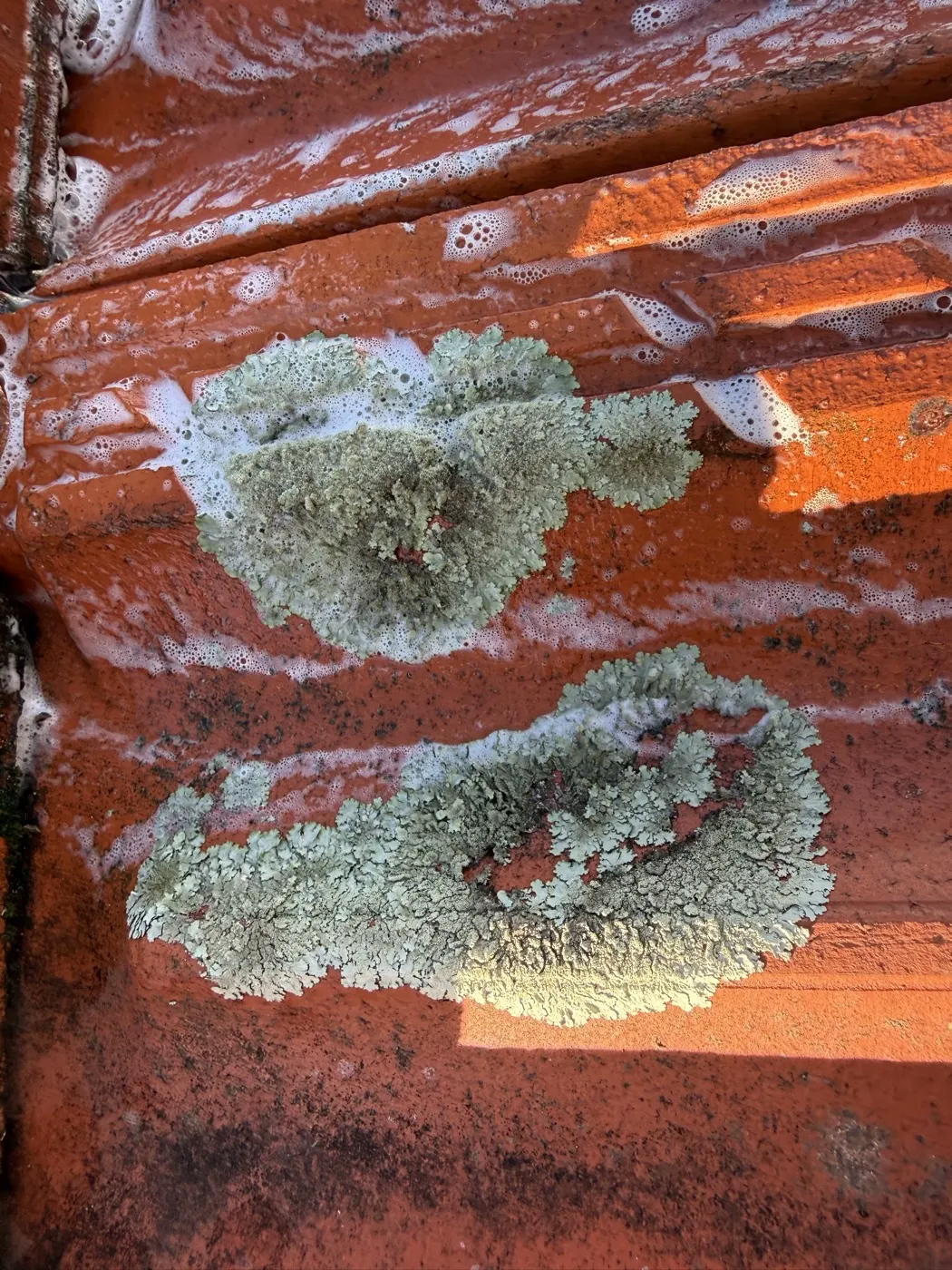
In plain terms You spray the weeds in a paved path and leave them. They brown off where they stand and the rain washes them out of the cracks. Nobody takes a chisel to the pavers.
White, grey or coloured lichen: the same answer
Lichens come in "various greens, yellows, reds, oranges and browns as well as shades of white and grey".16 The orange brown crusts on concrete are most likely Caloplaca and the yellow ones Candelariella, both found on concrete roof tiles,17 and on the roofs we treat, the pale grey and white spots on terracotta are crust lichens too. Each is anchored the same way and treated the same way. More in the orange stuff on roof tiles.
Before treating white spots, check they are alive. A flat, whitish grey haze on concrete can be efflorescence, salts from inside the tile, which Monier says "should disappear naturally over time".18 Most crust lichens have well delimited edges, and on some a dark fringe runs a little ahead as the lichen expands.19 White spots on roof tiles tells the two apart.
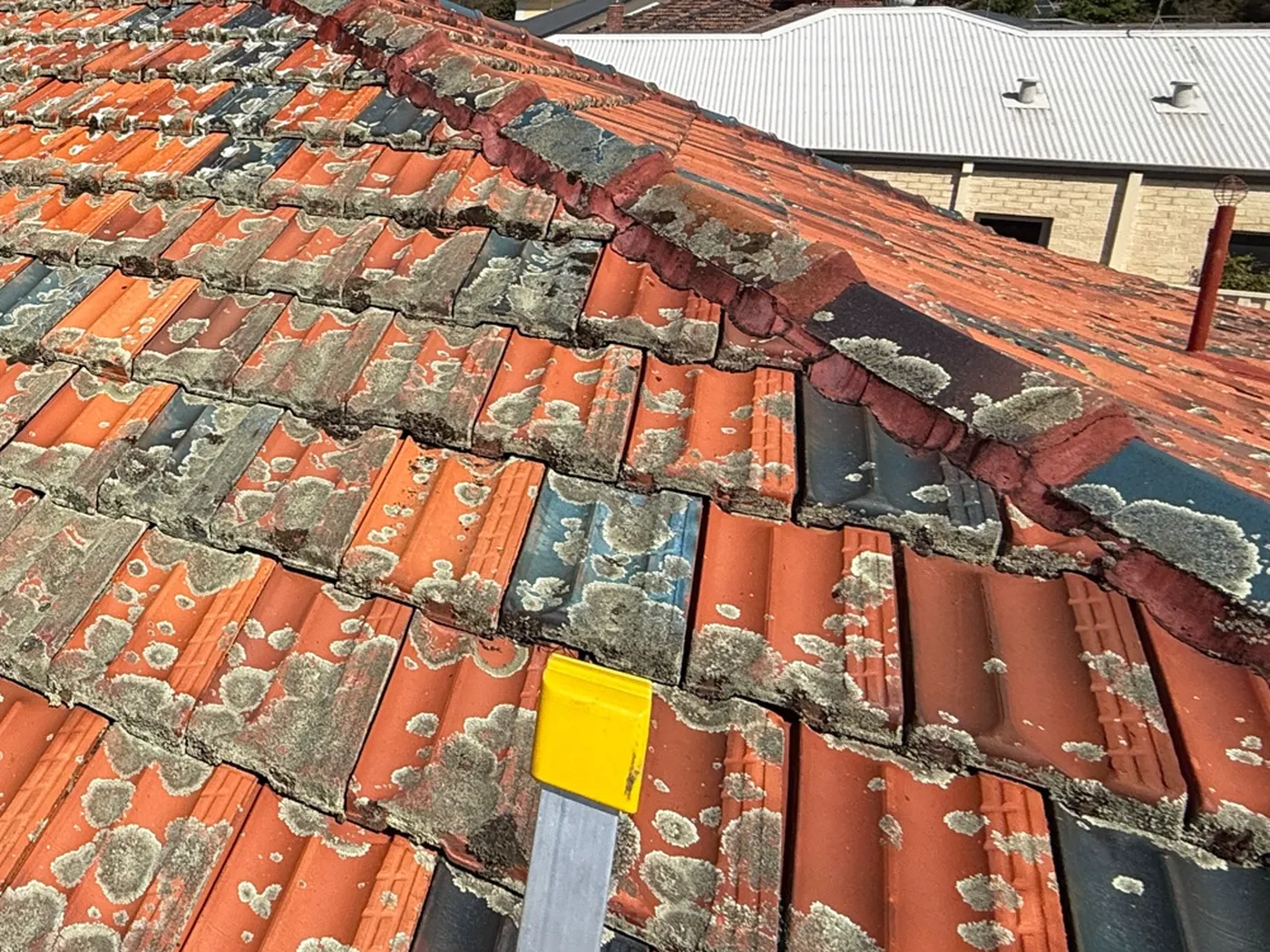
In plain terms Grey, white or coloured, it is the same weed in a different coat. The anchor underneath is the same, so the answer is too.
Removing lichen from terracotta and concrete tiles
Lichen on clay roof tiles is common. Researchers in Madrid testing ways to remove it from unglazed ceramic roofing tiles found that each tile's chemical make up affected how far the lichen interacted with it, and so how much it weathered it. Their combined procedure, laser pulses followed by a biocide, removed some of the lichen bodies and completely damaged both partners of the lichen in all three species, Verrucaria nigrescens among them.20 Even with lasers, ending the lichen was the part that worked on every species.
Terracotta's colour is baked into the tile in firing and does not fade,4 so once the dead crust weathers off, the tile's own colour shows, apart from any ghost mark where the lichen etched it. Concrete is alkaline, home to the lime loving lichens,21 and its colour is a coat.18 Wienerberger, a UK tile maker, warns that a jet washer "can damage the tile finish and strip away colour from concrete tiles".22 On either tile the method is the same, and terracotta or concrete compares the two.
In plain terms Terracotta is a flowerpot with its colour fired right through. Concrete is a painted paver, and when you blast a paver, the paint goes first.
How we get rid of it, and what it costs
We treat it with UNGROW Bailiff, our benzalkonium chloride treatment. The roof is measured from aerial imagery of the address, Bailiff is mixed on the day to the label rate for that area, and it goes onto every face from ladders at the roofline, through a low pressure soft wash pump and non-directional nozzles. Nobody walks on the tiles and nothing is forced under them. We spray around solar panels, not on them.
A first treatment with Bailiff is from $539 including GST, worked out from the roof's measured area with set additions for a second storey, difficult access and outer suburbs. It is a fixed price, with no site visit and no need to be home. What roof cleaning costs in Perth sets out what goes into it. The Roof Report shows your own roof from above, face by face, and where lichen settles first.
The roof looks the same when we leave. Growth starts coming away over 3 to 18 months as the weather breaks down the dead crust, and why dead lichen stays on the roof explains the wait. When will it clear? shows what a roof like yours does month by month, for the month it is treated. Our guarantee: we photograph the roof on the day, and if it looks the same as that photo at twelve months, we treat it again, free. Gutters are not part of the job. Dead growth washes into them over the months after, so they are worth clearing after the first winter, and Monier says to clear gutters at least once a year anyway, more often where trees surround the roof.4
In plain terms The work is done on the day, the clearing is done by the weather, and the photo is how you hold us to it.
What this means for your roof
Treated where it sits, the lichen ends in place, the weather carries the dead crust away, and your tiles keep their surface, with nothing torn off them and nobody walking on them. Tearing lichen off takes tile with it and leaves threads behind to grow again, and every year it stays, its acid marks more of the surface. We apply UNGROW Bailiff from the roofline, and because growth recurs wherever a roof stays damp, UNGROW Sentry, our preventative, keeps it treated after that, as how often a roof needs treating explains.
Also asked
How long does lichen take to come off the roof after treatment?
Over the months after, and the guarantee covers the wait. On the roofs we treat, growth starts coming away over 3 to 18 months, and lichen is the slow one: Wet & Forget gives it 8 to 12 months to decompose. A dead crust stays anchored until the weather breaks it down, so rain, the face of the roof and the thickness of the crust set the pace. We photograph the roof on the day, and if it looks the same at twelve months, we treat it again, free.
Can I get rid of lichen on my roof myself?
Yes, with a roof treatment from the hardware store used exactly to its label. Surrender, Wet & Forget and 30 Seconds all list lichen. The hard part is the roof: measuring it, covering every face at the label rate, and doing it without walking the tiles. Monier, which makes roof tiles, recommends that homeowners do not clean their own roof tiles at all, because of the risk of falls and of tile damage.
How much does it cost to get rid of lichen on a roof in Perth?
A first treatment with UNGROW Bailiff is from $539 including GST. The price is worked out from your roof's area, measured from aerial imagery of the address, with set additions for a second storey, difficult access and outer suburbs. It comes as a fixed price, with no site visit. A figure given without the roof's measured area means little, because the area is what sets how much treatment the roof needs.
Should I brush the dead lichen off once it is treated?
Not from on the roof. Yates says treated lichen can be left to weathering, and some conservators leave treated stone untouched for months, then lightly brush away only what is already coming loose. On a roof the weather does that job, with nobody standing on the tiles and no brush rubbing at the surface the lichen grew into.
Will the lichen come back?
Staying treated is what keeps it off, and that is the job of UNGROW Sentry, our preventative. Spores and fragments keep arriving on the wind and the rain, and whatever made that face of the roof suit lichen is still there, so a roof left untreated grows it again. In a 54 month study on rock surfaces in Italy, regrowth came in mainly from the untreated surfaces around each treated patch, which is why we treat every face.
Does getting rid of lichen include cleaning the gutters?
No. We treat the roof; we do not clean gutters. As the dead lichen weathers off over the months after a treatment, some of it washes into the gutters, so they are worth clearing after the first winter. Monier, which makes roof tiles, says to clear gutters, downpipes and valleys at least once a year, and more often where trees surround the roof.
On the record
- Australian National Botanic Gardens, What is a lichen?
- Scanning, Evaluation of the effect of lichens on ceramic roofing tiles by scanning electron microscopy and energy-dispersive spectroscopy analyses (2005)
- Microorganisms, The Control of Cultural Heritage Microbial Deterioration (2020)
- Monier, Roof cleaning and maintenance
- WorkSafe WA, Safety alert 12/2018: high pressure water cleaning of asbestos cement prohibited
- 30 Seconds Australia, Outdoor Cleaner
- Montana State University Extension, Monthly Weed Post, June 2021 (2021)
- Materials, Geopolymer, Calcium Aluminate, and Portland Cement-Based Mortars: Comparing Degradation Using Acetic Acid (2019)
- Yates / Hortag, Surrender Mosskiller label (10 L)
- 30 Seconds Australia, Roof Treatment
- Stresses, Accumulation and Phytotoxicity of Two Commercial Biocides in the Lichen Evernia prunastri and the Moss Brachythecium sp. (2021)
- Yates, Yates Surrender Moss Killer
- Montana State University Extension, Calibrating Home and Garden Sprayers
- Wet & Forget Australia, Roof cleaning information
- The Science of the total environment, Lithobiontic recolonization following cleaning and preservative treatments on the rock engravings of Valle Camonica, Italy: A 54-months monitoring (2023)
- Australian National Botanic Gardens, Lichen chemistry
- Australian National Botanic Gardens, Urban lichens in Canberra
- Monier, Monier Roofing FAQs
- Australian National Botanic Gardens, Crustose lichens
- International Biodeterioration & Biodegradation, Effect of biological colonization on ceramic roofing tiles by lichens and a combined laser and biocide procedure for its removal (2018)
- Australian National Botanic Gardens, Lichen habitats
- Wienerberger UK, How to Clean Roof Tiles