The ruling
Yes, at the roof. A dark roof absorbs more of the sun, so it runs hotter and heats the roof space under it; insulation decides how much reaches the rooms. For Perth, the Australian Government's YourHome guide says choose light coloured roof materials. Growth darkens a light roof, and treating it lets that film weather off.
Do dark roofs attract more heat?
Yes. Sunlight a roof does not reflect, it absorbs, and absorbed sunlight becomes heat. The share it absorbs is its solar absorptance. The NSW Government's BASIX guidance defines it as the proportion of the sun's radiation that the roofing absorbs, with the rest reflected, and classes a roof as light below 0.475, medium from 0.475 to 0.7, and dark above 0.7, and says the figure typically follows the roof's colour.1 BlueScope's figures for new Colorbond steel include 0.33 for Surfmist, a soft white, 0.73 for Monument, a deep grey, and 0.95 for Night Sky, its black.2, 3, 4 Monier, which makes roof tiles, gives its tile colours a solar absorbance rating and groups all its tiles into light, medium and dark.5
Colour is not the whole story, because about half of the sun's energy is near infrared light, which nobody can see. Traditional dark roofs absorb it along with the visible light.6 BlueScope's Thermatech technology raises the solar reflectance of Colorbond by reflecting more of that near infrared, and every colour in the core Colorbond range is designed to do it except Night Sky.7
In plain terms Walk barefoot across a bitumen road in January and step onto the white line. Same sun, same road, and the white paint is the part you can stand on.
Does a dark roof make the house hotter?
It makes the roof hotter first, and the roof space under it. The Heat Island Group at Lawrence Berkeley National Laboratory (LBNL) puts it plainly: traditional dark roofs strongly absorb sunlight, heating both the building and the air around it.6 The NSW guidance says a roof with a lower solar absorptance reflects more heat and keeps the roof space and dwelling cooler on a hot day.1 Monier says the same of tiles: a light coloured tile reflects more heat than a dark one, keeping the roof space cooler on a hot day.5
How much of it reaches the rooms depends on what sits between the roof and the ceiling. Monier calls insulation the most crucial factor in keeping a home at a steady temperature.5 The Australian Government's YourHome guide says foil insulation and light coloured roofing limit the radiant heat flowing into the roof space, and that a well ventilated roof space is a buffer between inside and out, under the hardest part of a house to shade: the roof.8 On a tiled roof, sarking is that foil layer.
In plain terms The roof is the house's hat. A black hat gets hotter in the sun than a white one, and how much of that you feel depends on what is under the hat.
Are black roofs good or bad for a Perth house?
Perth sits in climate zone 5, warm temperate: the coastal strip of Western Australia that takes in Geraldton, Perth and Bunbury.9 YourHome's advice for that zone is to balance cooling in summer against heating in winter, and to choose light coloured roof materials. It gives the same roof advice for every zone but one. In the alpine zone, where the main aim is heating, it says to choose dark coloured roof and wall materials.10
A dark roof has its reasons. In cold climates, LBNL notes, cool roofs increase the heating a building needs.6 And a roof coating maker says a pastel or darker colour may help raise the roof's temperature so it dries faster, which discourages mould and algae, and helps hide minor discolouration.11 Read the other way, that is the trade with a light roof: it shows its growth, and it has more to lose to it.
In plain terms A white shirt keeps you cooler in the sun and shows every mark. A black one hides the marks and soaks up the heat.
What is a cool roof coating, and does it reduce heat?
A cool roof is one made to stay cool in the sun, and it takes two properties: high solar reflectance, to throw the sunlight back, and high thermal emittance, to give the heat it does absorb back off as infrared. Roofing comes in white as membrane, elastomeric coating, painted metal and tile, and cool coloured roofing looks like a traditional dark roof but reflects more of the near infrared.6 In Australia, Dulux Acratex sells its roof membrane as solar reflective, and says its Cool Roof colour "minimises heat absorption".12
So why paint a roof white, and does it reduce heat? It does while the coat stays clean, by throwing back the sun: LBNL's comparison sets a clean white roof reflecting 80 percent of sunlight against a grey one reflecting 20, and LBNL says swapping a warm roof for a cool one reduces the heat conducted into the building.6 Whether a coat keeps doing it comes down to three things.
- It is a coat, on a schedule. Monier says repainted concrete tiles must be redone every five years or so to keep the look, and that terracotta does not need respraying because its colour is fired in.13 In Monier's words, "respraying your roof is aesthetic only and will not repair your roof".5 On steel, BlueScope says overpainting Colorbond "will void any warranties issued by BlueScope".14
- It has to stay clean. Initially high solar reflectance can be degraded by natural soiling and weathering, and in three years of US rating data, field applied coatings were among the products that lost the most of it, while factory applied coatings and metal lost the least.15 One Australian membrane maker recommends washing a coated roof at least every 12 months, to take off the salt, dirt, dust, chalkiness, mould, algae and lichen that deposit on it.11
- It does not stop growth. In a survey of biofilms on buildings in Europe and Latin America, fungi were rarely found on mineral surfaces and often on paint.16 That case is made in full in is painting roof tiles a good idea.
In plain terms A white coat on a roof works like a white ute. Fresh from the car wash it throws back the sun; leave it a year under the trees and the grime does the absorbing.
Growth turns a light roof dark
This is where moss, lichen, algae and mould come into it. LBNL's review of roof weathering says soiling causes objectionable stains and reduces the solar reflectance of reflective roofing, and it names biological growth (cyanobacteria, fungi and algae) as a cause, alongside deposited particles and soot.16 Black streaks are the clearest case: dead cyanobacterial colonies build up into dark stains on light coloured roofing.16 What makes them so dark is in what is the black stuff on my roof.
Researchers who studied the microbes on painted steel roofing note that some roofing is designed to reflect solar infrared to cut the heat passed into the building, and that colonisation and discolouration "inhibit solar reflection and thus retard the beneficial properties of the materials".17 BlueScope says very heavy growth across a lighter coloured roof can change its overall colour and appearance.18 The published figures are for a new roof: BlueScope's Colorbond values are nominal values based on new product.2 The metal side of this is in can moss and lichen grow on a metal roof.
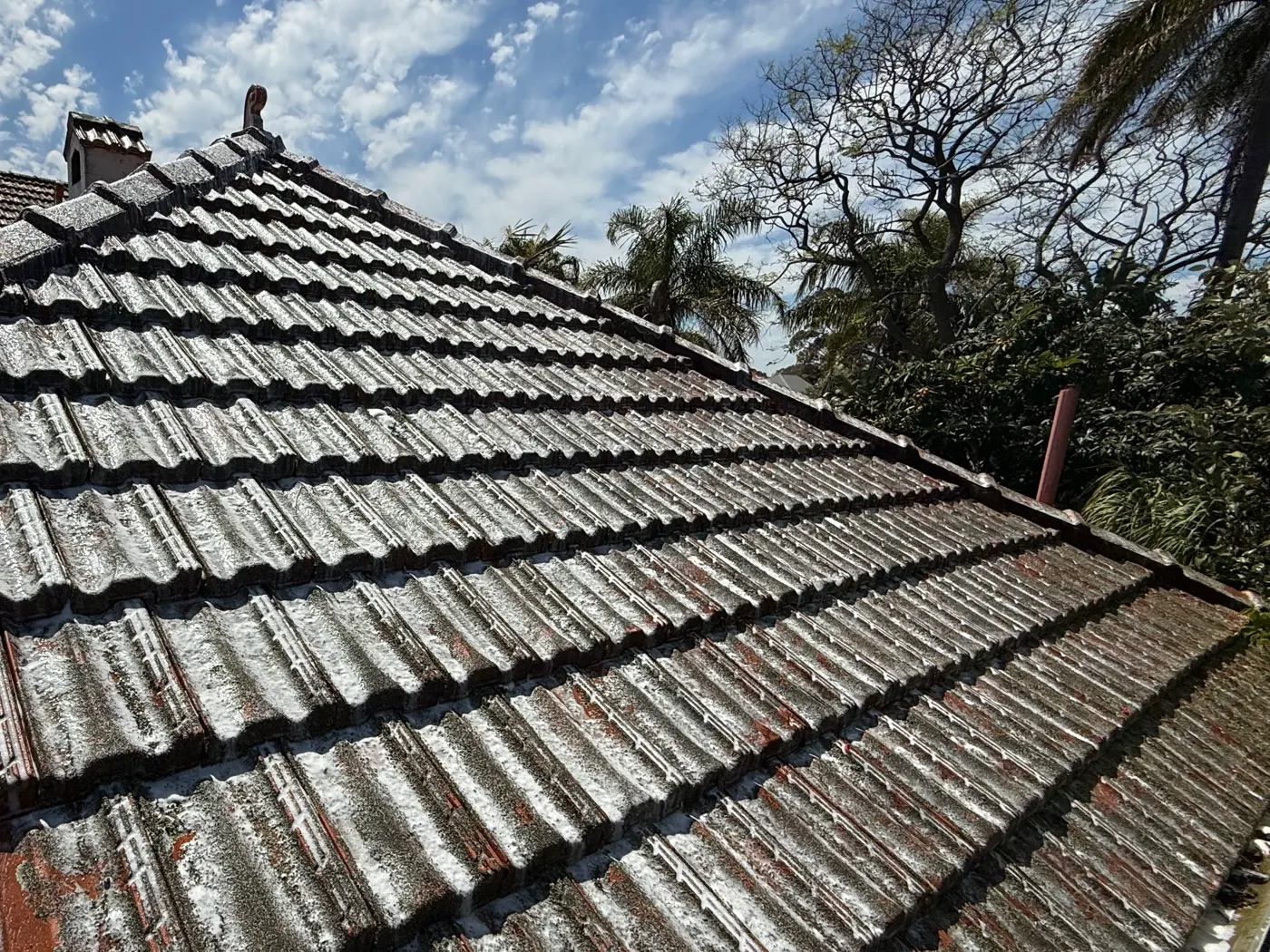
The loss has been measured. LBNL researchers put the solar reflectance of a new white membrane roof at about 0.8, which soot, dust and biomass such as fungi or algae can lower to about 0.6. On 15 white or light grey PVC roofing membranes taken from roofs across the United States, the soiled samples were absorbing 1.4 to 3.5 times the sunlight of the unsoiled membrane. Rinsing and washing took off nearly all of the soil, but left isolated dark spots of biomass behind.19 And the lighter the roof, the more it has to lose: in the US rating data, products with high initial solar reflectance tended to lose it as they aged.15
In plain terms A dark film on a light roof is a dark roof you never chose.
What this means for your roof
What you get is the growth ended where it sits, and the dark film it laid over the roof you chose weathering off over the months that follow, as When will it clear? shows for your roof. We treat it with UNGROW Bailiff from ladders at the roofline, through a low pressure soft wash pump and non-directional nozzles, and nobody walks the roof. Growth recurs on any roof that stays damp, so UNGROW Sentry, our preventative, keeps it treated after that.
Also asked
Is a black roof a bad idea?
For Perth, the Australian Government's YourHome guide says to choose light coloured roof materials, and recommends dark ones only for the alpine zone, where heating the house is the main aim. A dark roof absorbs more of the sun and heats the roof space under it. How much of that reaches the rooms comes down to insulation, which Monier, the tile maker, calls the most crucial factor in keeping a home at a steady temperature.
Do black roof shingles make your house hotter?
The physics is the same for shingles, tiles and steel. The darker the surface, the more of the sun it absorbs, and the Heat Island Group at Lawrence Berkeley National Laboratory says traditional dark roofs heat both the building and the air around it. Researchers there and at Oak Ridge have worked with makers on cool coloured asphalt shingle, metal and tile products that look like traditional dark roofs but reflect more of the sun's invisible near infrared.
Why would you paint a roof black?
Two reasons come up in the guidance. In a cold climate, a roof that takes in the winter sun helps heat the house, and YourHome advises dark roofs only for the alpine zone, where heating is the main aim. And one roof coating maker says a darker colour may help raise the roof's temperature so it dries faster, which discourages mould and algae and hides minor discolouration. For Perth's climate, YourHome's advice is light roof materials.
Does painting your roof white help reduce heat?
It does while the coat stays clean: a clean white coat reflects far more sunlight than a dark tile. In three years of US rating data, field applied coatings were among the products that lost the most reflectance, and one Australian membrane maker recommends washing a coated roof at least every 12 months. Monier does not recommend painting terracotta and calls respraying aesthetic only, and BlueScope says overpainting Colorbond voids its warranties.
Does mould or algae make a roof hotter?
It makes a light roof absorb more of the sun. The Lawrence Berkeley review of roof weathering names biological growth (cyanobacteria, fungi and algae) among the causes of soiling that reduce the solar reflectance of reflective roofing. On white and light grey roofing membranes taken from US roofs, the soiled samples had 1.4 to 3.5 times the solar heat gain of unsoiled membrane. A dark film on a light roof makes it, in effect, a darker roof, and treating it lets the film weather off.
On the record
- NSW Planning Portal (NSW Department of Planning and Environment), Roof Colour and Solar Absorptance
- BlueScope, Surfmist® | COLORBOND® steel
- BlueScope, Monument® | COLORBOND® steel
- BlueScope, Night Sky® | COLORBOND® steel
- Monier, FAQs
- Heat Island Group, Lawrence Berkeley National Laboratory, Cool Roofs
- BlueScope (Steel Select), Durable Performance of COLORBOND steel
- Your Home (Australian Government), Passive cooling
- Your Home (Australian Government), Australian climate zones
- Your Home (Australian Government), Design for climate
- Dulux Acratex (DuluxGroup Australia), Care & Maintenance Guide: Roofing (2024)
- Dulux, via Inspirations Paint, Dulux Acratex Roof Membrane Gloss (data sheet AUAC00047) (2024)
- Monier, Roof cleaning and maintenance
- BlueScope, TB-2 Overpainting and restoration of exterior BlueScope coated steel products (2022)
- Solar Energy Materials and Solar Cells, Soiling of building envelope surfaces and its effect on solar reflectance, Part I: Analysis of roofing product databases (2011)
- Lawrence Berkeley National Laboratory, Weathering of Roofing Materials: An Overview
- MicrobiologyOpen, Investigation of the microbial communities colonizing prepainted steel used for roofing and walling (2017)
- BlueScope, TB-27: Identification of fungus in the field and recommendations for its removal (2022)
- Atmospheric Environment, Effects of soiling and cleaning on the reflectance and solar heat gain of a light-colored roofing membrane (2005)