 Algae
The ruling
A flat green film on tiles is algae: microscopic green algae, often with cyanobacteria, living in a slime called a biofilm. It takes hold on the shaded, slow drying faces first, works into the tile's pores and alters the tile it lives on. It is part of a roof's first film and readies it for lichen and moss.
A film that is alive
The first things to live on a roof are microscopic. Bacteria, algae and fungi settle on tiles soon after they go up and form a biofilm, a community of cells embedded in a thick protective matrix they make themselves. Over time these biofilms mature and pigment, and show on the roof as green or black patches.1 On ceramic roof tiles left outdoors in southern France for six years, the biofilm averaged 22 to 26 micrometres thick, and its thickest points averaged 92 to 112 micrometres.1
The green in it is algae. In a survey of 71 samples from building facades across France, green algae were the most frequent organisms found, led by Klebsormidium flaccidum in 55 percent of samples, Trebouxia in 49 percent and Stichococcus bacillaris in 46 percent.2 Stichococcus bacillaris is a known colonist of ceramic roof tiles, a green alga that also forms lichens1, and on old concrete roof tiles in Israel, a researcher using electron microscopy found free living green algal cells colonising pits in the weathered surface.3
In plain terms A biofilm is the slime on the glass of a fish tank that nobody has cleaned, on your roof. On the six year old tiles in France it was a quarter as thick as a sheet of printer paper on average, as thick as the whole sheet in places, and alive.
Green algae, cyanobacteria and dark fungi
The colour of a film comes from what lives in it. Green algae are true algae. Cyanobacteria are bacteria that photosynthesise; they used to be called blue green algae, but they are quite distinct from algae.4 On the French facades, colonial cyanobacteria such as Gloeocapsa sanguinea grew alongside the green algae.2 Cyanobacteria are bluish green to khaki when moist, and brittle and blackish when dry.5 Dark fungi add their own colour. Cladosporium cladosporioides, a widespread melanised fungus, is a known colonist of ceramic roof tiles, and on the six year old tiles in France every tile carried the spots that melanised fungi leave.1
Climate shifts the balance. In a study of 230 biofilms on buildings in Europe and Latin America, algae were more prevalent at cool, damp European sites, and dark cyanobacteria were frequent at tropical sites above 1,000 metres. On roofing, the cyanobacterium Gloeocapsa infests mineral roofing granules and leaves black stains.6 On the Perth roofs we see, the film shows up mostly green. The dark streaks have their own file.
In plain terms Green algae and cyanobacteria are to a roof what pond weed and pond scum are to a farm dam. Same water, two different organisms, often side by side.
Why the shaded, damp faces go green first
Water decides it. Roof tiles are prone to colonisation because they are porous, and the pores take up the liquid water that microbial growth depends on; wetter climates favour algae on tiles.1 Anything that keeps a face wet for longer gives the film more hours to grow:
- Dew. On clear nights a roof cools below the air around it, and when the air is humid, dew forms on it.6 Perth's 9am humidity sits at 78 to 80 percent in June and July.7
- The wet season. Perth Metro gets about 77 percent of its 726.9 mm a year from May to September.7
- The sun's path. In Australia the sun's path is to the north8, so south facing planes see the least of it in winter and dry last.
- Trees. Monier notes that roofs under trees show dirt and debris more quickly, and that moss and lichen spores settle where moisture and dirt accumulate.9 Trees also shade the face beneath them.
The research backs up what a roof shows. In a field trial of cement samples set out in three different environments, the conditions they sat in had a greater effect on colonisation than the properties of the material itself.10 On sandstone rock engravings in Italy, watched for 54 months after cleaning, mosses and a dark cyanobacterial biofilm rapidly recolonised every cleaned patch in the more shaded zone, and the regrowth moved in from the uncleaned surfaces around each patch.11 Why some roofs grow more than others, face by face, is in why your roof grows it.
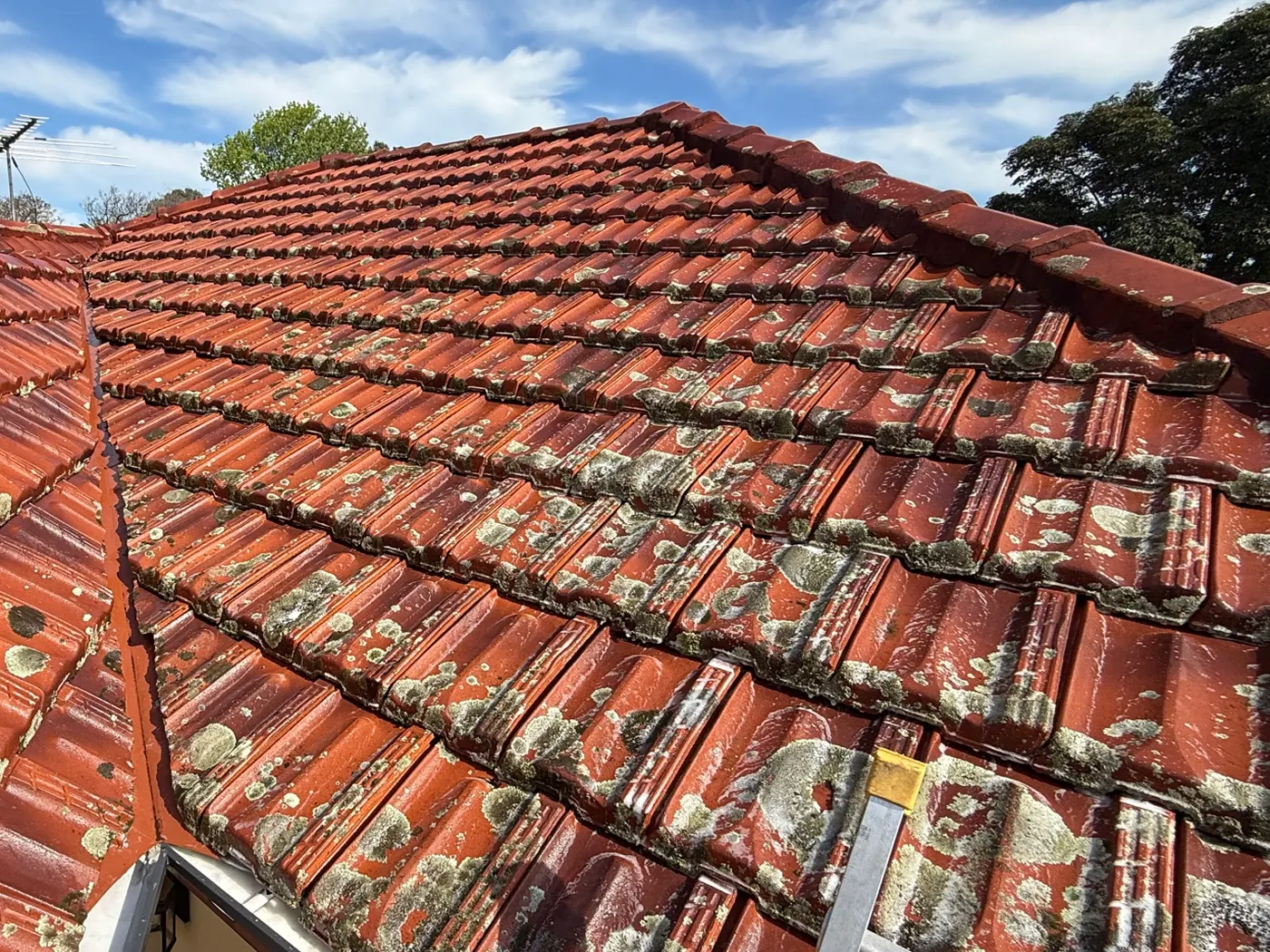
In plain terms Hang one wet towel in the sun and one in the shade, and the shaded one is still damp at lunch. A south face is that towel, every morning, all winter.
Into the tile
A film does not sit on top of a tile. The same pores that take up water let microbes work their way into the material.1 Ceramic tiles deteriorate with time like any building material, and the researchers who studied them name microbial colonisation, which starts soon after a tile is made and put outside, as one of the causes. The metabolic activity of the microbes in these films profoundly alters the composition of the tiles, and the films ultimately cause significant alterations in them.1
Concrete tiles show it too. On old concrete roof tiles, electron microscopy found dust, algal cells and lichen spores lodged in pits in the weathered surface, pits of the kind that trap water too. The inside of those pits was smooth, which the researcher put down to the algae acting chemically on the carbonates in the concrete.3
The rougher the surface, the better the next film does. In laboratory tests on cement based materials, how fast algae fouled the surface was governed by its roughness and porosity, along with the chemistry of the binder.12 Rough patches trap water and the spores and cells that drift onto a surface better than smooth ones.13 The tile makers warn against taking a jet to that surface. Monier "strongly advises against the use of pressure washers for roof cleaning"9, and Marley says high powered jet washing "can damage the surface of the slate or tile, thus reducing its expected life considerably".14 More in does pressure cleaning damage roof tiles.
In plain terms Water beads and runs off a glazed dinner plate. On an unglazed terracotta pot it soaks in and the pot stays damp for hours. Algae live on the pot, and in it.
Algae, lichen or moss
The three often share a roof, and they are easy to tell apart by form.
| Algae | Lichen | Moss | |
|---|---|---|---|
| What it is | Microscopic green algae and cyanobacteria in a biofilm.1, 2 | A fungus with an algal or cyanobacterial partner, living as one body.4 | A small plant with leaves on stems.15 |
| What you see | A flat green or dark film, with no thickness to speak of. | A crust, a leafy rosette or a tuft, with a definite edge. | A soft cushion or mat of tiny leaves. |
| How it holds on | Embedded in its own slime, into the surface pores.1 | Fungal threads and rhizines penetrate the surface and anchor it.16 | Rhizoids anchor it.15 |
They are also stages of one story, and the film comes first. On the six year old ceramic tiles in France, a microbial biofilm had colonised the tiles before any lichen could be seen, and the uncoated tiles already carried grey leafy lichens. Biofilms on tiles promote the settlement of mosses and plants.1 On concrete tiles, free algal cells, lichen spores and fungal threads were found together in the same surface pits, which the researcher read as the start of a new lichen forming.3 Trebouxia, found in nearly half the French facade samples, is one of the commonest lichen partners there is.2, 17 And a young moss starts as a protonema, a green thread that can look just like an algal film.15 The order things arrive in is in what lives on a roof, and a side by side guide is in lichen, moss, algae or mould.
In plain terms The algae is the undercoat. Lichen and moss are built on top of it.
What this means for your roof
A green film is the roof's first tenant, and it is already at work: holding water in the tile, working into its pores and readying the surface for lichen and moss. The sooner it is treated, the less time lichen and moss have to build on it. We treat every face with UNGROW Bailiff, not just the green patch, because regrowth moves in from whatever is left, and we apply Bailiff from the roofline with a low pressure soft wash pump through non-directional nozzles, so nothing is blasted off the tile or forced under it. Growth recurs, so UNGROW Sentry, our preventative, keeps the roof treated after that.
Also asked
What does algae on a roof look like?
A flat green film, with no thickness you can feel and no raised edge, heaviest on the shaded faces that dry last. The algae is the green. Darker patches in the same film are fungi or cyanobacteria, which run bluish green to khaki when wet and blackish when dry. Lichen is a crust or rosette with a definite edge, and moss is a soft cushion. Sorting the greens is in what is the green stuff on my roof.
Is algae a form of mould?
No. Algae photosynthesise. They carry chlorophyll and make their own food from light, which is why they are green. Moulds are fungi, which have no chlorophyll and live off organic matter. A roof biofilm usually holds both, along with bacteria, and that mix is why a green film can darken as it matures.
What causes green mould on a roof?
Water. The flat green film people call green mould is algae: its green is chlorophyll, which algae carry and moulds, being fungi, do not. Algae settle on tiles soon after they go up and thrive where a tile stays wet, because its pores hold the water the film lives on. So the slow drying faces go green first: south facing planes, faces under trees, and any face that holds the dew on humid winter mornings. Clearing it is in how do you get rid of algae on a roof.
Does algae damage roof tiles?
Yes. Researchers who study biofilms on ceramic roof tiles report that the microbes' metabolic activity profoundly alters the composition of the tiles, and that these films ultimately cause significant alterations in them. The film holds water in the tile's pores, works its way into the material and readies the surface for moss and lichen. On old concrete tiles, the pits where algae sat were smooth inside, which the researcher put down to the algae acting chemically on the concrete.
Will rain wash the algae off?
Rain rinses loose dirt, but a biofilm is built to stay. Its cells sit in a slime they make themselves, stuck to the surface and down into its pores, so rain mostly waters it. A film clears when the organisms in it die and the weather breaks them down.
Why is only one side of my roof green?
Because that side stays wet longest. In Australia the sun tracks across the north, so south facing planes, and anything under a tree, dry last after dew and rain. Across a single valley the difference between two faces can be stark.
On the record
- Microorganisms, Methyl Potassium Siliconate and Siloxane Inhibit the Formation of Multispecies Biofilms on Ceramic Roof Tiles: Efficiency and Comparison of Two Common Water Repellents (2021)
- Algological Studies, Diversity of algae and cyanobacteria growing on building facades in France (2006)
- Studia Geobotanica, Some observations on the establishment of the lichen Caloplaca aurantia on concrete tiles in Israel (1988)
- Australian National Botanic Gardens, What is a lichen?
- Australian National Botanic Gardens, What's not a lichen
- Lawrence Berkeley National Laboratory, Weathering of Roofing Materials: An Overview
- Bureau of Meteorology, Climate statistics for Australian locations: Perth Metro (009225)
- Your Home (Australian Government), Orientation
- Monier, Roof cleaning and maintenance
- The Science of the total environment, Evaluation of natural colonisation of cementitious materials: effect of bioreceptivity and environmental conditions (2015)
- The Science of the total environment, Lithobiontic recolonization following cleaning and preservative treatments on the rock engravings of Valle Camonica, Italy: A 54-months monitoring (2023)
- The Science of the total environment, Bioreceptivity evaluation of cementitious materials designed to stimulate biological growth (2014)
- Australian National Botanic Gardens, Ecology - microhabitats
- Marley (UK), Can I clean or jet wash my roof tiles?
- Australian National Botanic Gardens, What is a moss
- Australian National Botanic Gardens, Form and structure
- Australian National Botanic Gardens, Lichen chemistry