 Moss
The ruling
Moss is a small rootless plant that anchors to the tile and holds water like a sponge. It settles where water should leave the roof, in the laps, valleys and gutters, and keeps the tiles under it wet, which tile makers say damages them over time. It survives a Perth summer dormant and wakes with the first rain.
A plant with no roots
Moss is a bryophyte, one of a group of small, flowerless plants that also takes in the liverworts and hornworts. Bryophytes reproduce by spores, not seeds, and about 1,100 kinds of moss are known from Australia.1
A moss plant is leaves on stems. The leaves are small, generally half a millimetre to three millimetres long, and in most mosses they are a single cell thick.2 There are no true roots. A moss holds on with rhizoids, fine many celled threads that anchor it but do not draw water and minerals up the way a root does. It takes in water over its surface, through its leaves, and a mass of rhizoids can wick water along the outside of the plant by capillary action.2, 1
In plain terms A moss is not drinking from the tile. It sits on it like a scourer on a sink, held by its threads, soaking up whatever water lands on it.
Not everything called moss is one. Several lichens carry the word in their common names3, and the "mossy" rocks sold in many garden centres are mostly covered in lichens.4 On a roof the test is texture. A flat crust, grey or pale green, is lichen. A soft cushion of tiny leaves that you could pinch is moss.
Dormant, not dead
Mosses survive long dry spells dormant and become active again with very little water. Fog or dew is enough for many of them.1 A dry moss folds its leaves in against its stems and opens them again when wet, so the same plant looks quite different on a dry afternoon and a wet morning.2 Grimmia, a cushion moss that is fairly common on tiled roofs in Canberra, is grey green when dry and bright green when moist.5 Dried out, they can even take intense light that would quickly fade an ordinary leaf.1
That timetable suits Perth. Perth Metro averages 726.9 mm of rain a year, about 77 percent of it from May to September, and 9am humidity sits near 80 percent in June and July.6 Where winters are wet and summers dry, bryophytes spend much of the summer dormant and do their living in the cooler, wetter months.7 A roof also makes its own water. On clear nights it cools below the air around it, and when the air is humid, dew forms on it.8 Waking is not growing, though: significant growth needs continuously wet spells of a few days or more.9 Given them, moss fills in within weeks. In a growth chamber at 15 °C, watered once a week, fragments of the silvery moss Bryum argenteum spread to cover more than half of their containers within eight weeks.10
In plain terms A roof moss in summer is like a Perth lawn in February, brown and apparently finished. The difference is speed. One wet night and the moss is green again.
A sponge on the tiles
Bryophytes hold from a few times to many times their own weight in water, depending on the species. They take it up quickly and release it slowly, and a fist sized clump of moss on a tree trunk can hold as much water as a sponge of the same size.7
Many roof mosses grow as cushions of upright stems packed close together. As the stems grow, the lower leaves lose their light and die, so a cushion is a living green skin over a brown mass of dead leaves, stems, rhizoids and whatever debris the plants have trapped, and that dead layer keeps building.2, 7 It is how moss turns a bare surface into the start of a soil, a bed where seeds can later germinate.7
In plain terms A moss cushion is a wet sponge that never gets wrung out, parked in the places water is trying to leave by.
That is the part that matters on a roof. Wienerberger, the tile maker, asks whether moss damages roof tiles and answers "In short, yes." Moss soaks up water and keeps it after the rain has stopped, so the tiles under it stay damp, and that leaves clay tiles in particular more prone to delamination, the surface separating from the body of the tile.11 Marley, another tile maker, says moss, algae and lichen growth "can trap moisture and cause roof tiles to degrade over time".12 And Monier, who make roof tiles in Australia, name blocked gutters, downpipes and valleys as common sources of leaks.13 The full case is in what moss, lichen and algae do to a roof, and how it plays out on your roof in is moss on the roof a problem.
Where it settles on a roof
Moss goes where water and grit collect. Monier puts it plainly: "Moss and lichen spores can settle on roofing materials where moisture and dirt accumulate."13 On a stone or brick wall, moss grows in lines along the mortar joints. A rough joint catches spores and holds water longer than the smooth face beside it, and a spore that lands on a smooth surface is easily dislodged.14 The gaps between pavers do the same job on a path.5
A tiled roof has its own joints and low spots:
- The laps and interlocks. Every course of tiles overlaps the one below. The lap is the roof's version of a mortar joint, a narrow edge where water and grit gather. Wienerberger says moss grows within the joints and interlocks of tiles and blocks the channels that are there to drain them.11
- Valleys and gutters. Roofs catch a lot of fine dust, and rain washes it into the gutters, where it can build a thin layer of soil. In Canberra the silvery moss Bryum argenteum grows on exactly that.5 More in moss in gutters and valleys.
- The shaded faces. In Australia the sun's path is to the north15, so the south facing planes, and anything under a tree, stay wet longest after dew and rain. Why some roofs grow far more than others is in why your roof grows it.
- Wherever a film got there first. The microbial films that form on tiles promote the settlement of mosses.16 The order things arrive in is in what lives on a roof.
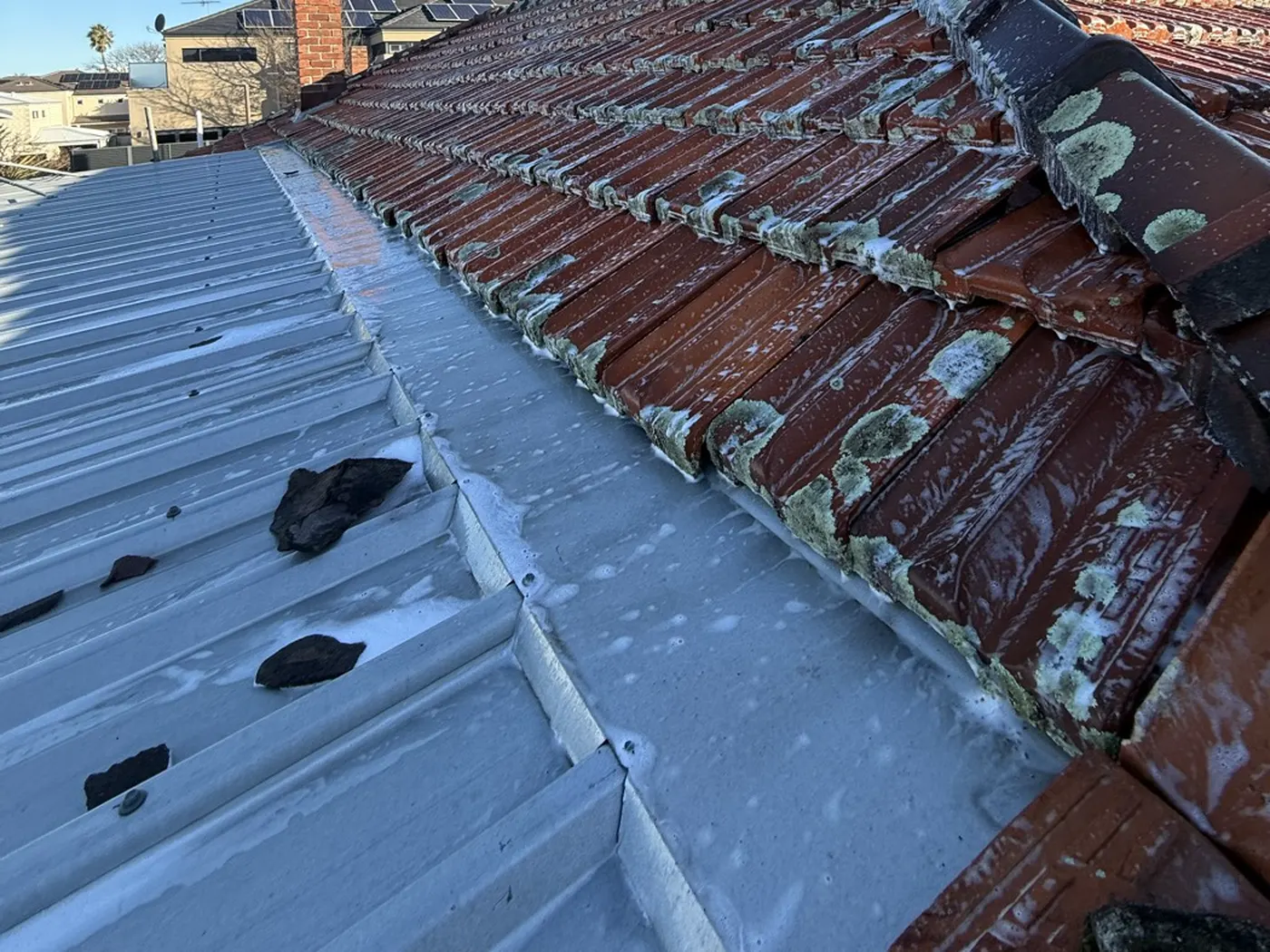
In plain terms Moss grows where a mopped floor stays wet longest. The corners, the joins and the low spots.
Which mosses grow on roofs
Roof mosses are city mosses, and the common ones are cosmopolitan: they grow all over the world.5 Bryum argenteum is perhaps the most widespread moss in the world, found from city pavements to the ice free parts of Antarctica.7 It forms silvery green colonies of tiny plants packed so tightly that, wet, the colony looks like a cobbled surface.2 In Canberra it is common where a bitumen road meets a concrete gutter, a colony there surviving buses driving over it daily, and in house gutters.5 Grimmia forms cushions on exposed walls and tiled roofs, and Tortula muralis is common on walls.5
They spread easily. Most bryophytes rely on wind for their spores, which are typically 5 to 50 micrometres across, small enough that a breeze too light to feel carries them off.17 A broken fragment can grow into a new plant, and many species make gemmae, small clusters of cells that raindrops splash away.1 A spore that germinates first grows a protonema, a green thread that can look like an algal film, before any leafy shoots appear.2
In plain terms Think dandelion seed, shrunk to the size of dust. Every roof gets sown on every breeze, and the wet spots are the ones that come up.
What dying moss looks like
Colour is a poor guide. Brown is the colour of the dead layer under the living green of a healthy cushion, and a dormant moss is dull and folded too.2, 5 A brown cushion on a summer roof is no sign the moss is finished. It may only be waiting for rain.
Moss treated with UNGROW Bailiff, our treatment, dies where it sits. It does not lift off on the day, because dead moss is still a mat of stems and rhizoids anchored to the tile, and it loosens and comes away with the weather. It is slow to rot, too. In a two year experiment in subarctic Sweden, litter from 27 mosses and liverworts broke down at about a fifth of the rate of vascular plant litter18, and the Royal Horticultural Society tells gardeners that moss raked out of a lawn can go on the compost heap but is slow to rot down in large quantities, so it should be mixed with other ingredients.19 On the roofs we treat, growth starts coming away over 3 to 18 months. Why the dead material lingers is in why dead lichen stays on the roof, and the timeline is in how long roof treatment takes.
In plain terms It is like spraying weeds in a paved path. They die where they stand, and the weather clears them over the months after. Nobody takes an angle grinder to the pavers.
What this means for your roof
Moss is a sponge parked where your roof needs to drain, and a dry summer does not end it: it only sends it dormant until the next rain. Every wet season it stays, it holds water against the tiles and builds up in the laps, interlocks and gutters. We treat it where it sits with Bailiff, from the roofline, with a low pressure soft wash pump through non-directional nozzles, so nothing is forced under the tiles or laps, and the weather carries the dead moss away. Growth recurs, and fresh spores ride in on breezes too light to feel, so UNGROW Sentry, our preventative, keeps the roof treated after that.
Also asked
Does moss on the roof die in summer?
Usually not. Moss goes dormant when it dries out, folding its leaves in and turning dull, and comes back with very little water. Dew is enough for many mosses. A crisp brown cushion in February is very often alive, and waiting for May.
Is green moss on a roof a kind of mould?
No. Moss is a plant, with leaves and stems, and it makes its own food from sunlight. Mould is a fungus and has no chlorophyll at all. A flat green film on tiles is usually algae. A soft green cushion you could pinch between two fingers is moss.
Where does roof moss come from?
Mostly from spores. Most moss spores are under a twentieth of a millimetre across, and a breeze too light to feel carries them. Broken pieces of moss also grow into new plants, so a cushion knocked loose by a bird or a gust can start another one further down the roof.
Is moss or lichen worse for a roof?
Both do damage, in different ways. Moss holds water against the tiles and builds up where water leaves the roof, in the laps, valleys and gutters. Lichen works on the tile itself, anchoring its threads into the surface and etching it with acid. The two very often grow side by side, and one treatment, UNGROW Bailiff, deals with both.
How fast does moss grow on a roof?
As fast as the roof stays wet. Moss needs continuously wet spells of a few days or more to grow significantly, so on a Perth roof it grows through the cool, wet months, on the faces that stay wet longest. Given water, it fills in within weeks: in a growth chamber at 15 °C, fragments of the silvery moss common in gutters spread over more than half their containers in eight weeks. How fast it returns after treatment is in how to stop moss growing back.
Can you put roof moss in the compost?
Moss composts, slowly. The Royal Horticultural Society says moss raked from a lawn can go on the compost heap, mixed with other ingredients, as it is slow to rot down in bulk. In a two year experiment, moss litter rotted at about a fifth of the rate of other plant litter. On the roofs we treat, nothing is scraped up: the moss ends where it sits and the weather carries it off, for the reasons in how to get rid of moss on a roof.
On the record
- Australian National Botanic Gardens, What is a bryophyte?
- Australian National Botanic Gardens, What is a moss
- Australian National Botanic Gardens, When is a 'moss' not a moss?
- Australian National Botanic Gardens, What's not a bryophyte?
- Australian National Botanic Gardens, Urban bryophytes in Canberra
- Bureau of Meteorology, Climate statistics for Australian locations: Perth Metro (009225)
- Australian National Botanic Gardens, Bryophyte ecology
- Lawrence Berkeley National Laboratory, Weathering of Roofing Materials: An Overview
- The Bryologist, Desiccation-tolerance in bryophytes: a review (2007)
- Plants, Optimising Artificial Moss Growth for Environmental Studies in the Mediterranean Area (2021)
- Wienerberger UK, How to Clean Roof Tiles
- Marley (UK), Roof tile maintenance: a homeowner's guide (2022)
- Monier, Roof cleaning and maintenance
- Australian National Botanic Gardens, Habitats - ecology - Micro-habitats
- Your Home (Australian Government), Orientation
- Microorganisms, Methyl Potassium Siliconate and Siloxane Inhibit the Formation of Multispecies Biofilms on Ceramic Roof Tiles: Efficiency and Comparison of Two Common Water Repellents (2021)
- Australian National Botanic Gardens, Dispersal
- Journal of Ecology, An experimental comparison of chemical traits and litter decomposition rates in a diverse range of subarctic bryophyte, lichen and vascular plant species (2009)
- Royal Horticultural Society, Moss in Lawns: Keep or Remove? | RHS Advice