 Mould
The ruling
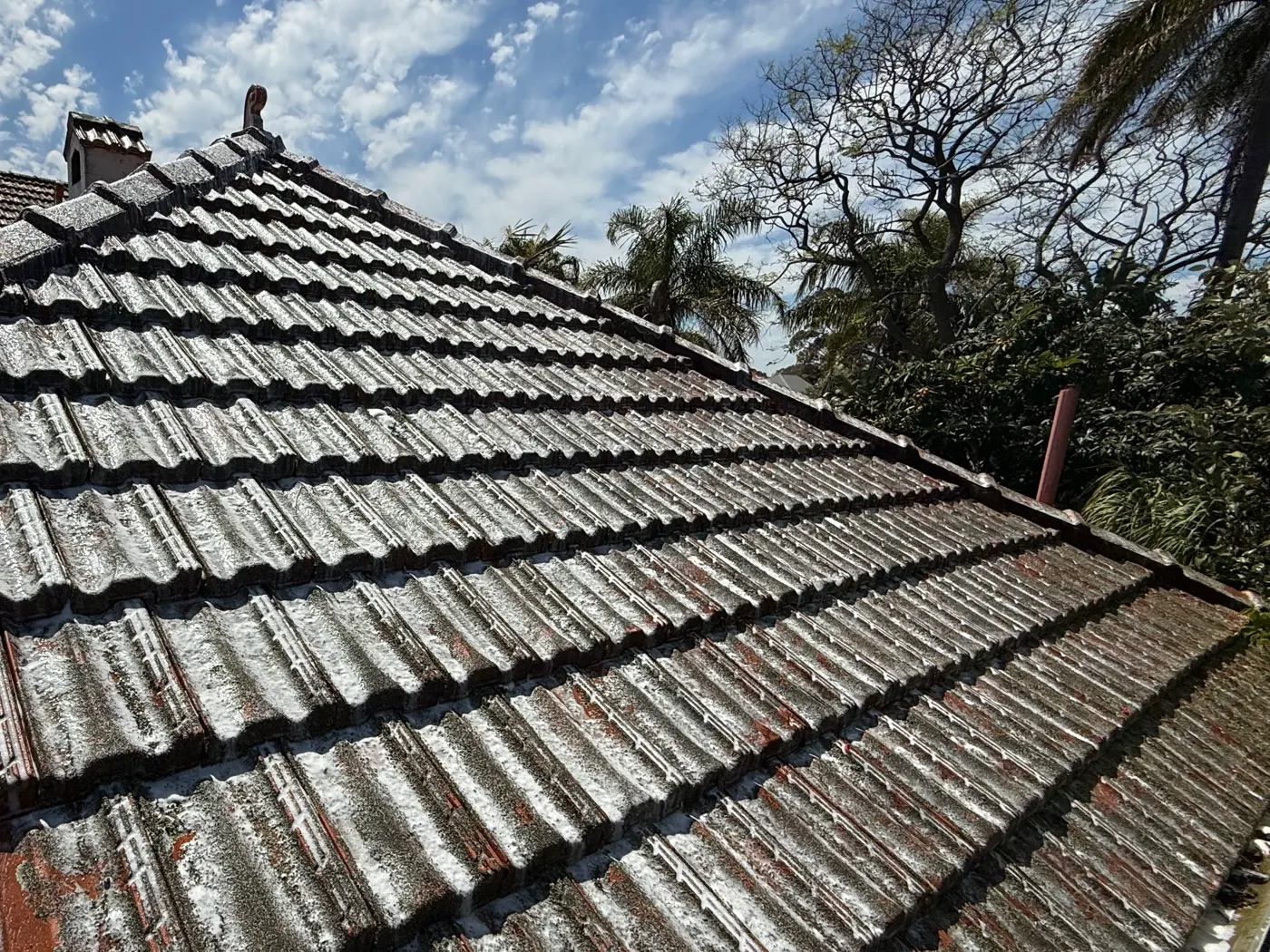
Usually it is alive: a film of cyanobacteria and dark fungi, darkened by their own sunscreen pigments. It runs in streaks because it grows thickest where rain runs and lingers, and it works on the tile and paves the way for moss and lichen. A treatment ends it where it sits, and the rain carries it off.
Usually, it is alive
Ask the people who study roof weathering what darkens a roof and the answer comes in two parts: things that grow on it, and things that land on it. A review from the Lawrence Berkeley National Laboratory lists biological growth (cyanobacteria, fungi and algae) alongside deposits of dust, organic particles, fly ash and soot.1 On tiles, the living part is a biofilm: bacteria, algae and fungi settled together in a thick matrix they make themselves. As it matures it takes on pigment, and the result is black or green spots across the roof.2
Clay roof tiles are particularly prone to it. Their pores soak up the water the microbes need, and let the microbes work their way into the material.2
In plain terms The black is usually a crowd, not a stain. Millions of microbes living together in a skin of their own making, the same kind of film that makes a rock in a creek slippery.
How that film paves the way for lichen and moss is in what lives on a roof.
Why it is black: the sunscreen
Cyanobacteria are bacteria that photosynthesise. In the United States the black streaking on asphalt shingle roofs is put down mainly to one of them, Gloeocapsa magma.1 The Asphalt Roofing Manufacturers Association calls it probably the most prevalent of several species involved, and says their natural pigments turn white or light roofs dark brown or black, evenly or in streaks.3
The pigment is the point. More than 300 kinds of cyanobacteria wrap their cells in a jelly sheath laced with scytonemin, a yellow-brown compound that stops about 90 percent of UV-A light reaching the cell.4 Dark fungi do the same job with melanin. Black fungi have thick, melanin packed cell walls and are among the most stress resistant organisms on Earth, able to take strong sun, drying out and wide swings in temperature.5
In plain terms A roof is a hard place to live, baked by day and dry for weeks. What survives up there wears its sunscreen on the outside, and from the street that sunscreen reads as black.
Green is the other half of the story. A survey of 230 biofilms on buildings in Europe and Latin America linked them to climate: algae more prevalent at cool, damp European sites, dark cyanobacteria frequent at tropical sites above 1,000 metres.1 A study of a house wall near Paris found the cyanobacteria less sensitive to the seasons than the green algae, because they resist drying out better.6 The green film has its own file: roof algae.
In plain terms The green film is the one that needs it damp. The black films are the ones that can wait out a dry spell.
The same film on tile and steel
Most of what is written about black roof streaks is American, and about asphalt shingles.3, 1 The same film grows on tile and metal roofs, and we treat it on both.
Gloeocapsa is not a shingle specialist. The genus is prevalent on damp rock, and turns up with Nostoc and Scytonema on stone monuments that take strong sun and long dry spells.1 Clay roof tiles left out for six years in the south of France were colonised by thick multispecies biofilms and spotted by melanised fungi.2 Closer to home, painted steel roofing panels left out for a year at Burrawang in New South Wales were colonised by cyanobacteria and fungi, with fungi the dominant organisms. Strong sun, heat and long dry spells did not stop them: by the end of the year the panels were relatively heavily fouled.7
In plain terms The film is not fussy about what the roof is made of. Tile, steel or shingle, it needs a surface, light and a wet spell now and then, and a Perth roof has all three.
Not everything black is alive
Other things darken a roof, and each has a tell.
- Soot and grime. Soot from combustion settles onto a roof out of the air, with dust and fly ash, in dry weather and in the rain. It is relatively unreactive, it absorbs sunlight strongly, which darkens a roof and heats it, and bleach barely touches it.1
- Dark lichen. Lichens come in shades of white, grey, green, yellow, orange and brown, and some are black.8 Some crust lichens also carry round black fruiting bodies, or sit on a black base layer that shows as dark lines between the patches.9 Lichen has a texture and an edge, where a film has neither. See lichen on roof tiles.
- Mould. Dark fungi in the film, and the sooty mould that grows on the sticky drip under some trees, have their own file: mould on a roof.
One pattern confirms the dark is growth. Below copper and galvanised (zinc) flashings, roofs sometimes stay clean, because zinc and copper ions hold growth back.1 A clean stripe under a flashing is a good sign that the dark around it is alive. Zinc strips have their own file: do zinc strips stop roof moss.
Researchers also have a simple way to tell a biological stain from inorganic dirt. A fresh bleach solution lightens most biological stains, and barely touches inorganic ones such as soot and iron oxide, which is rust.1 The shingle makers say the same of their roofs, and add that bleach is only temporary: the discolouration may recur.3
In plain terms Bleach lifts the black from shower grout because that black is mould. It does nothing to the soot inside a fireplace.
It is a researcher's test, not a reason to go up a ladder with a bottle. Monier, which makes roof tiles, recommends homeowners do not clean their own, because of the risk of falls and of damaging tiles.10 Form and place settle it from the ground: a dark film that follows the water down the roof and is heaviest on the shaded faces is growth. What bleach does on a roof is covered in vinegar, bleach and home remedies.
Why it runs in streaks
Water decides it. The Paris study starts from the point that water is the most important factor for microbes on a building, and found growth rose quickly after each rain. Where one paved patch carried more algae than its neighbour, the authors put it down to preferential run-off, the paths water favours as it drains away. The shaded wall under a tree, which stayed cooler and wetter for longer, carried more growth than the sunny one.6
On a pitched roof the water does not spread evenly. It gathers in the pans of the tiles and runs down the slope, and each course takes the run-off of every course above it. Those lines stay wet longest after rain, so that is where the film grows thickest. The sun's path in Australia is to the north11, so on a Perth roof the south faces see the least of it and dry slowest. The full story is in why your roof grows it.
In plain terms Think of the dark line that grows under a dripping garden tap. A roof has one for every path the rain takes.
What it does to a roof
A black film is more than a colour. It lowers how much sunlight a lighter roof reflects, so the roof takes in more heat.1 Monier makes the same point about tile colour: a light tile reflects more heat than a dark one, keeping the roof space cooler on a hot day.12
It also works on the tile. A biofilm keeps the surface under it damp for longer, and cyanobacteria and algae release organic acids that can dissolve minerals.6 On clay roof tiles, researchers describe these films as playing a crucial role in the tiles' deterioration: their metabolism profoundly alters the composition of the tile, and they promote the settlement of mosses and plants. On their six year test tiles, the microbial film was there before the lichen.2 On outdoor stone monuments, black fungi rank among the most damaging microbes there are, darkening the surface, cracking it and pitting it.5 The full mechanism is in what growth does to a roof.
In plain terms A damp cloth left on a timber benchtop marks the wood under it in time. The black film does that to a tile, and moss and lichen move in on top.
Treated, it clears over the following months rather than on the day. The dark is the colonies themselves, living and dead: LBNL describes the black on American roofs as an accumulation of dead cyanobacterial colonies.1 So a roof treated with UNGROW Bailiff looks the same on the day, then clears as the rain carries the dead film away. How that works is in how roof treatment works.
Blasting it off is the wrong trade. Monier strongly advises against pressure washers for roof cleaning, because of the significant risk of tile damage10, and the shingle makers say not to use a power washer or even a brush on theirs.3 The reasons are in does pressure cleaning damage roof tiles.
In plain terms It is like weeds in paving. You spray them, they die back where they stand, and nobody takes an angle grinder to the path.
What this means for your roof
The black on your roof is a living film, and it works on the tiles for as long as it stays. We treat it where it sits with Bailiff, from the roofline, through a low pressure soft wash pump and non-directional nozzles, every face covered and nothing forced under the tiles. Then it weathers off over the following months, and staying treated with UNGROW Sentry is what stops it building back up.
Also asked
Is the black on my roof mould or algae?
Usually a film of cyanobacteria and dark fungi, which is the mould side. The Lawrence Berkeley review of roof weathering notes that the roofing trade sometimes uses "algae" and "fungi" interchangeably for what grows there, but the algae on a roof shows as the green film. Biofilms on roof tiles are multispecies, with bacteria, algae and fungi settled together in one matrix, so a roof often carries both. It does not change what the roof needs: UNGROW Bailiff treats the whole film together, from the roofline.
Is the black on my roof lichen?
Usually not. The black that follows the water down a roof is a film of cyanobacteria and dark fungi, flat and with no edge. Black lichen is real, though. The Australian National Botanic Gardens notes there are even black lichens, and some crust lichens carry round black fruiting bodies, or sit on a black base layer that shows as dark lines between the patches. Lichen has a texture and an edge. Telling them apart is in lichen, moss, algae or mould.
What are the dark spots on my roof tiles?
Usually colonies of a living film. On clay roof tiles, researchers describe the film of bacteria, algae and fungi maturing and taking on pigment, producing black or green spots on roofs. Clay test tiles left out for six years in the south of France were all spotted by melanised fungi, dark fungi with melanin packed cell walls. Some spots belong to lichen instead: certain crust lichens carry round black fruiting bodies. Clearing them is in how do you get rid of black mould and streaks on a roof.
Are black streaks bad for the roof?
Yes. A black film darkens a lighter roof, so it takes in more of the sun's heat. It holds water against the tile, and on clay roof tiles researchers describe these films altering the tile's composition and promoting the settlement of moss. It is the first layer of growth, the one moss and lichen move into. And it builds up. The dark on a roof is an accumulation of colonies, built up over time.
Can I pressure wash the black streaks off?
You do not need to. Treating the film where it sits, and letting the rain carry it off, clears it and takes no surface off with it. Monier, which makes roof tiles, strongly advises against pressure washers on roofs because of the significant risk of tile damage, and the American shingle makers say not to use a power washer or even a brush on theirs. A blast takes surface off with the film, and how fast a cement based surface fouls is governed by its roughness and porosity.
Why is my roof turning black?
Because something is growing on it, usually over years, and thickest where the water runs and the sun reaches least. Age on its own dulls a roof. Monier says the colour coat on concrete tiles takes on a more subdued, matt look over the years, and that terracotta colour is baked in and does not fade. Black is something else, a film living on the tile.
Will the black come back after treatment?
Staying treated is what keeps it from building back. The microbes in a roof film arrive on the air, so any roof is recolonised in time, the wet and shaded faces first. That is the job of UNGROW Sentry, our preventative, after Bailiff has cleared the film. A roof that is treated on a cycle does not go back to where it started.
On the record
- Lawrence Berkeley National Laboratory, Weathering of Roofing Materials: An Overview
- Microorganisms, Methyl Potassium Siliconate and Siloxane Inhibit the Formation of Multispecies Biofilms on Ceramic Roof Tiles: Efficiency and Comparison of Two Common Water Repellents (2021)
- Asphalt Roofing Manufacturers Association, Algae discoloration of roofs
- Marine Drugs, Biotechnological Production of the Sunscreen Pigment Scytonemin in Cyanobacteria: Progress and Strategy (2021)
- IUBMB Life, Conventional and innovative approaches to black fungi control for stone heritage preservation (2025)
- PLOS ONE, Influence of climatic factors on cyanobacteria and green algae development on building surface (2023)
- MicrobiologyOpen, Investigation of the microbial communities colonizing prepainted steel used for roofing and walling (2017)
- Australian National Botanic Gardens, Lichen chemistry
- Australian National Botanic Gardens, Crustose lichens
- Monier, Roof cleaning and maintenance
- Your Home (Australian Government), Orientation
- Monier, FAQs