The ruling
Usually it is alive, and one of three things. A flat green film with no thickness you can feel is algae. A soft cushion of tiny leaves is moss. A pale or grey green crust or leafy rosette with a firm edge is lichen, which turns greener when wet. Each works on the tiles; one treatment covers all three.
The green stuff growing on your roof is alive
The green on a roof is chlorophyll, the pigment that lets a living thing make its own food from light. Algae and cyanobacteria contain it, and so the partner inside every lichen does too.1 Moss stems are often green when young, "with chlorophyll in the cells".2 A fungus has none, so it cannot make its own food and lives off organic matter instead.3 The green is not mould. It is algae, moss or lichen, and a roof often carries all three at once.
All three grow on tiles. Biofilms on roof tiles mature and pigment, "producing black or green spots on roofs".4 The Australian National Botanic Gardens lists roof tiles among the surfaces bryophytes grow on5, and names freshly tiled roofs among the bare surfaces lichens are often first to colonise.6 Colour is how you notice it. Shape and texture tell you which one it is.
In plain terms Green tells you the stuff on your tiles is alive and running on sunlight. It does not tell you which one, any more than green tells a lawn from a hedge.
A flat green film: algae
Algae live in a biofilm. Bacteria, algae and fungi settle on tiles together and form a community "embedded in a thick protective matrix that they synthesize".4 Where green algae lead, it shows as a flat green film with no thickness you can feel. A roof tile biofilm is that thin: on ceramic roof tiles left outdoors in southern France for six years, where fungi made up most of the film, it averaged 22 to 26 micrometres thick.4 Tiles are porous, and their pores take up the liquid water the microbes need4, so the film does best on the faces that stay wet longest. Which faces those are is in why your roof grows it, and the Roof Report reads them on your own roof from above.
A darker film is a different crowd. Cyanobacteria are "bluish-green to khaki-coloured when moist, but brittle and blackish when dry"7, so a khaki green film that turns black over summer is on its way to black streaks. The green film has its own file, roof algae.
In plain terms Algae is the green on the shady side of a timber fence. You can see it from across the yard, but run a finger over it and there is nothing to catch.
A soft green cushion: moss
Moss is a plant, a bryophyte, with leaves on stems. The leaves are generally half a millimetre to three millimetres long, and it holds on with rhizoids rather than roots.2 Many grow as cushions, dense colonies of plants packed together8, among them Grimmia, fairly common on tiled house roofs in Canberra and "grey-green when dry and brighter green when moist".9 A dry moss folds or curls its leaves around its stems and opens them again when wet, so the same cushion looks quite different on a dry afternoon and a wet morning.2
Moss sits where water and grit collect, along the laps, in the valleys and in the gutters.10, 11, 12, 9 Its close relatives, the liverworts, come two ways: leafy ones with leaves on stems, just like a moss, and thallose ones that grow as a flattish sheet.8 More in the moss suspect file.
In plain terms Moss is the soft one. It stands up off the tile like the pile on a carpet, and you could pinch it between two fingers.
A pale green crust: lichen
A lichen is a fungus living in partnership with a green alga or a cyanobacterium.1 Its colour depends on the weather. Dry, a lichen is usually grey or the colour of the fungal cells in its upper cortex. "When a lichen is wet, those cells become transparent, and the algal cells underneath get a chance to show their vibrancy."13 A green algal partner generally gives a lichen a bright green colour when wet; a cyanobacterial one gives it dark green, brown or black.13
On the roofs we treat, a lot of the pale green and grey green is lichen. It comes as a flat crust bound to the tile or a leafy rosette of lobes, and either way it has a firm, often rounded edge. Less often it grows as a small upright tuft, markedly three dimensional.1 Lichen is also the one anchored into the tile itself. On clay roof tiles six to ten years old, electron microscopy found its threads penetrating the tile and filling its fissures and cracks.14 More in the lichen suspect file.
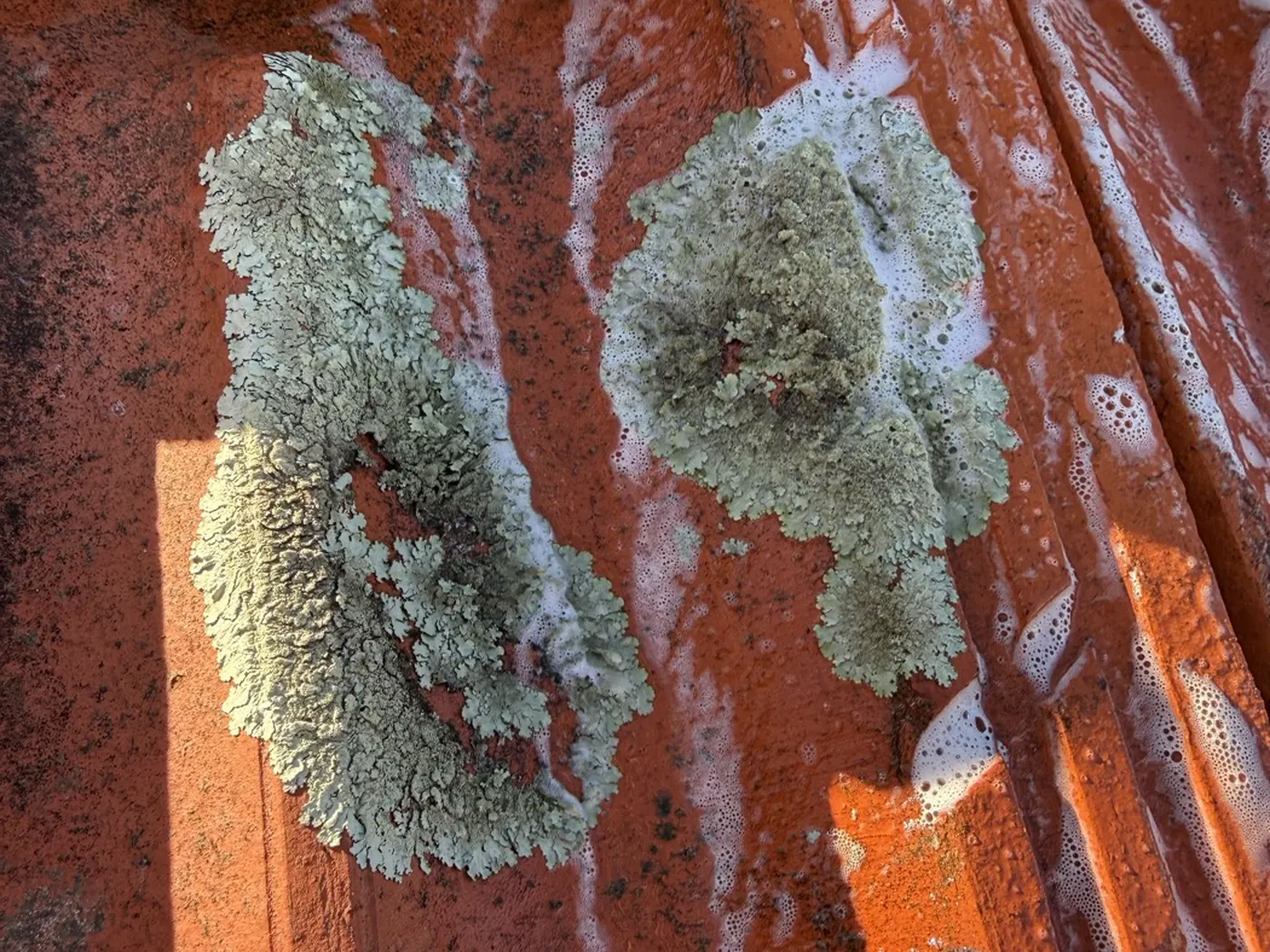
In plain terms Most roof lichen is like a pressed flower stuck to the tile. It turns greener in the rain and greyer in the sun, and where a lichen does stand up, it is a tiny branching shrub, not a soft cushion of leaves.
What is green on a roof: telling them apart from the ground
| What you see | What it is | Where it sits |
|---|---|---|
| A flat, even green with no edge and nothing to feel | Algae, in a biofilm | Shaded faces, below drip lines |
| A khaki or dark green film that dries black | Cyanobacteria, the start of black streaks | Where the water runs |
| A soft raised cushion, bright green wet, dull or brown dry | Moss | Laps, valleys, gutters |
| A flat crust or leafy rosette with a firm edge, or a small upright tuft; grey green dry, greener wet | Lichen | Open faces, ridges and hips, along the laps |
The film comes first: on roof tiles, biofilms "promote the settlement of macroorganisms such as plants and mosses".4 The sequence is in what lives on a roof, and the full side by side, mould included, is in lichen, moss, algae or mould.
Two greens are not growth at all. A green that is even across every tile, ridge to gutter, is the colour of the tile or the paint. And on copper, whether a roof, a gutter or a flashing, the green is patina: bare copper outdoors darkens to brown, then over several decades forms a green layer of copper corrosion products.15
In plain terms Shape gives it away. A film is a stain you cannot feel, a cushion stands up, and a crust lies flat with an edge.
Is the green stuff bad for the roof?
Yes. Each one works on the tile in its own way, and the science of each is in what growth does to a roof.
- The film alters the tile. Researchers working on ceramic roof tiles write that the microbes' "metabolic activities profoundly alter the composition of tiles", and the film readies the surface for moss.4
- Moss holds water. A fist sized clump of moss on a tree trunk can hold as much water as a sponge the same size, and it lets that water go slowly.5 Wienerberger, the tile maker, says tiles covered in moss stay damp, which leaves clay tiles more prone to delamination.11 Valleys collect moss with the leaves and sediment washed down from the tiles12, and Monier names blocked gutters, downpipes and valleys as common sources of leaks.10 More in is moss on the roof a problem.
- Lichen etches the tile. Researchers at the University of Novi Sad traced lichen's attack on ceramic roof tiles to its oxalic acid, and named the crystal it forms, whewellite, a "destructive crystal phase".14 The full case is in does lichen damage roof tiles.
Each one is dealt with by treating it where it sits, as how to get rid of algae, moss and lichen set out. The quick fix works the other way: Monier "strongly advises against the use of pressure washers for roof cleaning"10, and Marley, the UK tile maker, says high powered jet washing "can damage the surface of the slate or tile, thus reducing its expected life considerably".16
In plain terms They are three kinds of bad tenant. One stains the walls, one leaves the taps running, and one chips the benchtop. All three are worth evicting.
What this means for your roof
You do not need to tell the greens apart before you act: one treatment, UNGROW Bailiff, built on benzalkonium chloride, covers algae, moss and lichen together, at one price built from your roof's measured area. We apply it to every face, mixed to the label rate, from ladders at the roofline with a low pressure soft wash pump through non-directional nozzles, so nothing is forced under tiles or laps and nobody walks the roof. The dead growth starts coming away over the following 3 to 18 months as the weather works on it, and When will it clear? shows what to expect for the month it is treated. Green comes back to any roof in time, so UNGROW Sentry, our preventative, keeps it treated after that.
Also asked
Is the green stuff on my roof mould?
Usually not. Mould is a loose word for fungi, and a fungus has no chlorophyll, the green pigment that lets algae and plants make their own food from light. The green on a roof is chlorophyll at work, in algae, in moss, or in the algal partner inside a lichen. When people say green mould on a roof, they mean algae: see roof algae. The dark film that runs in streaks has its own file, the black stuff on a roof.
Why does my roof look greener after rain?
Because two of the three change colour with water. A dry lichen shows the grey of its fungal skin; wet, that skin turns see through and the green partner underneath shows. A dry moss folds its leaves in against its stems and opens them when wet, and Grimmia, a cushion moss fairly common on tiled house roofs in Canberra, goes from grey green to brighter green. The growth was there all along.
Does the green stuff on the roof die off in summer?
Usually not. It goes quiet. Moss sits out the dry months dormant, and for many mosses fog or dew is enough to wake them. Lichen dries out, greys off and waits for the next rain. A roof that looks browner and greyer in February still carries the growth it had in July, and it greens up again with the first wet nights of autumn.
Can I pressure wash the green off my roof?
Treat it instead. A treatment ends the growth where it sits and takes nothing off the tile. Lichen is anchored into the tile, so a jet takes surface off with it. Monier, which makes roof tiles in Australia, strongly advises against pressure washers on roofs because of the significant risk of tile damage, and Marley, the UK tile maker, says a high powered jet can damage the surface of the tile and reduce its expected life considerably.
How much does it cost to get rid of the green stuff on a roof?
With us, a first treatment with UNGROW Bailiff is from $539 including GST. The price is built from your roof's area, measured from aerial imagery, with set additions for a second storey, difficult access and outer suburbs. It is the same whichever green it is, because one treatment covers algae, moss and lichen together. It is a fixed price, with no site visit. How the price is built is in how much roof cleaning costs in Perth.
On the record
- Australian National Botanic Gardens, What is a lichen?
- Australian National Botanic Gardens, What is a moss
- Australian National Botanic Gardens, What is a fungus?
- Microorganisms, Methyl Potassium Siliconate and Siloxane Inhibit the Formation of Multispecies Biofilms on Ceramic Roof Tiles: Efficiency and Comparison of Two Common Water Repellents (2021)
- Australian National Botanic Gardens, Bryophyte ecology
- Australian National Botanic Gardens, Lichen ecology
- Australian National Botanic Gardens, What's not a lichen
- Australian National Botanic Gardens, What is a bryophyte?
- Australian National Botanic Gardens, Urban bryophytes in Canberra
- Monier, Roof cleaning and maintenance
- Wienerberger UK, How to Clean Roof Tiles
- BMI Malaysia (Monier), Roof Leak Causes and How Tile Roofs Prevent Them
- U.S. Forest Service, Lichen Biology
- Scanning, Evaluation of the effect of lichens on ceramic roofing tiles by scanning electron microscopy and energy-dispersive spectroscopy analyses (2005)
- Coatings, Artificial Patination of Copper and Copper Alloys in Wet Atmosphere with Increased Content of SO2 (2019)
- Marley (UK), Can I clean or jet wash my roof tiles?