 Algae
The ruling
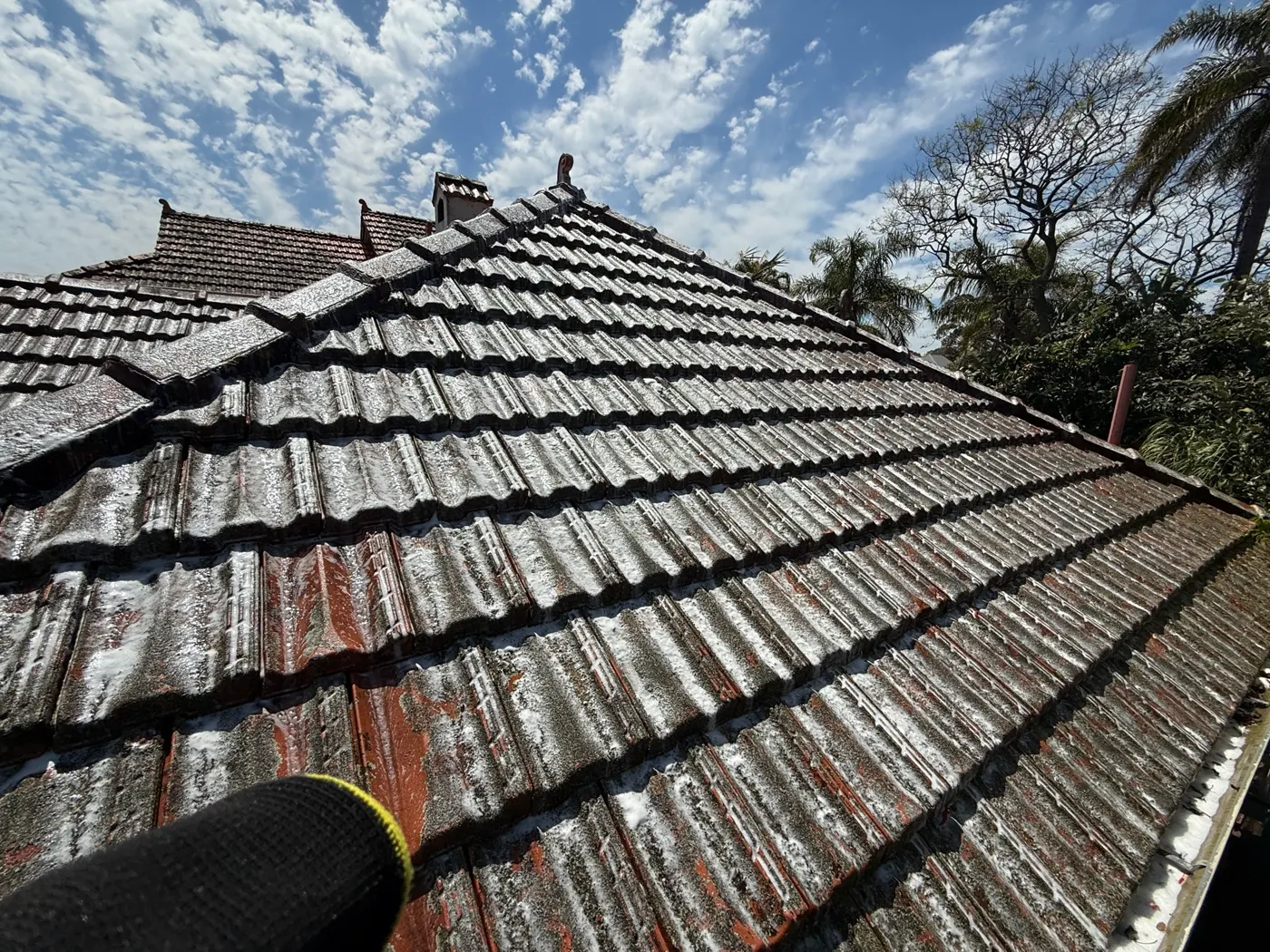
Treat it where it sits. Roof algae is a film of microscopic cells in a slime, worked into the tile's pores. A benzalkonium chloride treatment, applied at the label rate to every face and left on, ends it in place, and the weather carries it off. Of all roof growth, a green film clears fastest.
How to remove the green from roof tiles: treat the algae where it sits
The green on a roof is algae: microscopic cells living in a biofilm, a slime they build themselves. Roof tiles are porous, and the pores take up water and let microbes into the material, and bacteria, algae and fungi settle on the tile in a thick protective matrix of their own making.1 Researchers building a way to measure algae on facades and roof tiles by their chlorophyll found that the faintest film their instrument could pick up held 200,000 to 1.5 million cells of the algae they tested on every square centimetre.2 More on what it is in roof algae.
So the job is to end the cells where they sit, in the film and in the pores, and let the weather carry off what is left. A roof treatment goes onto a dry roof, soaks into the film and stays there. 30 Seconds' directions for its roof treatment say "DO NOT RINSE OFF"3, and Wet & Forget says rinsing its product off "would stop the product from working".4
Treat every face, not only the green one. On sandstone rock engravings in Italy, cleaned patches were recolonised mainly from the uncleaned surfaces around them.5 A face that is left becomes the seed for the faces that were done.
In plain terms Algae on a tile is mould in shower grout. Wipe the top and it is back in a fortnight, growing from what is still in the grout.
What is the best treatment for roof algae?
The chemistry is settled. Over two years of tests on the green coatings algae leave on historic brick, plaster and wood, researchers in Poland narrowed seven active compounds down to one, a quaternary ammonium compound, and biocides built on it proved successful at protecting the materials against green growth.6 Most of the roof moss products at Bunnings use one from the same family, benzalkonium chloride, as roof moss products at Bunnings sets out. Yates Surrender carries 500 grams a litre of it, sold "for the control of moss, algae, liverwort and lichen", and Yates calls it "an effective algicide".7 UNGROW Bailiff, our treatment, is built on benzalkonium chloride too.
Strength is not the hard part. These compounds are algistatic at 0.5 to 5 mg per litre, holding algae back, and microbicidal at 10 to 50 mg per litre.8 Mixed at its rate for tiled roofs, 20 mL to a litre of water7, Surrender puts about 10,000 mg of benzalkonium chloride in every litre of spray, by our arithmetic. What decides the result is how much of it reaches each square metre, on every face. In use, most problems with these compounds turn out to be pseudoresistance (apparent, not real, resistance) or user error, such as overdilution or incorrect handling.8
So the best algae treatment is a method, not a bottle: a treatment whose label names roofs and algae, mixed to the label rate, measured to the roof's area, put on every face and left on. How the active works on the cells is in how roof treatment works.
In plain terms Weed spray for a paved path is easy to buy. Whether the path comes up clean depends on whether every crack got its share.
Why a pressure washer is the wrong way to clean algae off a roof
A jet clears the green by taking the surface with it. Monier, which makes roof tiles, "strongly advises against the use of pressure washers for roof cleaning".9 Wienerberger, a UK tile maker, says the spray "can damage the tile finish and strip away colour from concrete tiles".10
Then the algae comes back to a better home. In laboratory fouling tests on cement mortars, how fast algae colonised a surface was governed by its roughness and porosity.11 Rough surfaces trap water, and whatever drifts onto them, better than smooth ones do.12 A tile with its finish damaged is a rougher, more open one, with better bioreceptivity for the next film. The full case is in does pressure cleaning damage roof tiles.
In plain terms A jet on a tile is sandpaper on a chopping board. It looks new for a while, and every fresh scratch is somewhere for the next stain to sit.
Does bleach get rid of algae on a roof?
It lightens it. Bleach is sodium hypochlorite, and most biological stains are lightened by it, which is why roofing researchers call a fresh bleach solution a useful test for biological growth.13 30 Seconds Outdoor Cleaner, a bleach cleaner made for algae, moss, mould and mildew, is kept wet on the surface for 5 to 10 minutes, then scrubbed and rinsed off, and its maker says to rinse the plants and grass around it before and after.14 Once rinsed, it is gone from the roof.
Even the makers who recommend bleach say it does not last. The US asphalt roofing makers, whose advice for algae on shingles is a bleach wash, put it plainly: "The effectiveness of such cleaning is only temporary, and the discoloration may recur."15 Bleach on steel is in how to clean a Colorbond roof.
In plain terms A bleach wash is a haircut, not a weeding. It looks tidy on the day, and it grows back.
Vinegar and other natural fixes for green algae
Vinegar is the usual kitchen answer, and the wrong one. Household vinegar is generally about 5 percent acetic acid, and Montana State University describes acetic acid as a contact herbicide: it "impacts only the parts of the plant it touches", and it is non-selective, so it "injures any plant it touches".16 Whatever runs off the roof lands on the garden. Acid is also the wrong direction for a concrete tile: in laboratory tests, acetic acid decalcified Portland cement mortar, the same family of binder.17
Sunlight is the natural control, and you cannot spray it: algae dominate on wet, shaded surfaces.1 And every home fix needs someone up there. Monier recommends "that you do not attempt to clean your own roof tiles due to the risk of falls and potential tile damage".9 The rest of the cupboard is in vinegar, bleach and home remedies.
In plain terms Vinegar on a roof is salad dressing on a footpath weed. It scalds what it touches, and the rest runs into the garden bed.
Algae goes fastest of the four
Of moss, lichen, algae and mould, a green film is the quickest to go. Yates says on Surrender's data sheet that under the right conditions and application rates "death will occur for algae and liverwort in minutes and moss and lichen within hours", and that algae disappears within days.7 Wet & Forget gives the same order: "Green algae usually disappears within days", black mould can take 2 to 4 months, and heavy lichen 6 to 12 months "as the rain slowly weathers away the dead organic matter".4
The reason is how little there is to hold on. A film on a tile is microscopically thin: on ceramic roof tiles left outdoors in southern France for six years, the film of microbes that formed averaged 22 to 26 micrometres thick, a few hundredths of a millimetre.1 Lichen and moss are anchored into the tile and stay put, dead, until the weather wears them loose (why dead lichen stays on the roof). A dead film that thin gives the rain far less to wear away. A dark film is slower; black streaks have their own file.
On the roofs we treat, a roof's mix of growth starts coming away over 3 to 18 months, at a pace set by rain, aspect and thickness, so nobody can promise a date. What we promise instead: we photograph the roof on the day, and if it looks the same as that photo at twelve months, we treat it again, free. For your own roof and the month it is treated, see When will it clear?; the stages are in how long roof treatment takes.
In plain terms A dead green film is a coat of dust. Dead lichen is an old sticker, still there until the weather works it loose.
What this means for your roof
A green roof is the quickest kind to clear: treated where it sits, the algae goes and the tile keeps its finish. We treat every face with UNGROW Bailiff, mixed to the label rate for the roof's measured area and applied from the roofline with a low pressure soft wash pump through non-directional nozzles, so nothing is blasted off the tile or forced under it, and nobody walks on it. Left untreated, it does not stay alone: biofilms on tiles promote the settlement of mosses and plants.1 Algae arrive on the air15, so UNGROW Sentry, our preventative, keeps the roof treated after that.
Also asked
What is the best moss and algae treatment?
One whose label names both, used at the label rate. Most roof treatments at Bunnings are built on benzalkonium chloride, and the big names list moss, algae and lichen together: Yates sells Surrender for the control of moss, algae, liverwort and lichen, and 30 Seconds sells its roof treatment for lichen, moss, mould and algae. What separates a clean roof from a patchy one is the dose that reaches every square metre, not the brand on the bottle.
Does vinegar remove green algae?
Not from a roof. Household vinegar is about 5 percent acetic acid, a contact herbicide that acts only where it lands and injures any plant it touches, including whatever the runoff reaches in the garden below. In laboratory tests acetic acid decalcified Portland cement mortar, the same family of binder as a concrete roof tile. It has no label rate for a roof, and it puts someone on a ladder.
What dissolves green algae?
Bleach comes closest: it lightens a biological stain on the spot, which is why a bleached roof looks better on the day, and the makers who recommend it say the effect is only temporary. A quaternary ammonium compound such as benzalkonium chloride works on the cells themselves: it disorganises the cell membrane and the contents leak out. The dead film is then carried off by the weather, with nothing scrubbed or blasted off the tile. How that works is in how roof treatment works.
What gets rid of green mould on a roof?
The same treatment as algae, because a flat green film on a roof is algae, whatever it gets called. The green is chlorophyll, the pigment researchers measure to count algae on facades and roof tiles, and moulds are fungi, which lack it. 30 Seconds sells one roof treatment for both algae and mould, so the method is the same: the label rate on every face, left on for the weather to finish.
How much does it cost to get algae off a roof?
A first treatment with UNGROW Bailiff is from $539 including GST. The price is worked out from the roof's area, measured from aerial imagery, with set additions for a second storey, difficult access and outer suburbs, and it comes as a fixed price, with no site visit. Algae on one face still means treating every face, because regrowth moves in from whatever is left. The Roof Report shows your roof from above, and what drives the figure is in roof cleaning cost in Perth.
Will the algae come back?
Staying treated is what keeps it off. Algae are carried on the air and settle wherever a surface stays damp, so a shaded face collects a new film in time. A treatment ends the film that is there, and UNGROW Sentry, our preventative, applied the same way from the roofline, keeps the roof clear after that. How it keeps a roof clear is in how do you stop moss growing back on a roof.
On the record
- Microorganisms, Methyl Potassium Siliconate and Siloxane Inhibit the Formation of Multispecies Biofilms on Ceramic Roof Tiles: Efficiency and Comparison of Two Common Water Repellents (2021)
- Biofouling, Quantification of algal biofilms colonising building materials: chlorophyll a measured by PAM-fluorometry as a biomass parameter (2006)
- 30 Seconds Australia, Roof Treatment
- Wet & Forget Australia, Remove Mould, Moss, Lichen & Algae Outdoor
- The Science of the total environment, Lithobiontic recolonization following cleaning and preservative treatments on the rock engravings of Valle Camonica, Italy: A 54-months monitoring (2023)
- Biofouling, Multistep approach to control microbial fouling of historic building materials by aerial phototrophs (2019)
- Yates Australia, Surrender Mosskiller: Technical Data Sheet
- Applied and environmental microbiology, Quaternary ammonium biocides: efficacy in application (2015)
- Monier, Roof cleaning and maintenance
- Wienerberger UK, How to Clean Roof Tiles
- The Science of the total environment, Bioreceptivity evaluation of cementitious materials designed to stimulate biological growth (2014)
- Australian National Botanic Gardens, Ecology - microhabitats
- Lawrence Berkeley National Laboratory, Weathering of Roofing Materials: An Overview
- 30 Seconds Australia, Outdoor Cleaner
- Asphalt Roofing Manufacturers Association, Algae discoloration of roofs
- Montana State University Extension, Monthly Weed Post, June 2021 (2021)
- Materials, Geopolymer, Calcium Aluminate, and Portland Cement-Based Mortars: Comparing Degradation Using Acetic Acid (2019)