The ruling
Yes, when it treats the growth where it sits. You get tiles that keep their surface, water that keeps moving off the roof and a house that looks looked after from the street. Lichen etches tiles and moss packs the valleys every year they stay, so treating it sooner costs the roof less.
Why is roof cleaning important?
Dealing with roof growth buys you three things: tiles that keep their surface, water that keeps moving off the roof, and a house that looks looked after from the street. Moss, lichen, algae and mould each work against one of those for as long as they stay.
Lichen works on the tile itself. On clay roof tiles six to ten years old, electron microscopy found lichen hyphae penetrating the tile and filling its fissures and cracks, and the researchers traced the lichen's effect on the ceramic to oxalic acid.1 Moss works through water. Wienerberger, which makes roof tiles, asks whether moss damages them and answers "In short, yes": moss "absorbs moisture and retains it even after rainfall has stopped".2 Algae and mould live as a biofilm in the tile's pores, where they alter the tile's composition, help moss settle and mature into spots you can see from the street.3 The detail is in what growth does to a roof.
Buyers see all of it from the footpath, and REIWA says they often take a list of repairs from the building inspection report to the selling agent.4 More in does growth on the roof matter when you sell.
In plain terms Growth on a roof is a dripping tap. Nothing fails the day you notice it, and it costs you something every day it is left.
What damages a roof the most?
On a tiled roof, water going where it should not. Monier calls cleaning the gutters, downpipes and valleys "the number one maintenance issue", because when they block, water "overflows back into your roof, which can create an enormous amount of water damage".5 Growth feeds the blockage. Valleys collect moss and sediment washed down from the tiles above6, and moss in the interlocks can block their channels and let water through to the sub-roof.2
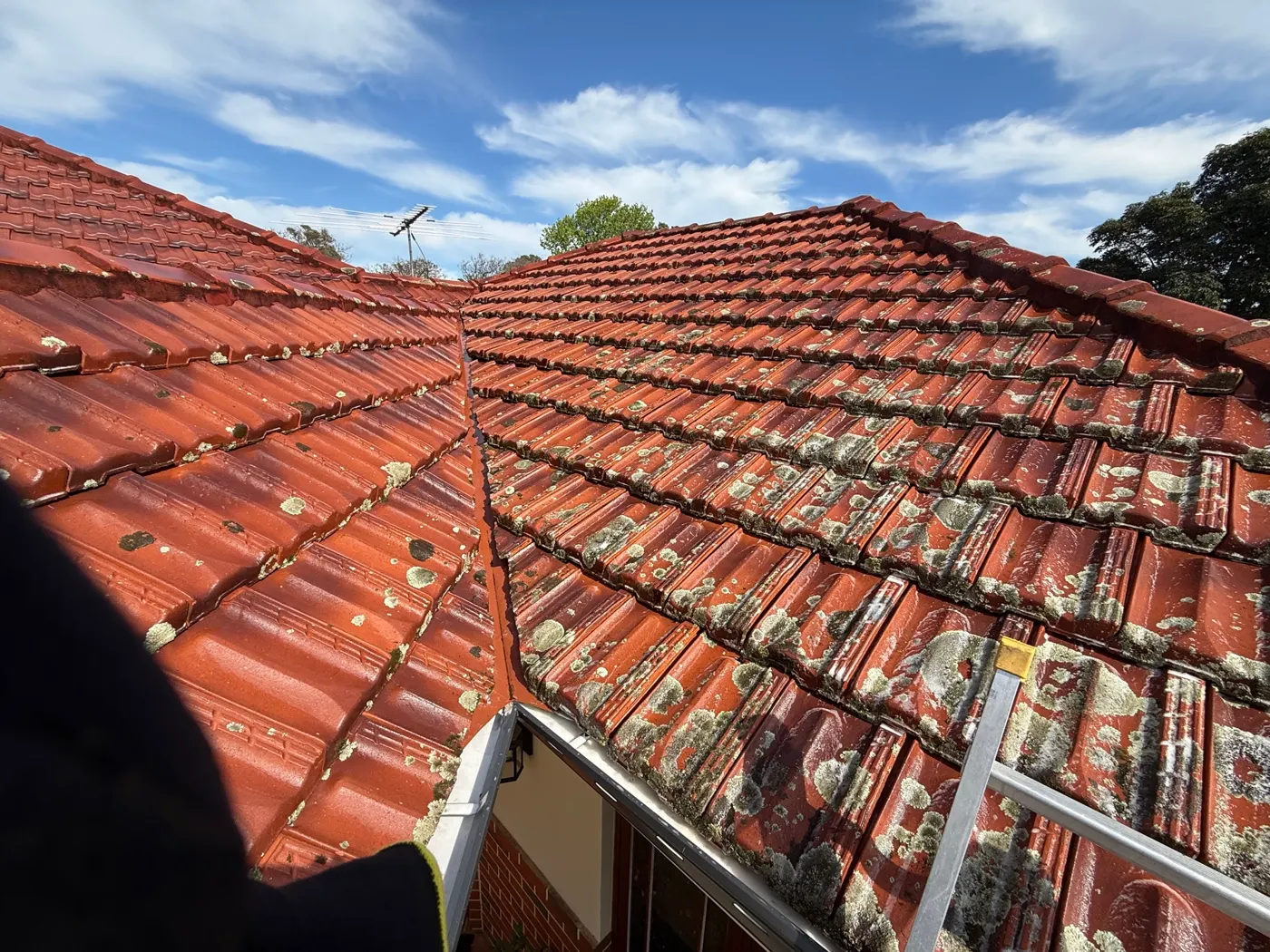
It is also the kind of damage an insurer may not pay for. Allianz says insurance "doesn't usually cover normal wear and tear or poor maintenance", and lists blocked drains, downpipes and gutters among its examples; insurers often call wear and tear gradual deterioration.7 The tile makers write upkeep into their warranties too: Monier's concrete tile warranty applies only to tiles "cleaned and maintained in accordance with Monier Roofing guides".8
In plain terms A roof is a car park with drains. The surface wears slowly. Block the drains and the water finds the ceiling.
Does roof cleaning work?
Every method changes how a roof looks. What separates them is what each one costs the tile and how long the result holds, in the words of the makers, the regulator and the researchers:
- Pressure cleaning gets growth off on the day, by force. Monier "strongly advises against the use of pressure washers for roof cleaning"9, and Marley says high powered jet washes "can damage the surface of the slate or tile, thus reducing its expected life considerably".10 On asbestos cement in WA, high pressure water is prohibited.11
- A bleach wash lightens algae and mould12, and on algae the American asphalt roofing makers say the result "is only temporary".13
- Scraping risks broken tiles and scrape marks, and "the process will have to be repeated in the future as the mosses and lichens return".14
- A treatment ends the growth where it sits. In a laboratory test, benzalkonium chloride severely impaired photosynthesis in a lichen and a moss, with no recovery over the 21 days of the test.15 Over 54 months on engraved sandstone in Italy, biocides applied after cleaning, benzalkonium chloride among them, gave the best results through two growing seasons away from the deepest shade.16
A treatment works the day it goes on and shows over months. Yates says its Surrender "kills lichens on roofs but does not remove them"17, and the weather does the removal. How long roof treatment takes to work has the timeline, and every way to clean a roof the full comparison.
In plain terms Nobody takes an angle grinder to the weeds in a paved path. You spray them and let them die back.
Will roof cleaning make your roof last longer?
Treated where it sits, yes: it ends what is wearing the tile and takes nothing off it. The Australian Roofing Tile Association lists moss and lichen among the common causes of fretting in older clay tiles, because they "can retain moisture and may damage the tile over time".18 Marley puts it simply: "when an issue is caught early, it will be easier and cheaper to repair".19
Blasted off, it goes the other way. The UK Roof Tile Association says a high pressure jet on concrete tiles "will result in erosion of the surface thereby reducing the potential lifespan of the roof tile".14 A rougher surface also grows the next crop sooner. In an accelerated algal fouling test on cement mortars, the fouling rate was governed by roughness and porosity20, and a review of bioreceptivity research notes several studies in which recolonisation after cleaning ran quicker than the first colonisation.21
Where lichen has already etched a tile, the etch can stay after the lichen goes, as a ghost mark. The sooner the roof is treated, the less of it carries one.
In plain terms Treating growth is weeding a garden bed. Blasting it is weeding with a shovel: the topsoil goes with the weeds, and the next weeds take to the bare ground first.
How long does roof cleaning last?
On the roofs we treat with UNGROW Bailiff, growth starts coming away over 3 to 18 months as the weather carries it off. When will it clear? shows it month by month for a roof like yours. We have roofs in field testing that were treated three and a half years ago, with nothing done since, and they are still looking great.
Spores land on every roof, all the time. Monier says moss and lichen spores "can settle on roofing materials where moisture and dirt accumulate"9, and what differs is the surface they land on: rougher after a blast, the same one after a treatment. So after the first treatment, staying treated is routine: UNGROW Sentry, our preventative, is a top up from the roofline that ends young growth before it anchors, and a shaded roof comes due for it sooner.16 How often is in how often does a roof need treating.
In plain terms Staying treated is brushing your teeth, and a blast is the drill. Only one of them takes off something that does not grow back.
What it costs, and what you get for it
A first treatment with UNGROW Bailiff is from $539 including GST. Each roof gets a fixed price, worked out from its area, measured from aerial imagery of the address, with set additions for a second storey, difficult access and outer suburbs. A figure given without the roof's measured area means little. How much roof cleaning costs in Perth has the detail, and the Roof Report shows your roof from above, face by face.
For that, Bailiff is mixed on the day to the label rate for the roof's measured area and applied to every face from ladders at the roofline. Nobody walks the tiles, and treatment is kept off solar panels. We photograph the roof on the day and check it against that photo at twelve months. If it looks the same, we treat it again, free. We are fully insured, and the gutters are not part of the job.
The other way to spend money on a growing roof is a roof restoration with a pigmented respray. Monier says respraying "is aesthetic only and will not repair your roof"5, and that repainted concrete tiles "must be redone every five years or so".9 Roof restoration or roof treatment compares the two jobs.
In plain terms It is a car service, not a respray. You pay for the roof to keep working, not for a new colour over the old problem.
What this means for your roof
What you get is tiles that keep their surface, moss that stops packing the valleys, and a house that looks looked after from the street, and the sooner it is done, the less of the tile carries a mark. We apply Bailiff from the roofline with a low pressure soft wash pump through non-directional nozzles, nobody walks the tiles, and the weather carries the dead growth away. Sentry keeps the roof treated after that.
Also asked
Is roof cleaning necessary?
If anything is growing on the roof, yes, and sooner costs less than later. Lichen etches the tiles, and the etch can stay after the lichen has gone. Moss holds water against the tiles and sheds into the valleys and gutters. Neither stops on its own. Moss that browns off in summer is dormant, not dead, and picks up again with the first rain. What is not necessary is taking surface off the roof to deal with it.
Is roof moss treatment worth it?
Yes. Wienerberger, the tile maker, asks whether moss damages roof tiles and answers "In short, yes". Moss holds water against the tiles even after the rain stops, and it can grow into the interlocks, block their channels and let water through to the sub-roof. Treated where it sits with UNGROW Bailiff, it ends in place and weathers off over the following months. Some of it lands in the gutters on the way, so they are worth clearing after the first winter.
Is roof washing worth it?
A wash is built to change how the roof looks on the day. Monier strongly advises against pressure washers for roof cleaning, and Marley says a high powered jet can damage the tile surface and shorten its life. A bleach wash lightens algae and mould, and the American asphalt roofing makers say its effect on algae is only temporary. Neither leaves anything on the roof to keep working. A treatment does, which is why it is the one worth paying for.
Can you get your roof cleaned without anyone walking on it?
Yes. We treat from ladders at the roofline, with a low pressure soft wash pump through non-directional nozzles, and nobody walks the tiles. Where an obstruction or a second storey needs access, it is one line, up a valley. We spray around solar panels, not on them. The price comes from aerial imagery of the address, so there is no site visit and you do not need to be home.
Does a roof treatment include cleaning the gutters?
No. We treat the roof, and gutter cleaning is not part of the job. Dead growth washes off the roof over the months after a treatment and some of it ends up in the gutters, so they are worth clearing after the first winter. Monier calls cleaning the gutters, downpipes and valleys the number one maintenance issue on a roof, and says to check and clean the roof at least once a year.
Is a roof restoration better value than a treatment?
They buy different things. A restoration pressure cleans the roof, repairs it and usually resprays it in a new colour. Monier says respraying a roof is aesthetic only and will not repair it, and that repainted concrete tiles need redoing every five years or so. A coat of colour sold as the fix for growth or leaks fixes neither. If the roof leaks or tiles are broken, a roofer comes first. If the tiles are sound and growing, the growth needs treating.
On the record
- Scanning, Evaluation of the effect of lichens on ceramic roofing tiles by scanning electron microscopy and energy-dispersive spectroscopy analyses (2005)
- Wienerberger UK, How to Clean Roof Tiles
- Microorganisms, Methyl Potassium Siliconate and Siloxane Inhibit the Formation of Multispecies Biofilms on Ceramic Roof Tiles: Efficiency and Comparison of Two Common Water Repellents (2021)
- REIWA, What is the purpose of pre-purchase building inspections
- Monier, FAQs
- BMI Malaysia (Monier), Roof Leak Causes and How Tile Roofs Prevent Them
- Allianz Australia, Does insurance cover wear and tear? What you need to know (2026)
- Monier Roofing (CSR Building Products), Warranty: Concrete Roofing Products (July 2026) (2026)
- Monier, Roof cleaning and maintenance
- Marley (UK), Can I clean or jet wash my roof tiles?
- WorkSafe WA, Safety alert 12/2018: high pressure water cleaning of asbestos cement prohibited
- BlueScope, TB-27: Identification of fungus in the field and recommendations for its removal (2022)
- Asphalt Roofing Manufacturers Association, Algae discoloration of roofs
- Roof Tile Association (UK), Care, Maintenance & Repair of Clay and Concrete Roof Tiles (2016)
- Stresses, Accumulation and Phytotoxicity of Two Commercial Biocides in the Lichen Evernia prunastri and the Moss Brachythecium sp. (2021)
- The Science of the total environment, Lithobiontic recolonization following cleaning and preservative treatments on the rock engravings of Valle Camonica, Italy: A 54-months monitoring (2023)
- Yates, Yates Surrender Moss Killer
- Australian Roofing Tile Association, Fretting in Clay Roof Tiles: A Consumer's Guide (2024)
- Marley (UK), Roof tile maintenance: a homeowner's guide (2022)
- The Science of the total environment, Bioreceptivity evaluation of cementitious materials designed to stimulate biological growth (2014)
- Science of The Total Environment, Revisiting and reanalysing the concept of bioreceptivity 25 years on (2021)