 Mould
The ruling
Treat it where it sits. Black mould and streaks are a living film in the pores of the tile, and a leave-on treatment soaked into that film ends it in place. The weather then carries it off over the following months. Wiping only reaches the surface, and bleach only lightens it for a while.
Why black mould is hard to wipe off a roof
The black on a roof is not a stain sitting on top. It is a biofilm: bacteria, algae and fungi settled together in a thick protective matrix they make themselves. Roof tiles are particularly prone to it because they are porous: the pores take up the water the microbes need, and let the microbes work their way into the material.1 The black comes from black fungi and dark cyanobacteria in that film, each with its own file: mould on a roof and the black stuff on my roof.
Black fungi are among the most stress resistant organisms on Earth, able to take strong sun, drying out and wide swings in temperature, which is why a wipe does not shift them. On stone monuments they work into existing microfractures, cracking and pitting the surface, and conventional biocides remain the most used treatment against them.2
In plain terms It is the black in old shower grout. Scrub the top and it looks better for a week, because the stain is in the grout, not on it.
Scrubbing harder does not fix that. Monier, which makes concrete and terracotta roof tiles, "strongly advises against the use of pressure washers for roof cleaning", because they pose a significant risk of tile damage.3 Marley, the UK tile maker, says high powered jet washing "can damage the surface of the slate or tile, thus reducing its expected life considerably".4 And a rougher surface fouls faster: in lab tests on cement mortars, how fast algae fouled the surface was governed by its roughness and porosity.5 More in does pressure cleaning damage roof tiles.
Bleach or vinegar: will either get rid of black mould on a roof?
Bleach is sodium hypochlorite, and it does take the black out where it lands. BlueScope's field test for fungus is a drop of household bleach: if the dark material is fungus, the bleach destroys it and leaves a clean spot.6 That is why a bleached roof looks better on the day. The asphalt shingle makers' association says bleach lightens the streaks on its roofs, and adds the catch: "The effectiveness of such cleaning is only temporary, and the discoloration may recur."7 Black mould on a Colorbond roof has its own file: how to clean a Colorbond roof.
A bleach clean is also a scrub and rinse job. For black mould, 30 Seconds' directions for its sodium hypochlorite Outdoor Cleaner are to keep the surface wet for at least 15 minutes, then brush and rinse off.8 On a roof, that is someone up there with a brush, and the rinse running to the gutters and the garden.
Household vinegar is about 5 percent acetic acid, a contact herbicide that "impacts only the parts of the plant it touches" and "injures any plant it touches".9 In a University of Adelaide laboratory test against two common indoor moulds, vinegar at about 4 percent acetic acid held back the growth of only one of them.10 And acid is the wrong thing for a concrete tile: in laboratory tests, acetic acid decalcified Portland cement mortar, the same family of binder.11
So which is better? Neither is a roof treatment. Bleach lightens the black for a while and has to be scrubbed and rinsed off, and vinegar attacks the cement. Monier recommends that you do not clean your own roof tiles at all, because of "the risk of falls and potential tile damage".3 More in vinegar, bleach and home remedies and can I clean my roof myself.
In plain terms A bleach wash is mowing the lawn. It looks tidy that afternoon, and the lawn is back after the next rain.
How to treat mould and black streaks on a roof
What works is a treatment that soaks into the film and is left there, not one that is scrubbed and rinsed. The biocides used on roofs against moss, lichen and algae are built mainly on benzalkonium chloride12, a quaternary ammonium compound, and these act on fungi as well as bacteria: the US Centers for Disease Control and Prevention describes the quaternaries sold as hospital disinfectants as generally fungicidal as well as bactericidal, and puts their action on bacteria down to disrupting the cell membrane, denaturing essential cell proteins and shutting down the enzymes that produce the cell's energy.13 On stone artworks, conventional broad spectrum biocides are still "the most used and efficient methods" for controlling the microbes that live on them.2 The leave-on roof products name mould themselves: 30 Seconds lists it for its Roof Treatment, on terracotta, slate, concrete and steel roofs, with no scrubbing or rinsing.14 The chemistry is in how roof treatment works.
That is how we treat it. We apply UNGROW Bailiff, our benzalkonium chloride treatment, from ladders at the roofline: mixed on the day to the label rate, measured to the roof's area, and applied to every face with a low pressure soft wash pump through non-directional nozzles, so nothing is forced under tiles or laps. Nobody walks on the roof. We spray around solar panels, not on them.
A first treatment with Bailiff is from $539 including GST, worked out from the roof's area measured from aerial imagery, with set additions for a second storey, difficult access and outer suburbs. It is a fixed price, with no site visit needed. What the price covers is in how much roof cleaning costs in Perth.
In plain terms Nobody takes a scrubbing brush to the weeds in a paved path. You spray them where they grow, and they die back where they stand.
How long the black takes to go
A treated roof looks the same on the day. The dark is the colonies themselves: the Lawrence Berkeley review of roof weathering describes the black stains on light coloured roofing as an accumulation of dead colonies of cyanobacteria.15 The rain lifts them off, a little at a time.
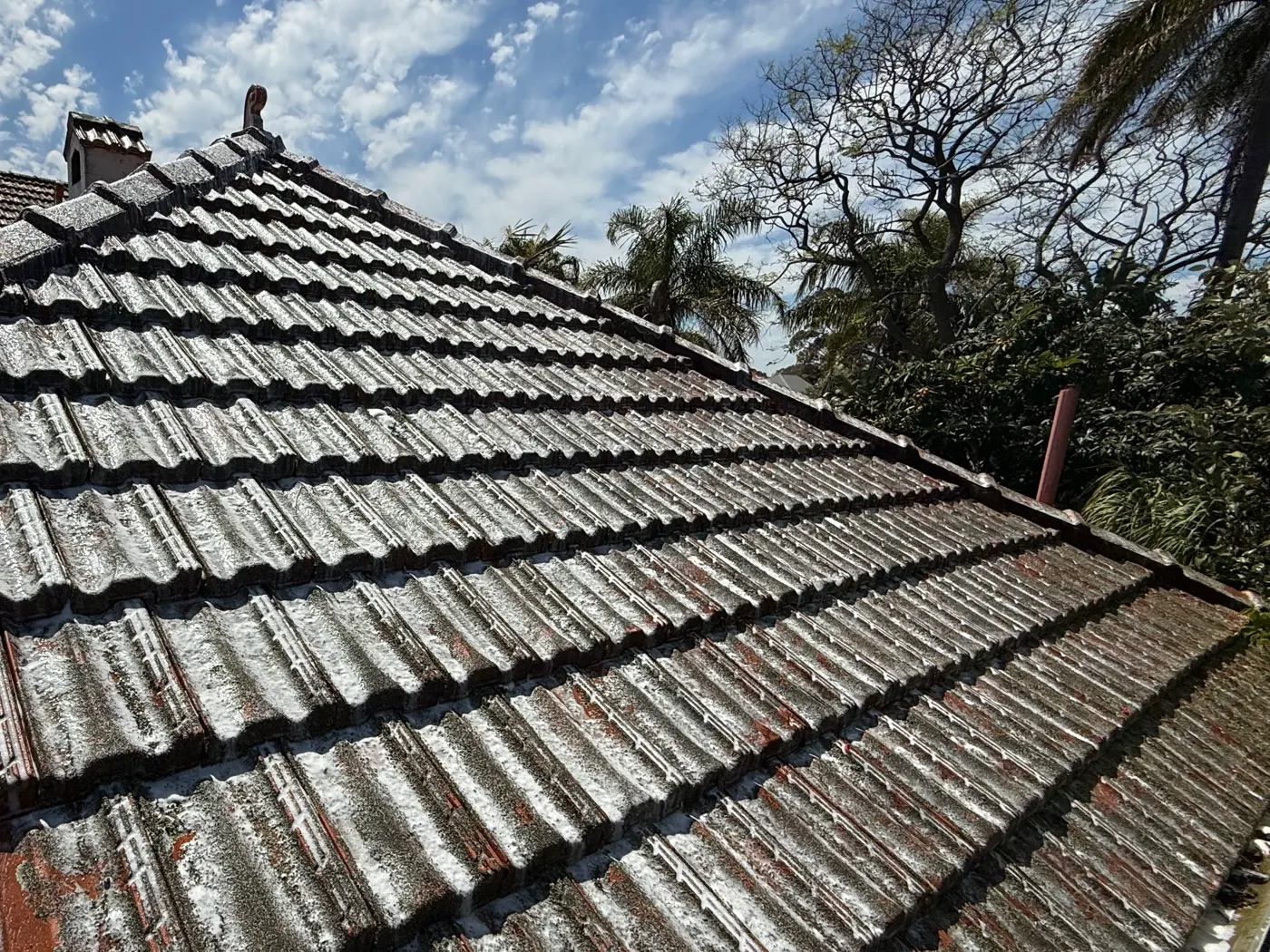
Wet & Forget's product page says black mould can take 2 to 4 months16; its article on black mould on roofs puts black mould and lichen at 6 to 8 months, and a badly contaminated surface at 12.17 30 Seconds says some mould may take up to 6 to 8 weeks to show any sign of decay, and heavily contaminated surfaces up to 6 months to come clean.14 On the roofs we treat, growth starts coming away over 3 to 18 months, and rain, aspect and the thickness of the film set the pace. How long roof treatment takes and a treated roof, month by month go through it. To see it for what is on your roof, which way it faces and the month it is treated, try When will it clear?
We photograph the roof on the day from a fixed position. If at twelve months it looks the same as that photo, we treat it again, free.
In plain terms It is a dead tree in a paddock. It does not fall the day it dies; the wind and rain bring it down a branch at a time.
Will the black come back?
Staying treated is what keeps it off. BlueScope, citing published estimates, says a cubic metre of the air around us may carry as many as 10,000 fungal spores, and that they constantly settle on surfaces of all descriptions.6 So the question is not whether spores land on your roof again. It is whether the roof is still treated when they do. That is the job of UNGROW Sentry, our preventative. How to stop it growing back covers algae and black streaks, and how often a roof needs treating covers the rhythm of it.
One thing is worth checking from the ground. A patch of black that matches a tree's canopy may be sooty mould, which grows on the honeydew dropped by sap sucking insects such as aphids, scale and psyllids, and it gradually decreases once the insects are brought down.18 There, the tree is the source as much as the roof.
In plain terms A treated roof is a weeded garden bed. Seed keeps blowing in. What matters is whether anything is there to stop it taking hold.
What this means for your roof
What you get is a roof treated where the black lives, with nobody scrubbing, blasting or walking on it. We apply UNGROW Bailiff from the roofline through a low pressure pump and non-directional nozzles and photograph the roof on the day, and the dead film weathers off over the months that follow. Staying treated with UNGROW Sentry after that is what stops the black building back up. To see which faces of your roof stay wet longest, run the Roof Report.
Also asked
Should black mildew on a slate roof be cleaned?
Yes, but not with a jet or a brush. Slate is stone, and on stone the black fungi work into existing microfractures, cracking and pitting the surface. Marley says high powered jet washing "can damage the surface of the slate or tile, thus reducing its expected life considerably". Leave-on treatments name slate: 30 Seconds lists slate roofs for its Roof Treatment, with no scrubbing or rinsing. Treated where it sits, the dead film weathers off over the months that follow.
How do you get black streaks off roof shingles?
The asphalt shingle makers' association names Gloeocapsa magma, which science now classes as a cyanobacterium, as probably the most prevalent cause. It says a bleach and water solution lightens the streaks, that the effect is "only temporary", and "DO NOT use a power washer or any type of brush or broom" on the roof. A leave-on roof treatment that names shingles, such as 30 Seconds Roof Treatment, is sprayed on and left, and the dead film weathers off over the following months.
Can I use a mould remover from the hardware store on my roof?
Read two things on the label: whether it names roofs, and whether it is rinsed off or left on. Bleach based outdoor cleaners, such as 30 Seconds Outdoor Cleaner, are sprayed, scrubbed and rinsed, and for black mould its maker says to keep the surface wet for at least 15 minutes, then brush and rinse off. On a roof, that is someone up there with a brush. The leave-on roof treatments, mostly benzalkonium chloride, name mould and roofs, and are not rinsed.
Will the dead mould end up in my gutters?
Some of it, over the months after treatment, as the rain carries the dead film down the roof. Gutters are not part of our job: we treat the roof, and we do not clean gutters. So they are worth clearing after the first winter. Monier names blocked gutters, downpipes and valleys as common sources of leaks, and says to clean them at least once a year, more often under trees.
Is there a homemade black streak remover that works?
Not one made for a roof. Bleach lightens the black, and the shingle makers say the effect is only temporary. Vinegar is acetic acid, which attacks the cement in a concrete tile, and in a laboratory test it held back only one of two common moulds. Neither is a leave-on roof treatment, and both put someone on a ladder. A treatment soaked in where the film sits is what reaches it.
On the record
- Microorganisms, Methyl Potassium Siliconate and Siloxane Inhibit the Formation of Multispecies Biofilms on Ceramic Roof Tiles: Efficiency and Comparison of Two Common Water Repellents (2021)
- IUBMB Life, Conventional and innovative approaches to black fungi control for stone heritage preservation (2025)
- Monier, Roof cleaning and maintenance
- Marley (UK), Can I clean or jet wash my roof tiles?
- The Science of the total environment, Bioreceptivity evaluation of cementitious materials designed to stimulate biological growth (2014)
- BlueScope, TB-27: Identification of fungus in the field and recommendations for its removal (2022)
- Asphalt Roofing Manufacturers Association, Algae discoloration of roofs
- 30 Seconds Australia, Outdoor Cleaner
- Montana State University Extension, Monthly Weed Post, June 2021 (2021)
- International Journal of Environmental Research and Public Health, An evaluation of antifungal agents for the treatment of fungal contamination in indoor air environments (2015)
- Materials, Geopolymer, Calcium Aluminate, and Portland Cement-Based Mortars: Comparing Degradation Using Acetic Acid (2019)
- Water research, Benzalkonium runoff from roofs treated with biocide products - In situ pilot-scale study (2015)
- US Centers for Disease Control and Prevention, Chemical Disinfectants
- 30 Seconds Australia, Roof Treatment
- Lawrence Berkeley National Laboratory, Weathering of Roofing Materials: An Overview
- Wet & Forget Australia, Remove Mould, Moss, Lichen & Algae Outdoor
- Wet & Forget Australia, Lichen or black mould on your roof?
- UC Statewide IPM Program, University of California, Sooty Mold